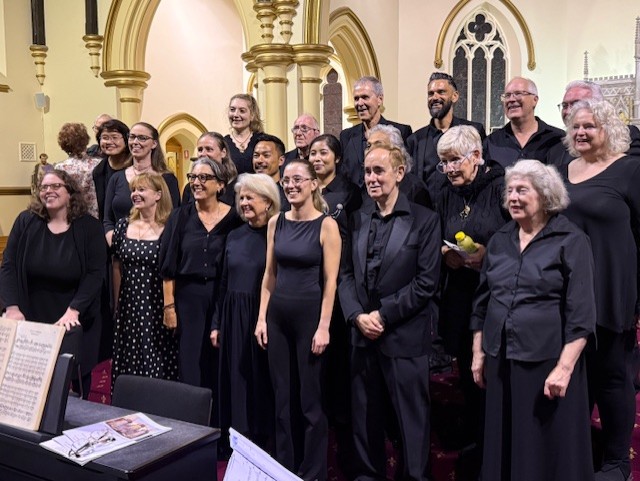
As Lent draws to a close and the anticipation of Easter intensifies, I have felt especially fortunate to attend a number of concerts that illuminate this most profound season in the Church’s calendar. Among them, one event stood out with particular distinction: a simply titled Lenten Concert at St Ambrose, Brunswick.
Presented under the assured direction of Dr Anthony Halliday, who conducted and played continuo throughout concert, the performance brought together eight exceptional soloists in a program of remarkable insight and cohesion. The pairing of Miserere mei, Deus by Gregorio Allegri with Part II of Messiah by George Frideric Handel proved both inspired and deeply moving, tracing a powerful arc from the anguish of Christ’s Passion to the triumphant joy of the Resurrection.
Allegri’s Miserere, rooted in the haunting plainchant “Tonus Peregrinus”, unfolded as a spellbinding meditation. Its interplay of austere chant and luminous ornamentation created a sense of timeless suspension, the music seeming to stretch heavenward in moments of breathtaking purity. The work’s enduring mystique—famously linked to the young Wolfgang Amadeus Mozart transcribing it from memory after a single hearing in the Sistine Chapel—only deepens its impact.
The performance here was nothing short of exquisite. Soprano Phoebe Paine crowned the texture with a radiant top line, her tone pure, effortless, and ethereal. Her ascent to the high C was delivered with such ease and clarity that it became a moment of quiet transcendence. Beneath her, the ensemble of soloists provided a rich, balanced foundation, allowing the chant to breathe and the embellishments to shimmer with clarity.
The transition to Part II of Handel’s Messiah brought a shift in emotional landscape, from introspection to dramatic narrative. The opening chorus, “Behold the Lamb of God,” set a solemn tone, leading into a deeply affecting account of Christ’s suffering and ultimate victory. Mezzo-soprano Sally-Anne Russell delivered a profoundly moving “He Was Despised,” her rich timbre and expressive restraint capturing both sorrow and dignity. Her interpretation was so finely judged that it seemed to suspend time, drawing the audience into a shared experience of grief and contemplation.
Moments of contrast were handled with finesse. The chorus “All We Like Sheep” offered a welcome lightness, its playful, wandering lines vividly depicting human frailty before resolving in unified acknowledgement of Christ’s sacrifice. The orchestral accompaniment throughout was vibrant and responsive, underpinning the unfolding drama with energy and sensitivity.
The orchestra had its moment of drama in the bass aria “Why Do the Nations So Furiously Rage”, shared between Jerzy Kozlowski and Johnny De Simone. This unusual dual interpretation brought an interesting variation in tone colour and perspective. While the tenor contribution in “Let Us Break Their Bonds Asunder” lacked some desired weight, the overall musical narrative remained compelling and cohesive.
The final “Hallelujah Chorus” provided a resplendent conclusion, with the soloists joined by the Brunswick Moreland Catholic Community Choir and the brilliant trumpet of Thomas Saar. The result was a moment of radiant exultation, bringing the audience to a fitting sense of awe and celebration.
Notably, both this concert and a recent performance of the Miserere at St James, King Street in Sydney drew capacity audiences—clear evidence that, when presented with artistry and conviction, the central story of the Christian faith continues to resonate deeply. Through music of such beauty and spiritual depth, its timeless message remains as powerful and relevant as ever.
Photo supplied.
____________________________________________________________________________
Janet Bagnall reviewed “Lenten Concert”, presented at St Ambrose Catholic Church, Brunswick on March 20, 2026.