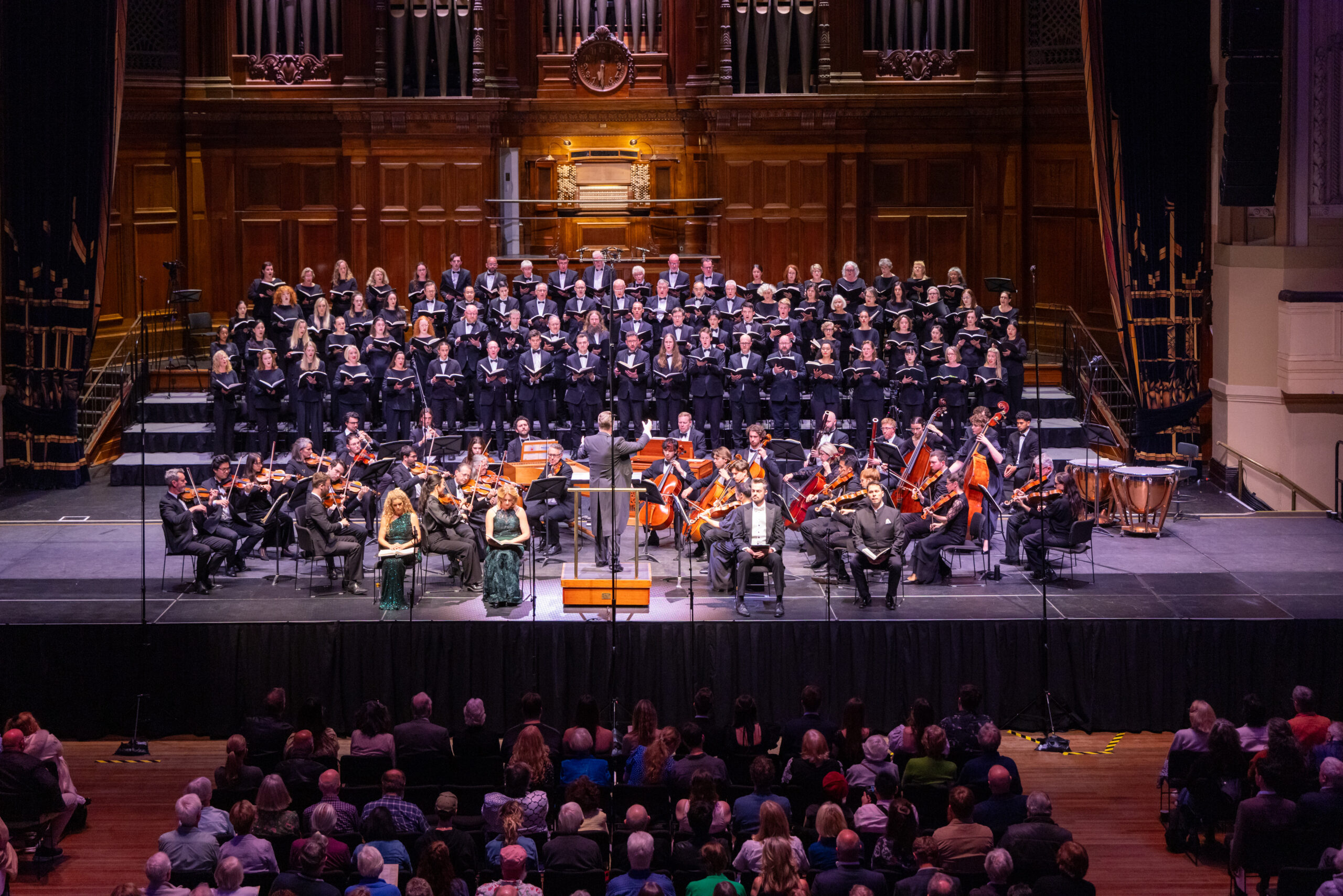
It is extraordinary to think that Handel’s monumental oratorio, Messiah, has been performed 246 times in the history of the highly admired Royal Melbourne Philharmonic Choir and Orchestra. This performance also marked the RMP’s concert No. 941.
The atmosphere of the spectacular Melbourne Town Hall stage setting for nearly one hundred choristers, an excited crowd bubbling with anticipation, familiarity and memories of being in this wonderful historic venue (did I hear Yehudi Menuhin’s name mentioned a few times?) and the ongoing popularity of this celebrated repertoire, plus the huge amount of talent in the combined forces of conductor, soloists and instrumentalists, meant there were very few empty seats – as always! I overheard the comment: “They did a fantastic job last year” (so could it get any better?). As Andrew Wailes has directed all versions of Handel’s Messiah, there was an expectancy for this annual event to keep rising in status and musical achievement with new interpretations and an extended deep-dive into textual expression.
In the opening to Part the First: Synfony (Overture), we heard a fine and well blended string tone, a finely balanced ensemble establishing sensitive support for tenor Kyle Stegall’s aria “Comfort ye”, showing a beautiful tone, projected strongly in his upper register. With four soloists (baritone David Greco, mezzo-soprano Fiona Campbell and soprano Sara Macliver), the RMP chorus of nearly one hundred voices, and the RMP orchestra (28 strings, four woodwind, two trumpets, with timpani, harpsichord, chamber and grand pipe organ), this was a spectacular sight to behold.
We were highly drawn into the polished delivery of the first Chorus, “And the Glory of the Lord” – music so well known to all. It was driven at a nicely forward tempo with detailed ensemble phrasing, beautiful tonal teamwork and balance between Macliver and Campbell, and unswerving clear enunciation of the traditional celebratory text. Also at his strongest when in the upper register, David Greco was impressive in the Air (Air and Arias were noted as Song in the program) “But Who May Abide”, his warm tone, expressing a richly toned lyricism, with expressive phrasing increasing a sense of drama with accented and staccato prestissimo texts.
Wailes held pauses to an absolute minimum between each musical section, maintaining discipline and unity in all choruses, keeping the audience’s fullest attention and involvement with his onward drive. To some traditionalists, the forward tempo may have felt “close to the edge”. It had taken much time for members of the capacity audience to enter the balcony and upper balcony with one entrance door only. They faced a challenge climbing stairs and getting settled before the scheduled starting time, so with two short breaks between the three Parts, Wailes lost no extra time by keeping a disciplined and flowing momentum throughout the performance of this large-scale work. Solemn texts, andante, largo and larghetto movements were never laboured.
Choosing a small string group, perfectly supported by Stefan Cassomenos on harpsichord and Andrew Bainbridge on chamber organ, enabled each soloist to interpret text and phrasing with greater opportunity for “word-painting” with clarity and intimacy, as changes in tonal expression and phrasing, original embellishment and tempo freedom, with splendid ensemble support in nicely phrased final cadences added freshness to this performance.
In the buoyant chorus “For unto us a Child is Born”, Wailes drew a superb gentle and touching affirmation with a surprising sudden diminishing of power and dynamics for the closing text “the Prince of Peace”. From power and might to peace in balanced harmony – a lesson in interpretation and the richness of Handel’s score, immediately setting a scene of beauty for the next song, and the angelic vision of Macliver, shining in her sparkling dress, silvery in her highest notes.
The song for bass soloist, “Why do the nations”, was taken at quite a pace, showing Greco’s agile and athletic vocal technique, clarity and lightness in his precise articulation of every triplet in this prominent climactic moment in Part the Second. Occasionally it was difficult for some individual solo lines to fill the voluminous Town Hall space in the very lowest notes demanded, especially with the ensemble loosening up and playing out more, warming up towards the two most famous choruses.
Organist Bainbridge excited the audience as he hurriedly left the on-stage chamber organ to re-locate on a higher plane in front of the spectacular array of pipes of the Town Hall Grand Pipe Organ. No guesses why – the Hallelujah chorus. Bainbridge, with trumpets Lewis Grey and Stephen Mosa’ati and timpanist Brent Miller were ready to steal the limelight from the beautiful team of vocal soloists.
Opening Part the Third, Macliver brought increased power and expression to “I know that my Redeemer liveth”, adding much sunshine, beauty and sensitivity to another angelic solo presentation, showing a wide range of dynamics and a pleasing sparkling, delightful vision. Wailes held the immediately following chorus “Since by man came death” in a very smoothly hushed and shadowy light, with choristers seated, symbolically motionless, then standing instantly together for a rousing text on the resurrection of the dead. It is Handel who triumphs always with the final chorus, “Worthy is the Lamb”, and “great” Amen, but it is also a fine timpanist who catches the eye.
Once again Andrew Wailes and all performers received a full standing ovation, which prepared the audience for Wailes’ invitation to join in fully with a reprise of Hallelujah Chorus, with greater audience participation expected. A perfect close to another memorable Messiah.
Many years of hard work, fellowship, highly detailed and illustrated program notes, first class soloists and instrumentalists, and continuing a great musical tradition, Wailes and RMP team get the gold medal here.
Photo credit: Ruth Woodrow
____________________________________________
Julie McErlain reviewed Handel’s “Messiah”, presented by the Royal Melbourne Philharmonic Choir and Orchestra at the Melbourne Town Hall on December 7, 2025.