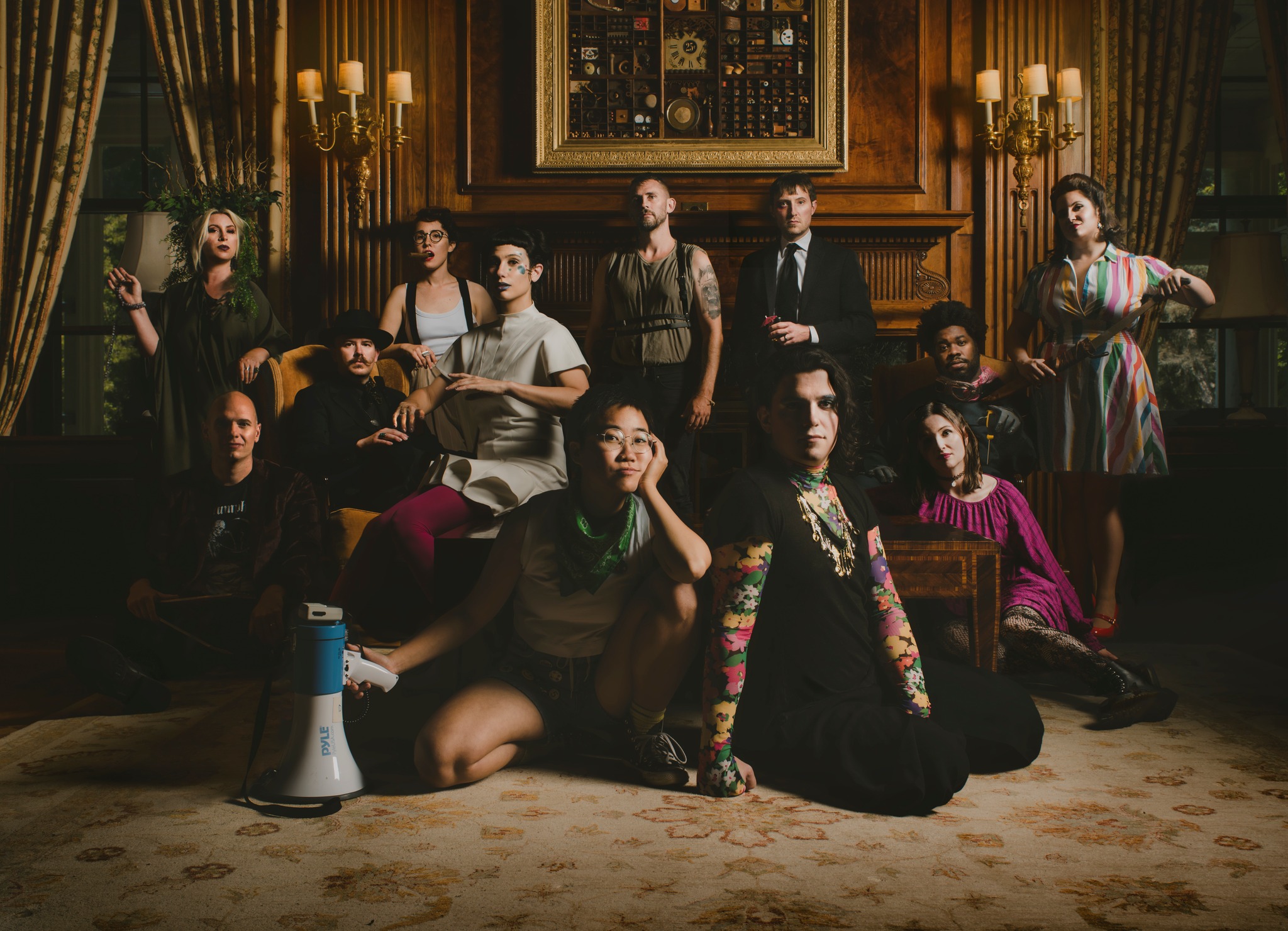
Roomful of Teeth describes itself as a “band” — a telling choice of identity for an ensemble that resists conventional choral categorisation. In the Elisabeth Murdoch Hall on Wednesday night, the Grammy Award-winning American vocal octet demonstrated why the term feels apt. Like many touring bands, they functioned as a tightly woven collective, yet their sonic world extends far beyond popular idioms. Drawing from contemporary classical practice, non-Western vocal traditions, minimalism, jazz, gospel, and electronic sound design, the group constructs immersive environments that dissolve boundaries between ancient ritual and cutting-edge experimentation.
Amplification is central to their aesthetic. Each singer performs with an individual microphone, and the presence of sound engineer Randall Squires is not incidental but foundational. This is not merely about acoustic reinforcement. Electronically modified textures, synthesised layers, and carefully sculpted reverb form part of the ensemble’s identity. The singers demonstrate exceptional microphone technique — a discipline quite distinct from traditional acoustic vocalism — negotiating proximity, colour and dynamic shading with precision.
The program opened with Missy Mazzoli’s Vesper Sparrow, a work inspired by Sardinian “cantu e tenore” techniques. Pulsing minimalist textures in asymmetric metres established an immediate rhythmic vitality, with lower voices driving a dynamic ostinato beneath ornithological gestures in the upper parts. Ensemble pitch and balance were impeccable. Particularly striking was the group’s ability to oscillate seamlessly between tightly unified sonority and moments of individualistic prominence — an interplay that defines their collective virtuosity.
Leilehua Lanzilotti’s On Stochastic Wave Behaviour offered a contrasting meditative stillness. Sung entirely in ʻŌlelo Hawaiʻi, the work embodies a synthesis of indigenous knowledge and scientific metaphor. Micro-ambient textures — shaped by glottal articulations, aspirated effects, and delicately sustained tones — evoked the gentle lapping of water and the resonant decay of a struck meditation bowl. Silence functioned as structural space rather than absence. The ensemble’s control in pianissimo passages was extraordinary, producing sonorities that at times seemed indistinguishable from natural sound. The closing participatory gesture, inviting the audience to hum a chosen pitch within a collective drone, created a moment of genuine communal connection — an elegant merging of performer and listener within the work’s philosophical frame.
Caroline Shaw’s The Isle, commissioned by the Boulder Shakespeare Library, occupied the evening’s conceptual centre. Drawing on monologues from The Tempest, Shaw’s work functions less as narrative setting and more as atmospheric reconstruction. A nebulous drone blossomed into consonant harmony before dissolving into nasalised timbres suggestive of non-Western choral traditions. Sound and space blurred; language fractured into murmured textures. Moments of Western harmonic progression — often bass-led — would flower briefly into polyphonic clarity before returning to more disembodied timbral states. Harmonic singing, vocal fry, glottal effects, and sotto voce passages coexisted within a soundscape that felt simultaneously ancient and modern. Tynan Davis’s featured contributions were delivered with focused intensity, while ensemble blend remained impeccably calibrated.
Gabriel Kahane’s Speaking in Tongues from Elevator Songs shifted the mood. Framed within a liminal hotel setting, the song opened with lilting melody shared by two upper male voices, bookended by textless refrains of ghostly resonance. As the refrains grew in harmonic urgency before receding into the songlike verse, one could detect an uncanny echo of The Beach Boys — a subtle homage embedded within Kahane’s layered idiom. The presence of an elevator operator as narrative thread lent theatrical coherence, while the ensemble’s lightness of touch provided welcome contrast to the program’s denser textures.
Angélica Negrón’s Math, the one which is sweet introduced a sensual ambience. Pulsing staccato ostinati, fragmented vocal slides, and aspirated effects interacted with synthesised backing to produce a texture at once playful and suggestive. The blend of live amplified singing and electronic underpinning was expertly managed by Squires, whose sound design throughout the evening demonstrated refined musical sensitivity.
William Brittelle’s Psychedelics — from the Grammy-winning album Rough Magic — proved the program’s most avant-garde offering. Its fragmented, pixelated structure evoked the ghosts of Cage and Feldman, refracted through contemporary media aesthetics reminiscent of radio and early MTV collage. Jodie Landau’s contributions on keyboards expanded the ensemble’s timbral palette, and the singers navigated the overlapping micro-moments with charisma and assured technical command. If any single work encapsulated the evening’s aesthetic remit, it was this.
The encore, Alev Lenz’s Fall into Me, arranged by founding member Dashon Burton, concluded the program in a wash of reverberant stillness. Harmonic minor inflections and low drones evoked echoes of Byzantine chant and Hildegardian modality. Virginia Kelsey’s rich mezzo-soprano tone floated through extreme reverb, the hall awash with ghostly resonance — a fittingly atmospheric close.
Across seventy-five minutes, Roomful of Teeth traversed cultures, epistemologies, and sonic traditions with remarkable fluency. This was music that inhabited liminal spaces — between speech and song, ritual and experiment, analogue breath and electronic mediation. Few ensembles demonstrate such breadth of stylistic command while maintaining ensemble cohesion of this calibre. In a program of diverse influences and aesthetic risk, the result was not fragmentation, but a compelling portrait of the human condition expressed through the boundless possibilities of the voice.
Photo supplied.
____________________________________________________
Stephen Marino reviewed “Roomful of Teeth”, presented by the Melbourne Recital Centre in the Elisabeth Murdoch Hall, Melbourne Recital Centre on February 11, 2026.