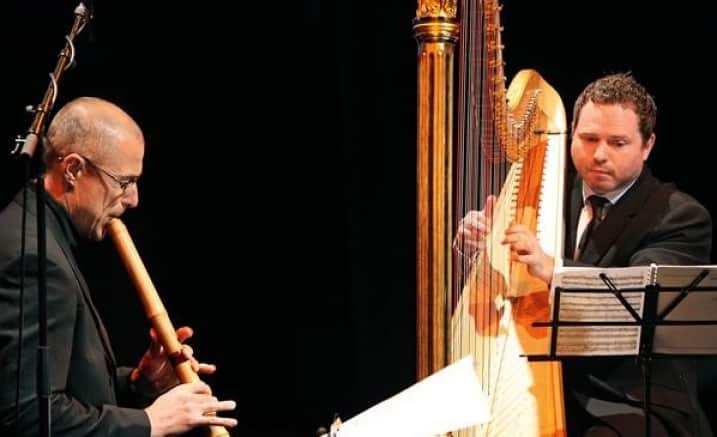
There wasn’t an empty seat in the Primrose Potter Salon where Riley Lee joined the inimitable and skilled harpist Marshall McGuire for a highly anticipated exotic and most elevating concert. Described in Wikipedia as the first non-Japanese person to become a shakuhachi master, and with fifty years of performing, teaching and recording, the American-born Riley Lee also directed the first World Shakuhachi Festival in Sydney in 2008, advancing his instrument’s popularity in the Western world. As a member of Elision Ensemble since 1988, and a promoter of both Australian and new compositions, Marshall McGuire was the perfect musical partner, complementing a colourful and creative presentation of duo and solo repertoire that spanned ten centuries of varied vocal and instrumental genres. While we associate the shakuhachi with Japanese and Zen cultures, McGuire brought images of the traditional stringed instrument, the Koto, into the Salon with his remarkable imitative style, technical prowess, sensitivity and vitality.
Composer Anne Boyd is known for her involvement with Asian traditions, so her work for flute and piano Goldfish Through Summer Rain (1979) drew us immediately into a timeless soundscape of other worlds. An opening harp introduction of brittle, sprinkling and dynamic patterns developed into a rhythmically supportive framework for Lee’s free, almost improvisatory modal phrases. With varied playing techniques, both musicians expanded the harmonic spectrum producing a rich and subtle range of tone, colour and pitch. If musical notes have a beginning, a middle and an end, the shakuhachi can produce a fourth and fifth dimension, as new harmonic spectrums and note frequencies are explored, with the harp adding a gentle mix of Oriental and Western harmonies and harmonics that seem to surround space and silence. In Ross Edwards’ Raft Song at Sunrise (1995) this almost 3-D effect from the shakuhachi’s warm vibrato and sustained notes enveloped us in an intriguing way. There was an abundance of musical beauty. At times, unusual breath tones and fluttered patterns created tension and rhythmic geometrical shapes, while song-like phrases were repeated with startling soft, soft echoes.
Coming from the French school of harp playing, Hasselmans’ popular piece for solo harp – Gitana – showed a mix of Classical and Romantic forms, with “verses” of song, gypsy waltzes and romantic melodies linked by showy cadenzas in the style of a spirited Spanish fantasia. With McGuire’s impressive technical fluency, joie de vivre, and range of dynamic contrasts this was most enjoyable, and Lee acknowledged his partner’s achievement saying: “Now that was a piece worth coming for!”
Famous for his koto playing, and inventing new kotos with 17 strings (bass) and 80 strings, Michio Miyagi (1894-1956) was recognised as an authority in new Japanese music, composing his most famous piece Haru no Umi (The Sea In Spring) in 1929 – still popular and being played annually as a New Year piece. This very programmatic music gently began with a dreamy, contemplative atmosphere, (The Empty Beach), developing with purposeful activity akin to folk music, with charming modal melodies, lightly skipping rhythms and dancing running patterns shared between both instruments (Sea, Birds, Fishermen). Scintillating plucked harp strings and downward glissandos sketched the fishermen throwing their nets down, before the opening scene of solitude on the beach returned. An evocative rendition of The Hurdy-Man from Schubert’s Die Winterreise song cycle followed, flowing beautifully with its slow, circular turning patterns allowing a powerful breadth of shakuhachi tone, subtle bending of line and unique instrumental colour.
Lee told us of his passion for the music of Hildegard von Bingen, playing three contrasting unaccompanied Antiphons– truly defining his mastery of the spiritual and healing aura of the shakuhachi, with its timelessness, peaceful, and meditative sound. Introducing the second Antiphon, Lee read the accompanying text that associated von Bingen with her garden, her response to nature and the environment, which was musically portrayed in a more lively and spirited statement with hints of blurred Medieval and Celtic musings. Lee’s Antiphons completely assured us that in music there could be peace in the world.
Satie’s Trois Gymnopédies was not a surprising inclusion, but each was strategically placed between other groups of pieces. McGuire referred to them as being “the anchors to other worlds”, atmospheric and ageless in the context of the program. He added triplet rhythms, arpeggiated chords and new life to the hypnotic flow of Satie’s well-known accompaniment, complementing the very full-bodied lower notes on the shakuhachi, which were broadened and bent with unexpected relish.
First Stirrings of Spring by Nagasawa (1971) reinforced the simplicity and purity of the shakuhachi’s tone, with gentle, almost extemporised patterns creating the seeds of thoughts, which would blossom as the harp introduced firmness and forwardness in strong repeated alternating chords defining new pulses. Fine balance and musical interplay between the two instruments drew energetic applause and appreciation from an audience whose fascination for these two instruments showed as people surrounded the stage wondering how such a “simple” bamboo instrument can produce such affective music. It takes a true Master.
Photo supplied.
__________________________________________________________
Julie McErlain reviewed “Goldfish Through Summer Rain”, performed by Riley Lee, Shakuhachi, and Marshall McGuire, Harp, the Melbourne Recital Centre’s Primrose Potter Salon on January 25, 2023.