Essential for every music festival is a Festival Artist, a drawcard and flag bearer of distinction, who represents what the festival stands for. Since their formation in 1995, Ensemble Offspring have shown much flair, dynamism, charisma and innovative “trail-blazing” in performances, making them a perfect choice to be this year’s Festival Artists. With over 350 commissions and premieres by contemporary Australian composers, particularly emerging First Nations and female composers, there is an infectious excitement generated by each musician. They are well-loved by people of all ages, and this year they offered three concerts, including a free family concert at the cool bush setting of Balnarring Civic Reserve.
Set among tall, scented pines more than 75 years old and extensive lush green vines, Main Ridge Estate has an ideal small concert room built from recycled warm stone and timber, which offers an extraordinary warm and fulsome acoustic that added a fourth dimension to the music. Led by acclaimed percussionist, Claire Edwardes, with Lamorna Nightingale (flutes), Jason Noble (clarinets), Rowena Macneish (cello) and Véronique Serret (violin), we were welcomed to a quality program of all Australian music by female composers.
Brenda Gifford’s Bardju (2017) (Footprints) was a most colourful and gently buoyant opening, with repeated cello ostinato patterns – a reflection on the composer’s influences of jazz and connection with country. Strongly rhythmic and regular, blocks of sound absorbed us in a rich blend of tone colours. With a nod to the music of Marin Marais, Felicity Wilcox’s Tambourin (2014) gently followed with the warmth and simplicity of French Baroque elegance, and modal clarinet lines warmly colouring the air over sustained drones.
Eerily poignant today, Ella Macens Falling Embers for vibraphone and crotales (small, tuned cymbals) was commissioned by Edwardes following the 2020/21 ravaging bushfires, a gentle meditation on the vision of burnt landscapes. Our relationship with nature and the ocean was felt in Nicole Smede’s Djeera Gadhu (Ocean Stories) (2024) where instruments flowed free with nature, the flute leading a joyful waltz at times. Improvisatory free patterns and suggested bird-song flutters, sustains and free cello lines added to gently spirited melodies weaving and dancing around each other. Challenging and moving in intensity and effectiveness, was Serret’s solo performance on violin and voice in Cathy Milliken’s Crie (2014) with a wide range of emotion, monotones, pitch bending and anguished inflexions over surging open strings, all closing with a pianissimo final cry.
The audience was very enthusiastic, truly appreciating the unique tonal variety of sounds explored by each musician as a soloist or in ensemble, and excited at being seated so close to each performer in this small venue – a rare concert experience these days! Bridget Bourne’s virtuosic and improvisatory composition for solo clarinet was highly applauded when Noble took her piece Wood Grooves (2020) from beautiful descriptions of birds and nature in a very Australian portrait, to an exciting acceleration and a virtuosic conclusion.
Who doesn’t love the tawny frogmouth, a truly cute character? In Caitlin Yeo’s A Tawny Tale (2025), the quirky bird’s rhythmic call and humorous character was featured. Bowed vibraphone keys introduced its mysterious gentle and colourful night-time character, and fine blended weaving harmonies from the woodwind rose from shifting and developing chords with fused echoes and harmonious insistency.
Kate Moore’s longer work, Rose of Roses, Flower of Flowers, harkened to the Cantigas de Santa Maria – medieval monophonic songs with repetitious patterns and sections building up in momentum as folk-like Portuguese dance rhythms were added. Strong unison lines and free violin improvisation over shifting harmonies in drone-like patterns created much interest as heavily accented dance rhythms and a feeling of Latin American cross-beats and syncopation strengthened the final statements. It was hard to get festival patrons to go home from this fine venue and heart-warming concert.
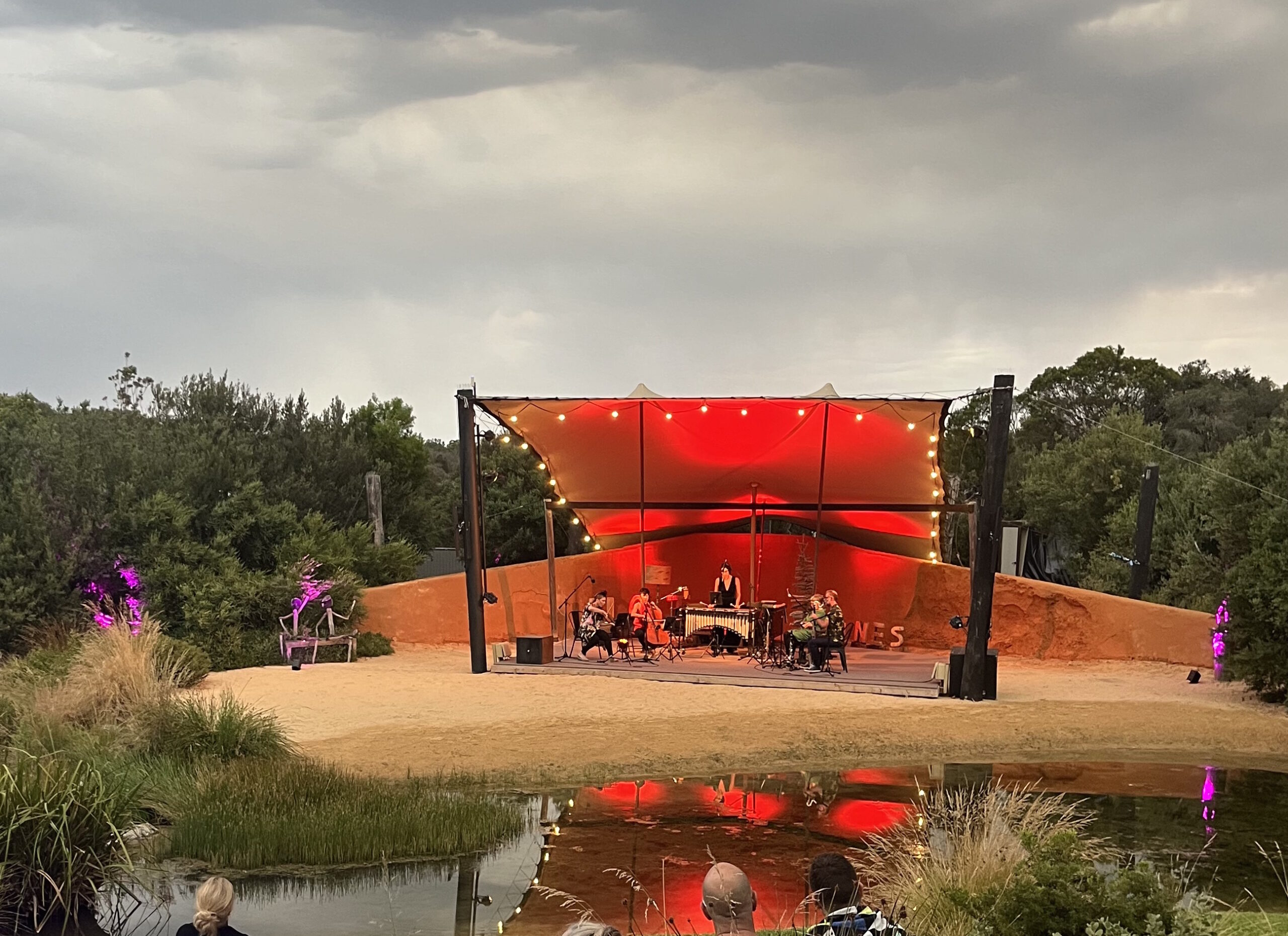
Outdoor performances in the wonderful Amphitheatre in the Peninsula Hot Springs are also truly unique events. So perfect for audiences to engage all the human senses in water, nature, the sky, the natural universe, as the sun sets and coloured lights emerge on stage and in the surrounding pools, hills and gullies.
“Every Plant Has Its Own Dreaming” brought Ensemble Offspring together with acclaimed first nations composer Aaron Wyatt for a newly commissioned work, created for this festival and inspired by the flavours and growing cycle of five local indigenous plants. Spoken stories of their indigenous life cycles, planting and harvest were interspersed between most colourful and absorbing musical portraits.
In tourist season it is very uniting and humbling to see people of many backgrounds, ages and cultures brought together while silently absorbing and sharing beautiful music and a colourful environment together, feeling connected and at peace through connection with music and country. From the stories of the plants: murnong, lomandra, chocolate lily, garawang and karkalla, we were taken into a contemporary dreamtime experience, with beauty in each musical piece, a reflective and timeless simplicity of sweet pastorale melodic lines, with an array of contented bathers barely noticing the single note fade-outs at the close, after birds had flown to bed.
How beautifully Wyatt’s music balanced new melodic ideas, mesmerising gentle waltz textures and layers of repeated and cleanly spaced orchestration, drawing out the colours and tonal possibilities of each instrument in this most rewarding environment.
__________________________________________
Julie McErlain reviewed two Ensemble Offspring concerts given as part of the Peninsula Summer Music Festival: “Nature Stories” at Main Ridge Estate on January 7, and “Every Plant Has Its Own Dreaming” at Peninsula Hot Springs on January 9, 2026.