It was the enthusiasm of renowned Italian organist and teacher Sergio de Pieri that led to his planning and staging of this prominent music festival, now in its 28th year and ably directed by Judith Houston. With wonderful unmodified organs scattered through the Central Highlands and Goldfields of Victoria, Organs of the Ballarat Goldfields is now renowned for its early music programs and its celebration of historical venues and musical instruments.
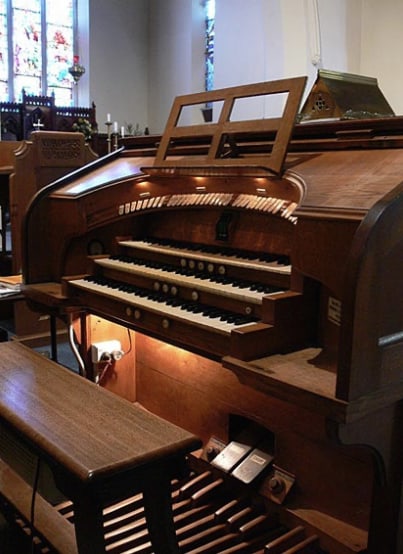
St Peter’s Anglican Church is a fine bluestone building, built in 1864-1867, with commemorative stained glass windows, stone pulpit and carved timber furniture. The Hill, Norman and Beard organ (1929) is in a finely conserved mechanical state, but sadly is located in a chamber opening of the north transept, blocked by a carved wooden screen, which tends to slightly diminish the maximum volume that can reach the audience. The clarity and colours of the instrument though were a delight to hear – pristine and balanced.
A regular Festival guest, Dr Anthony Halliday is an extraordinary organist and pianist, with many years of performing throughout Europe and Australasia, noted for his orchestral transcriptions and extemporisations. Wearing a very elegant Arthur Gallen-designed jacket, Halliday introduced his repertoire with informative and meaningful historic and musical understanding. While the colourful Festival program had very full CV’s of concert artists, it was lacking in details of recital programs.
The opening work, Antonio Soler’s Concerto in G for Two Organs, was transcribed by Halliday nicely connecting late Baroque and early Classical style, with lightness and clarity in its imitative dialogue. Continual conversation between short, rapid alternating blocks of orchestral voices and volume settings was colourful and also playful and lightly amusing. With many intricate trills and ornamentations, the piece grew to a more complete toccata-like virtuosic setting, and was a fine prelude to the succeeding indispensable music of Handel, a resplendent Fugue in A minor that was delivered in an authoritative and virtuosic style. Dignified and solemn, there were touches of pathos in the opening theme with its descending leaps and chromatic downward steps. Halliday added much warmth of tone colour, and enjoyed exposing the rhythmic and melodic motifs that mirrored recognisable themes from Handel’s major works. Bach’s Pièce d’Orgue BWV 572, (Fantasy in G) opened with an adventurous and spirited “violin” cadenza, heralding a multi-layered powerful reverential hymn, full of regal splendour and technical virtuosity. Halliday showed both the organ and Bach at their best, with brilliantly defined strong bass chromatic melodies and a final dramatic episode of high explosive glissandos and brassy forthright pipe registrations.
Halliday enthusiastically introduced a rarely heard work of Beethoven, The Consecration of the House Op. 124 – as being one which the composer was so fond of that he chose it to be played before the first performance of his Ninth Symphony in Vienna in 1894. Arranged by Halliday for organ solo, this work was regal and joyful, full of celebratory dotted rhythms and trumpet fanfares in a grand introduction that preceded an extended double fugue bearing the influences of Bach and Handel but coloured by Beethoven’s inspiring melodies and exciting crescendos.
A change of ambience came with Halliday’s mellow orchestration of “The Swan” by Saint-Saëns, with a very shadowy bass line plumbing the dark watery depths under silvery upper woodwind, although the bright shiny higher rippling accompaniment, so well known, occasionally dominated the quieter, beautiful hush and reedy-toned principal melody.
Charles-Marie Widor is best remembered for his ten grand symphonies for organ, so Halliday’s choice of the Adagio and Finale from Symphonie No. 6 Op. 42 was most welcome. In G minor, the Adagio can sometimes be overly solemn, almost tragic, heavy and sorrowful, but Halliday brought out the most colourful string tones, creating lightly exotic and pastoral scenes, with clean melodic contours. The Finale brought us a rapturous explosion of brass and Handel-like splendour, with insistent and driving forceful blocks of orchestral architecture and wonderful pedalled bass melodies.
And then came the true icing on the cake! Halliday spoke to us of the European tradition, where the performer is given a few bars of an unseen written melody, to inspire an impromptu performance in a test of skill and improvisation. Three melodies were offered by audience members: the opening line of a Parry hymn, a Celtic tune and a Christmas carol. Here we saw Dr Anthony Halliday at his very best. No facet of extemporisation was left out in this challenge as creativity and imagination fuelled the results. Melodic fragments were enhanced, played forward, backwards, inverted or played on bass pedals, flowing in new ways with never a hesitation. With cadenzas, sparkling trills and ornaments added, melodies were re-harmonised, overlapped and played against each other. This was a classy, textbook example of classical improvisation and a showcase for Halliday’s extraordinary musicianship. It was an exciting finish.
Photo supplied.
_________________________________________________________________
Julie McErlain reviewed the Organ Recital performed by Anthony Halliday as part of Organs of the Ballarat Goldfields at St Peter’s Anglican Church Ballarat on January 14, 2024.