When Gioachino Rossini famously proclaimed “Give me a laundry list and I’ll set it to music!”, you could hardly blame him; it was no idle boast. Forty operas before the age of forty and an opera that is the seventh most performed in the world give credence to that claim. Melbourne alone has hosted many productions, Opera Australia’s production of The Barber of Seville (1816) being the latest.
The main reasons why Barber is so popular are plain: the plot, enlivened by Cesare Sterbini’s libretto, is entertaining, and Rossini’s music is joyously melodious. Another important reason is that it provides the perfect showcase for exceptional opera singers; the music is vocally demanding, and finely honed acting skills are required for maximum comic effect – factors that have made several of the arias mainstays of vocal competitions around the world as well as being popular inclusions in recitals. Happily, the singers for both casts were well and truly capable of delivering the delights of this opera.
While Melbourne’s State Theatre is undergoing extensive renovation, Opera Australia has been without its usual home. Meanwhile, we have heard concert performances of operas and recitals by some of the world’s most prominent international stars – both homegrown and overseas – most of which have been exceptional. The move to the Regent Theatre almost provides an experience comparable to a standard opera theatre, but involves important compromises. For Barber, the stage area was more than adequate – as would be the case with most productions designed for the relatively small stage of the Sydney Opera House – but the lack of a pit and shallow raking of the Stalls seating entails much of the audience being on a similar level to the orchestra so that vision and acoustics can be problematic.
Conductor Tahu Matheson did his best to accommodate the singers by ensuring suitable dynamic balance, but the lack of acoustic resonance was unhelpful. Listening to the alternate cast from the middle of the back row of the Circle, however, was more satisfactory, even with competition from the air-conditioning system during the quietest moments. Although some cast members were different – and both John Longmuir (Count Almaviva) and Simon Meadows (Figaro) are renowned for their vocal power and excellent projection – Clifford Plumpton’s Fiorello sounded stronger from upstairs on the second night.
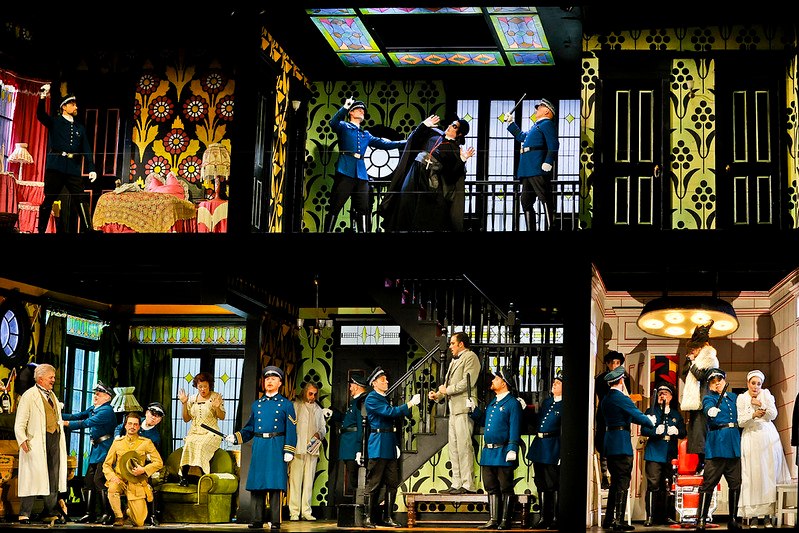
This revival of the late Elijah Moshinsky’s 1995 production has much to recommend it. The overture was played with curtain down, enabling a focus on the skillful playing of Orchestra Victoria – from honeyed horns and delicate strings to surging orchestral crescendos featuring brass and percussion. The curtain design, a kind of colourful Mondrian abstraction, was an introduction to the 1920’s setting, where imaginative details of Michael Yeargan’s set design and Dona Granata’s costumes were in keeping with the carefully choreographed action.
The curtain rose to reveal a miniature row of terrace houses and a line of palm trees – conjuring up Australia’s urban architecture more than Seville’s. Tiny mobile figures furthered the doll’s house enchantment as Count Almaviva, disguised as the “student” Lindoro, tried to woo Rosina, the ward of the Doctor Bartolo, who was villainously intent on marrying her – pronto. There were also some unexpected ideas woven into the musical fabric; Lindoro’s serenade was prefaced by a short passage from Don Giovanni’s serenade – a clever allusion to this Count’s poor treatment of Rosina in Mozart’s The Marriage of Figaro, the story’s sequel. In the same scene, an uptempo flamenco verse, with an “Ole!” thrown in for good measure was part of the fun.
An impressive upper extension to his range and exceptional vocal agility made Shanul Sharma a logical choice for the role of Almaviva. His ornamentation had fluent clarity and even the highest notes were completely free and ringing. Sharma also has an extremely pleasant vocal timbre and has seemed to gain in overall strength and ease, both dramatically and vocally, over the years. A veteran of the role, John Longmuir was also an admirable Almaviva, the many coloratura passages cleanly articulated and his voice always well-projected.
In the title role, both Samuel Dundas and Simon Meadows gave animated performances and sang with agile assurance; however, the busyness of the production did detract from their characterisation at times. It’s true that the stage business in Figaro’s barber shop was very entertaining, but it did tend to pull focus.
The main set, a two-storey dolls’ house looking cutaway of Bartolo’s house/surgery, became overly cramped. Rosina’s small bedroom may have created the atmosphere of a suffocating environment, but limited the physicality of a feisty heroine. Mezzo-sopranos Helen Sherman and Emily Edmonds both have very lovely voices, but their delivery of Rosina’s big Act 1 aria, “Una voce poco fa”, while displaying vitality and commendable vocal agility, was fairly contained.
One of the most important occasions when stage business detracted from the main focus was the entrance of Almaviva as an inebriated soldier waving false billeting papers. Jane Ede’s Berta was so compelling that it was hard to take her eyes off her as she secretly raided her boss’s alcohol cabinet and secreted it in the surgery that she basically ran as Dr Bartolo’s nurse. Without exaggerating any of the action, Ede simply upstaged everyone else; she was terrific as the snuff and alcohol addicted Berta, singing her main aria with a warm full voice and contributing effectively to the ensembles.
With six main areas sometimes crowded with several comic non-singing roles and a chorus of policemen, the space between principals was sometimes too wide for easy communication. This was most evident in Act 2 when Bartolo was in his surgery – either attending to his patients or being shaved by Figaro. Even given that Barber is opera buffa and the element of French farce (with numerous comings and goings through numerous doors) is par for the course, better musical coherence could have been achieved in the Act 2 trio and some ensembles. As it was, however, the cast did a wonderful job of negotiating complex movement that was at times hilariously frenetic.
The intricacies of Rossini’s score with those tongue-twisting patter songs were also very well negotiated. Andrew Moran was a suitably authoritative and objectionable Bartolo with a firm, forthright voice capable of crisp, well-articulated delivery. Possessing a bass baritone voice of quite considerable beauty, Shane Lowrencev tended to be a more bemused Bartolo, but he did spit out those patter passages with convincing precision.
Bass David Parkin was sonorous of voice and nimble of foot as the unprincipled, avaricious Don Basilio; yet, again, a sharper theatrical focus on the aria itself was needed as he described his dastardly machinations in the famous aria, “La calunnia è un venticello”.
Despite certain quibbles with the staging, Heather Fairbairn’s revival of this production is heaps of fun and very well performed indeed. Wherever seated, the audience is guaranteed to have a great night out – but perhaps a little more so upstairs.
Photo credit: Jeff Busby
________________________________________________________________________________
Heather Leviston reviewed Rossini’s “Barber of Seville”, presented by Opera Australia at the Regent Theatre on October 31 and November 1, 2025.