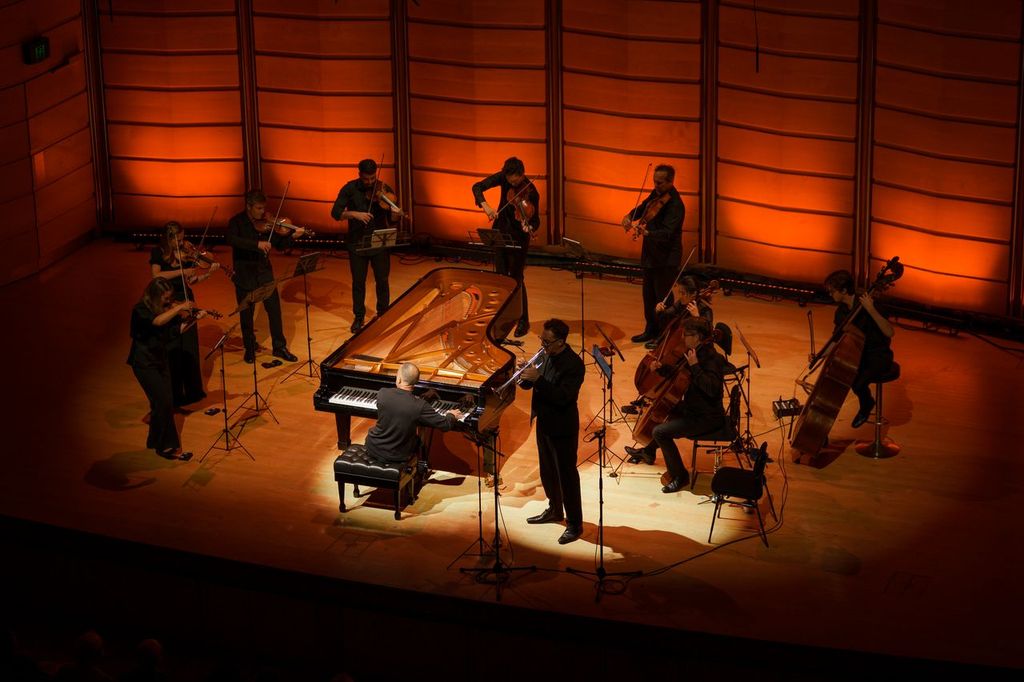
Opening with Starburst, Jessie Montgomery’s dynamic and much-loved mini-masterpiece for string orchestra, Omega Ensemble did indeed provide an evening of stellar ensemble playing with virtuosic performances by soloists, Vatche Jambazian on piano, David Rowden on clarinet and David Elton on trumpet.
Written in 2012 by Montgomery, a Black American composer and violinist, Starburst was composed for a somewhat larger group of strings. It was interesting, therefore, to hear this performance by Omega Ensemble consisting of four violins, two violas, two cellos and one double bass. In place of the larger, more aggressive sound of a bigger group, individual members of Omega Ensemble worked seamlessly together to provide us with an exciting performance marked by energy and intensity but which was more appropriate to a musical starburst than an ear-shattering explosion. The complex overlapping rhythms of the jagged repeated notes and dancing syncopations contrasted well with the softer, more ethereal moments leading to a glorious final crescendo that remained hanging, momentarily, in the upper atmosphere.
Gerald Finzi’s Concerto for Clarinet and String Orchestra, Op. 31 was no less demanding in terms of ensemble playing but also required the highest level of technical proficiency from the solo clarinettist and founder/Artistic Director of Omega Ensemble, David Rowden. More frequently performed in the UK than in Australia (it has been played three times at the BBC Proms), it was a pleasure to have this work included in Omega Ensemble’s program. Completed in 1949, this concerto remains a major orchestral work in the clarinet repertoire.
From the clarinet’s melodic entry after a satisfyingly dramatic introduction by the strings, to the run of rapid-fire arpeggios that brings the concerto to an emphatic end, the bright, ringing tones of Rowden’s clarinet and his mastery of the instrument made for an impressive rendition of the work. The fullness of sound achieved by the string ensemble and the clarity of the solo clarinet line throughout was aided by Finzi’s consummate skill in balancing the many different elements that make up the composition.
Whereas the final movement of the concerto with its familiar lilting pastoral theme introduced by the clarinet was a delight, it was the Lento, the second and longest movement, that gave the ensemble full scope for expressiveness. Here, the strings excelled from the delicate introduction to the movement in the upper strings, to the resonant pizzicati passages in the lower strings, to their support for the clarinet’s frequent changes in mood and pace, up to the movement’s final heart-wrenching notes.
Those who know something about playing the clarinet will know that the movement provides many challenges that can only be met successfully by performers with David Rowden’s command of the instrument. As well as the fluidity of his arpeggios and his ability to maintain an evenness of tone across the whole instrument, there was also the delicacy of Rowden’s sustained pianissimos and diminuendos in the upper register. What, if anything, might have enhanced the performance would have been greater use of the darker, more melancholy tonal possibilities of the clarinet. Similarly, for the ensemble as whole, it would not have detracted from the performance of the slow movement to give even more emphasis to some of the changes in dynamics and pace, but not to the extent of sentimentality. Having said that, it must also be noted that the final soulful phrases of the movement were not at all sentimental, but breathtaking!
Shostakovich’s Concerto for Piano, Trumpet and Strings, Op. 35 could not provide a greater contrast to the Finzi concerto except that both have very beautiful and moving slow movements. Otherwise, the contrast is stark. Where Finzi is lyrical and tender, Shostakovich has moments of huge light-heartedness and fun that capture the audience and take us along for a rambunctious ride. This was certainly the case with this performance by Jambazian and Elton, ably backed by the Omega strings. As a result, this work turned out to be the highlight of the concert.
Composed in 1933, the concerto was written by Shostakovich early in his career when the clouds of political censure were gathering but had not quite burst. As a young, talented pianist Shostakovich earned his living playing and then writing for silent movies. It was these experiences, along his studies as a student at the Petrograd Conservatoire, that gave rise to many of the wildest and wittiest moments in the concerto and his many brief satirical quotations from the works of other composers. Amazingly, Shostakovich manages to knit an array of vastly contrasting elements and musical styles into a serious work that, as conductor Kenneth Woods puts it, “juxtaposes humour and grotesquery on the one hand with the deepest tragedy and vulnerability on the other”. All these complexities and contrasts were expertly tackled by Omega.
From the sparkling entry by the piano in the first movement to the end of the concerto, the strings and the two soloists provided a performance of great energy and versatility. Jambazian was no less than virtuosic in negotiating this most challenging of piano concerti. Fast and at times grotesquely loud but never brittle, Jambazian’s playing was also highly sensitive and nuanced such as in the poignant passages at the beginning and end of the slow movement. Equally, the plaintive entry of Elton’s muted trumpet towards the end of that movement provided us with an exquisite moment of musical enjoyment. From here, however, it was on towards the musical Keystone cops craziness of the final movement with its many abrupt changes from one musical quotation to another, even faster and more furious piano passages, a jazzy quote from a Broadway hit and, finally, to Elton’s “bugling” trumpet solo that goaded the ensemble on to the concerto’s mad-cap close.
This highly entertaining performance of the Shostakovich concerto by Omega Ensemble was hugely appreciated by the audience, but it was undoubtedly Vatche Jambazian’s performance on piano that brought the audience to its feet for a standing ovation.
The final work in the program, Lachlan Skipworth’s brand new work, A Turning Sky, was inspired by Virginia Woolf’s description of a view over the ocean and a night sky, continuing the heavenly theme that began the concert. Composed, unusually, for solo trumpet and clarinet with piano and strings, this modern and very accessible double concerto was commissioned from Australian composer, Lachlan Skipworth, by Omega Ensemble.
From the opening, the rippling piano riffs that accompanied the high strings evoked the movement of the tides and vastness of the Australian landscape. A particular feature of the composition was the use of different combinations of instruments within the ensemble, such as the piano with the first violins, the clarinet with the violas and the two solo instruments with piano. This added to the complexity and variety of the work as well as the lush scoring for whole ensemble sections. The trumpet and clarinet sounds combined well, with the trumpet adding brilliance and the clarinet, in its lower registers, providing warmth to the overall sound texture. The last movement surprised by beginning with a slow waltz played by piano, trumpet and clarinet. After a hint of Country and Western style, a bit of jazz, and repeat of the gently rippling piano accompaniments, the concerto moved toward its close. Like the moment before sunset, a melancholic muted trumpet turned into a soaring trumpet and clarinet duet accompanied by suspended chords in the upper strings and the end to this expansive, technically complex and imaginative contribution to Australian music.
Photo credit: Amelia Kain
_________________________________________________________
Maree Gladwin reviewed “Starburst”, presented by Omega Ensemble at the Elisabeth Murdoch Hall, Melbourne Recital Centre on February 18, 2026.