It seems to be quite a fashion to brand fine music concerts with a pithy title – alluring signage to whet our appetites and stir our curiosity? Elevator music was first found in the elevators of the 1930s, soothing music (later referred to as “Musak”) designed to alleviate the anxieties and “noise” of modern life. We think of light classical music, ambient and “easy” listening, and so welcomed Omega’s smooth selection of music as a chance for the listener to experience inner peace and calm and the less serious side of “new music”.
With no speeches or announcements, the youthful, animated and very blended chamber ensemble of fifteen strings opened the program with a sprightly and quite uptempo Mozart – the Allegro from Serenade No.13, “Eine kleine Nachtmusik” – always popular, always satisfying. Principal violinist Veronique Serret always sets an infectious mood and much flair with her leadership, brightens our spirits and delivers artistic excellence in the finest softness and unity of ensemble.
Anna Clyne’s work followed, nicely linking “sounds both familiar and new” in Stride, a work commissioned by the Australian Chamber Orchestra and premiered in 2020. Clyne had heard moments of connection between the American tradition of “stride” piano playing, and the driving bass line rhythms in her composition. Recognisable melodic, rhythmic and harmonic fragments from the “Pathétique” Sonata are cleverly hinted at, almost “quoted” unashamedly and humorously mixed with virtuosity and modern string textures. Dramatic Beethoven was felt when double basses projected moody lower octaves, and viola melodies had a gentle sadness under more intense chromaticism from violins. This was a most satisfying twelve-minute three-movement work, blending a nostalgic romantic sense with a more melodramatic and strongly rhythmic work, intriguing, absorbing, newly modern yet enjoyable “easy” listening.
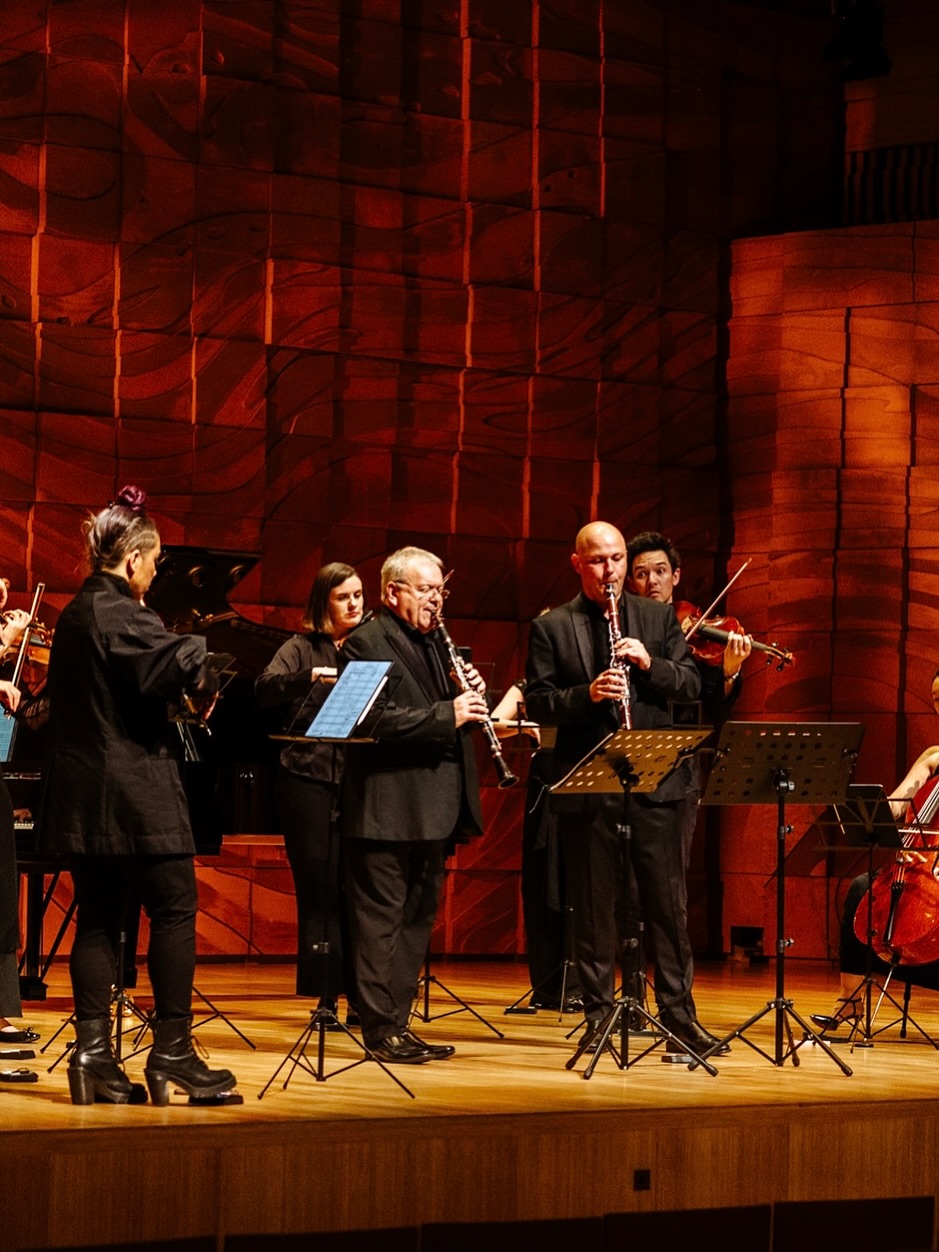
It was Adelaide composer Graeme Koehne whose work Elevator Music (1997) gave this concert its name, and his distinctive and most enjoyable music has successfully brought popular elements from movies, films, cartoons, and jazz styles into his inventive material. Commissioned by Omega Ensemble especially for tonight’s solo performers, we heard the premier performance of Dances on the Edge of Time, a work featuring Omega’s Director, clarinettist David Rowden, with legendary international guest, clarinettist Michael Collins. A delightfully brisk tempo matched the confident and at times extroverted personalities on stage as the duo shared lively folk dance melodies with mimicry and unison patterns in energetic virtuosic sparkling sequences with pianist Vatche Jambazian.
Titled Rigaudon, “Work like you don’t need the money”, the first movement’s pleasantly repeated harmonic sequences and gorgeous harmonised duets did provide warm appeal; the following Chaconne, “Love like you’ve never been hurt” brought a pleasant panorama of mellowness with a touch of Hollywood perhaps. True romanticists could feel a Pachelbelian sense of beauty and repetition through flowing rhythms and emotive legato string phrases, and the harp (Paul Nicolau) completed the popular romantic texture and colour of the work. Clarinets paired joyfully in equally matched tone and technical virtuosity for the third movement, a folk-like Gigue, “Dance Like Nobody’s Watching”. An abundance of rising scale themes gave these two maestros an opportunity to show an effervescent partnership and joy in the performance, and their exuberance and textbook musicianship was highly felt and appreciated by the audience. This was classy and exciting elevator music, which brought smiles to our faces.
Against a tender harp pattern, gentle rising and falling soaring lofty steps put a spell on us in the opening bars of Copland’s Clarinet Concerto (1950), with Michael Collins showing why he is a highly awarded and distinguished soloist and conductor. This was perfect clarinet playing, with Collins producing a huge range of dynamics and outstanding breath control as solo clarinettist, then smoothly taking the lead role to conduct Omega with finely communicated sensitive and authoritative hand and facial gestures. Most dreamy and imaginative was the lengthy solo cadenza section that linked the two movements, itself a showpiece of contrast and expression, with continuous quirky fragments, leaps and jumps, at the extremes of the clarinet’s register. Fun and frolics developed as swinging jazz licks and crazy interjections flew above basses at first, and then fully danced everywhere in the busy traffic of strings and piano. A staccato whirlwind followed with a masterful and seriously challenging long glissando from soloist and ensemble. What a delight!
Such a well-loved musician, Collins offered us more, addressing the audience to introduce one more piece, Ornamental Air (2007) by Elena Kats-Chernin, a work beautifully in keeping with the flow of this program, re-written for Michael Collins and David Rowden. With Kats-Chernin’s distinctive colours, invigorating urban rhythms, sparkling piano, two superb clarinets and a finely blended Omega ensemble, this was truly the icing on the cake.
Photo credit: Eloise Coomber
___________________________________________________
Julie McErlain reviewed “Elevator Music”, presented by Omega Ensemble at the Melbourne Recital Centre, Elisabeth Murdoch Hall on August 16, 2025.