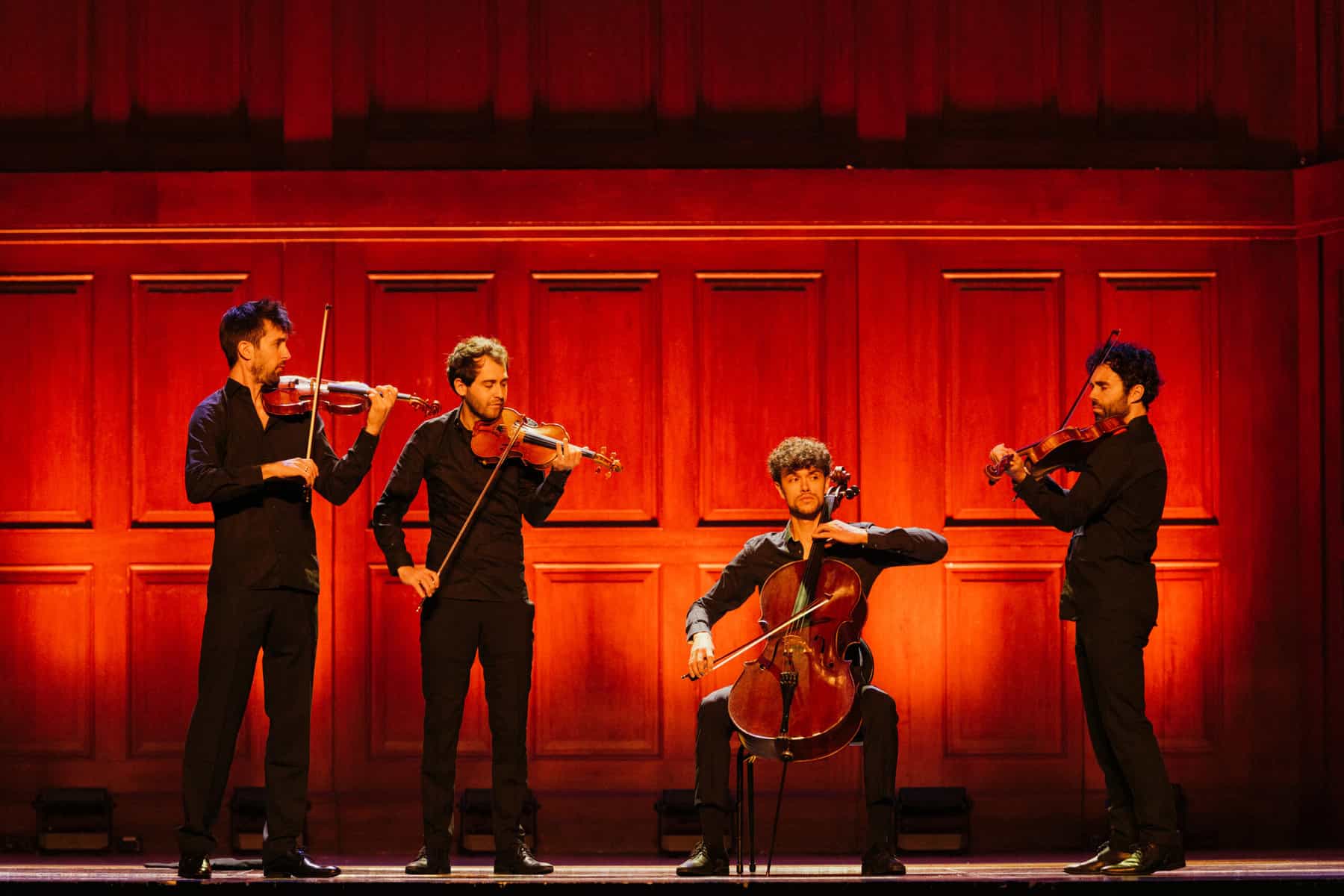
Their name says it all.
Widely regarded as one of the world’s finest string quartets, the multi-award-winning Vision String Quartet from Berlin is a tour de force of imagination, versatility and vision. Since forming in 2012, these four young musicians – Florian Willeitner (violin), Daniel Stoll (violin), Sander Stuart (viola) and Leonard Disselhorst (cello) – have been on a mission to re-imagine how classical music is presented and perceived by both new and traditional audiences.
Making their Melbourne debut last Saturday, these rockstars of classical music treated the audience to an exhilarating journey through works of Bloch, Bartok and Dvorak. Yet a few things were missing – there were no music stands, no sheet music, no iPads. One of the many things that sets this ground breaking quartet apart from others is, they perform everything entirely from memory. With eleven years of collaboration behind them, the Vision String Quartet members have clearly attained the skill, maturity and confidence required to do this.
The German newspaper Der Tagesspiegel describes the group as “completely fearless”, and such a feat demands this. “There surely lies a certain risk in playing chamber music by heart”, says the Vision String Quartet, “but this extra thrill pays off so much for both us and our audience”. When asked how the players prepare to tour a full concert program from memory, violinist Daniel Stoll offers a surprisingly simple response, “Repeat, repeat, repeat”.
Something else was missing on stage at the Elisabeth Murdoch Hall last Saturday evening – there were no chairs. Just a solitary piano stool greeted concert goers. At 7pm sharp, the quartet stepped nonchalantly onto the stage clad in classic concert black, shirts untucked.
The concert commenced with the emotive Prelude B.63 for string quartet by Ernest Bloch. Composed in 1925, the work draws upon the composer’s Jewish heritage. Short and sweet, it was the ideal concert opener.
Engaging then with the audience, first violinist Florian Willeitner expressed the group’s excitement at being in the city of culture and the arts – Melbourne. He also spoke about the absence of music stands: “It’s not that we’ve forgotten them, but we get a special kick out of playing without music … it provides us with a lot of freedom and flexibility to perform”. Not only does the quartet play by heart, they also play standing up, bar the cellist, of course. After all, if you don’t need music, why stay confined to a chair?
Introducing Bela Bartok’s 5-movement String Quartet No.4 in C major, Sz.91 as, “a cool piece”, Willeitner encouraged the audience to clap after each movement if they felt so moved, as they readily do in Europe, he said. We nodded with approval, and happily offered well-deserved applause after each movement.
It was during this second work that the calibre of this young group became clear. With its highly chromatic passages and timing challenges, this piece would not have been easy to commit to memory. Yet the precision, musicianship and interpretative insight of this complex work were masterly.
Facing the audience using the group’s alternative configuration of players, cellist Leonard Disselhorst shone during the beautiful third movement, his tone rich and mellow. By the movement’s end, all four bows were placed on the cellist’s lap, generating yet another round of applause.
The fourth movement, all pizzicato, was a highlight. Unfortunately – or not – first violinist Willeitner snapped his E string during a particularly enthusiastic, so-called “Bartok snap pizzicato”. Returning to the stage with his newly strung instrument, he quipped, “Nothing’s worse for E strings than Bartok”, before more applause and a repeat of the fourth movement.
The final and most complex of the five movements was delivered unapologetically, the upper three parts standing in classic power pose, the cellist going hell for leather. All appeared to relish the challenging music, as if performing this most complex of chamber repertoire by heart was the very least audiences could expect from a quartet.
Interval provided concert goers an opportunity to fully digest the Bartok and discuss the wonder and merits of rote playing before the group returned for the final work, Dvorak’s String Quartet No.13 in G major, Op.106 – a joyous, invigorating and beautifully crafted piece. This was the perfect choice to close a program of composers influenced to varying degrees by both European and American folk music. And traditional folk musicians tend to perform effortlessly without music!
Watching any chamber group perform on stage with only their instruments is rare. Add to that the finesse and integrity offered by the Vision String Quartet on Saturday night, and one might be forgiven for shrugging off the weeks, months and years taken to achieve such a feat. But the Melbourne audience on Saturday seemed to understand, with the applause increasing following each consecutive movement of the Dvorak quartet, accompanied now by raucous cheering. We had been transformed into a European audience.
Following two “curtain calls”, the Vision String Quartet returned for a toe-tapping encore of Copenhagen, from their Warner Classics album Spectrum, demonstrating they are as equally comfortable with folk, pop and funk music as they are with the classical string quartet repertoire.
Fortunately for Melbourne audiences, the Vision String Quartet returns to the Melbourne Recital Centre towards the end of a national tour with Musica Viva Australia. If you missed their first Melbourne performance, this second opportunity on October 10 is a must see.
Photo credit: Charlie Hardy.
__________________________________________________________________________
Helen Rommelaar reviewed the concert given by the Vision String Quartet, part of a national tour presented by Musica Viva Australia, at the Melbourne Recital Centre, Elisabeth Murdoch Hall on September 23, 2023.