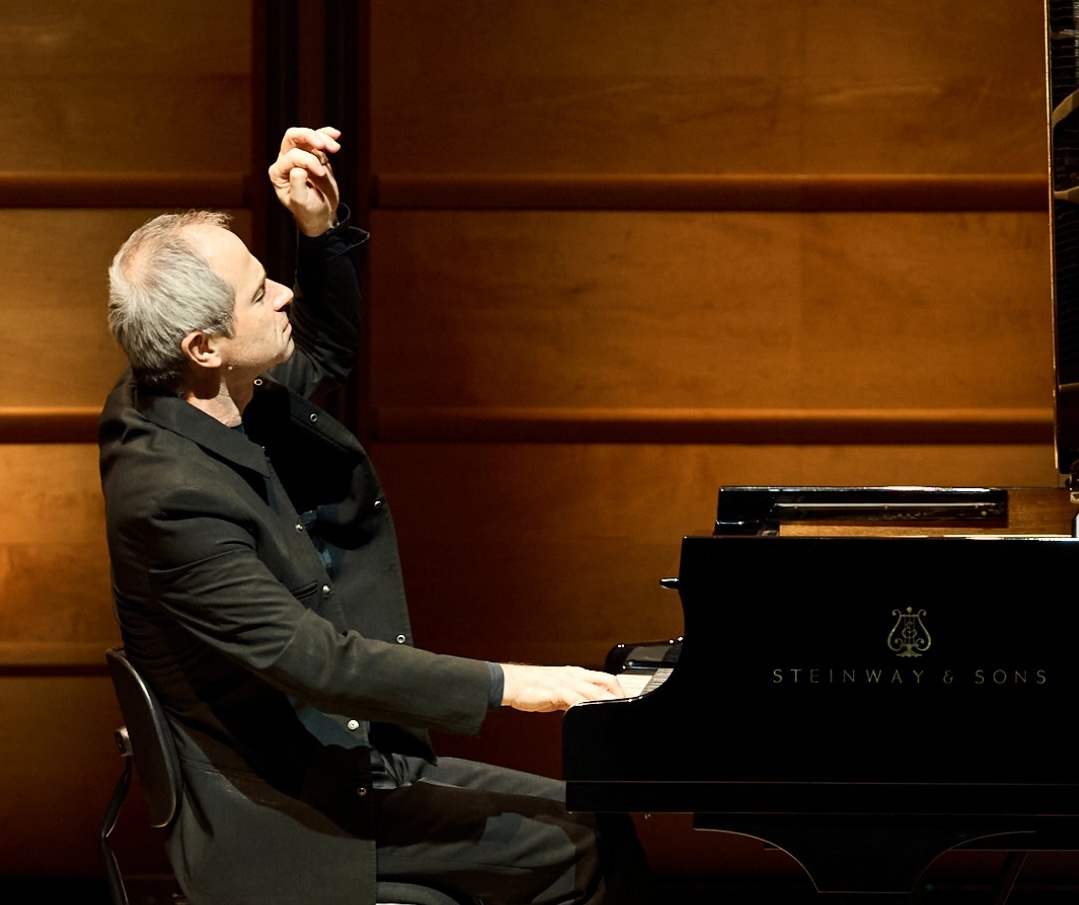
In a concert presented by Musica Viva, acclaimed Polish pianist Piotr Anderszewski presented a program featuring solo piano works by the so-called three B’s: Bach, Beethoven and Brahms.
The first half of the recital was comprised of a generous selection of smaller works from Brahms’ late period collections Opp. 116-119, works composed after Brahms’ self-declared retirement from composition, and works for which music lovers are eternally grateful that Brahms changed his mind. These are works far removed from the youthful headiness and overt virtuosity of the three expansive early sonatas. Rather, they are far more intimate and inward-looking works, perhaps better suited to a salon setting rather than for a 1000-seat concert hall. The selections were arranged in a manner that highlighted key relationships and affective connections and contrasts.
Anderszewski opened with my personal favourite, the melancholic Intermezzo in B minor Op. 119 No. 1. His gloriously spacious pacing was ideal for underlining the harmonic discourse, replete with agonizing dissonances that achingly yearn to resolve, yet tantalizingly take their time doing so. A suitably turbulent Op. 118 No. 1 was followed by the most popular of the late works – the Intermezzo Op. 118 No. 2 in A major. With his delicately refined tonal palette, Anderszewski effortlessly realized the tenderness of the long, consoling melodic arches, subtly highlighting secondary melodic lines when textures were repeated. Anderszewski’s exquisitely nuanced voicing and finely-tuned balancing of textures were a feature not only of this Intermezzo but indeed of all of the miniatures heard this evening. The G minor Capriccio Op. 116 No. 3 unleashed a hitherto unheard power and explosion of tone, while the ensuing E major Intermezzo, with its cross-hand choreography allowed a more plaintive discourse to unfold.
The imperial Rhapsody in E-flat major, which is the final work from Opus 119 would, on the surface, seem to have made an appropriately triumphant and buoyant conclusion to the first half of the recital, but Anderszewski, as is perhaps befitting such a thoughtful and seemingly philosophical performer, chose to conclude the Brahms set with perhaps the two most searching Intermezzos of the collections. The B-flat minor Op. 117 No. 2, with its intertwining arpeggios laced with elegiac resignation, was followed by one of the summits and certainly one of the most personal utterances of the Brahms oeuvre – the Intermezzo in E-flat minor Op. 118 No 6. Anderszewski perfectly captured the weariness of this desolate meditation on death. Temporary solace was provided by the all-too-briefly heroic middle section, with Anderszewski thereafter resuming the tragic tenor of the score, its bleak closing lines providing a fittingly introspective epilogue, not only to Opus 118, but to the first half of the recital.
After interval, Anderszewski performed two Preludes and Fugues from Bach’s Well-Tempered Clavier Book 2 (replacing the previously advertised Partita No. 1 in B-flat major). We often forget that the preludes and fugues, so closely associated with piano pedagogy and music exams, make for engrossing concert repertoire. Anderszewski approached the Prelude in E major in a genially pensive manner, emphasising its linear lyricism with smoothly-shaped melodic contours, stylishly embellished repeats and mellifluous trills. By contrast, the hymn-like Fugue was slightly unorthodox in approach, with its juxtaposition of abrupt and extreme dynamic changes. The ensuing Prelude in G-sharp minor elicited a rhythmically robust reading, often featuring “terraced dynamics” – this was not Bach for the faint-hearted – driven, energetic, yet never brash of tone. Again by contrast, the Fugue was broadly-paced, contemplative in character, and with clearly-etched subject entries emerging, particularly from the bass register.
Barely without any pause to reflect, or indeed to receive applause, Anderszewski then launched into the final work of tonight’s program, Beethoven’s Sonata No. 31 in A-flat major, Op. 110 (replacing the previously advertised Schubert Sonata in C minor D 958). He delivered a persuasively understated, yet beguilingly lyrical opening movement, one whose organic rhythm was underpinned by an inexorable sense of line, free of excess rubato. Again with no pause, Anderszewski segued into an unhurried reading of the Allegro molto second movement, where a more robust tone came to the fore. With the opening of the third movement, Anderszewski once again revealed himself to be a master of all things pianissimo. The quasi-improvised opening lines were so intimately delivered, one almost felt as being something of an aural interloper, intruding on the pianist’s own personal meditations. Anderszewski is definitely an artist who seeks to draw listeners in, inviting them into his personal space, rather than barraging them with well-honed thunder and bluster virtuosity. The concluding fugues were notable for their cathedral-organ-like subject entries, and a particular sonic highlight was the well-crafted massive, repeated-chord crescendo leading into the second of the two fugues.
As a first encore, Anderszewski played Bartok’s Three Folk Songs from the Czik District in Transylvania. Bartok of course is the putative “fourth B” so this made for a fitting encore. His wonderfully colourful reading easily evoked the shepherd’s flute, which inspired this folk-song arrangement. Then followed a deliciously ornamented Sarabande from Bach’s Partita No. 1, restrained, refined and ruminative – a perfect end to the evening.
Photo supplied.
___________________________________________________________
Glenn Riddle reviewed the piano recital given by Piotr Anderszewski, presented by Musica Viva Australia at the Elisabeth Murdoch hall, Melbourne Recital Centre, on November18, 2025.