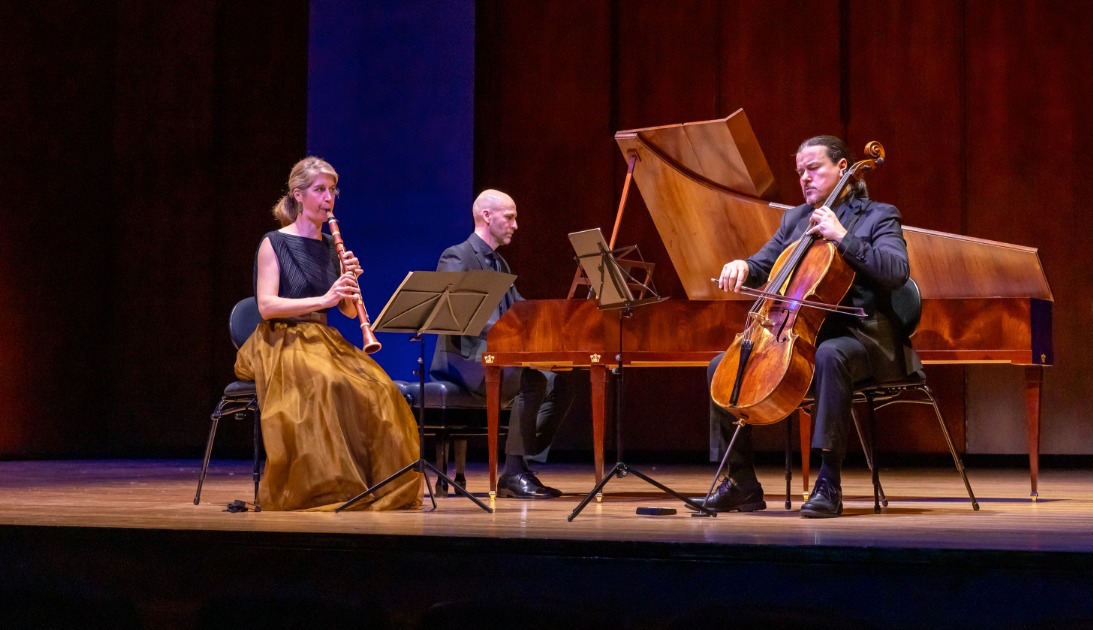
On Tuesday July 22, Musica Viva Australia presented a fascinating insight into the early clarinet with “Mozart’s Clarinets”. The concert was given at the Elisabeth Murdoch Hall, Melbourne Recital Centre, by the internationally renowned Nicola Boud on basset horn and period clarinet, with Erin Helyard on fortepiano and Simon Cobcroft on cello.
The program featured two works by Mozart: his Trio in E flat major, K498 (known as the “Kegelstatt” 1786); and the Piano Sonata in C major K454 (1788). Against four works by Beethoven it seemed at first glance there was not a lot of Mozart in “Mozart’s Clarinets”. However, the programming made clear that what we would hear was the clarinet Mozart pioneered and favoured, the very instrument that inspired Beethoven.
The concert began with Beethoven’s Sonata for Fortepiano and Basset Horn, Op. 17 (1800) arranged by Beethoven’s contemporary, clarinettist Joseph Friedlowsky. It is an arrangement of a horn sonata, done with Beethoven’s approval and, indeed, Beethoven relied on Friedlowsky’s insights when writing for the clarinet.
It was a curious start to the concert. The basset horn is a strange looking instrument. Nicola Boud later explained to us why it had a “steam-punk” appearance. It produces a sweet and fairly subdued sound, and to balance it Erin Helyard may have played with a lot of restraint, as the fortepiano sounded very distant in the stalls. An observer higher up thought the sound was balanced, so that might be an artefact of the Hall. Nothing to fault in the execution of the work, it was very beguiling.
The next work was Beethoven’s 12 Variations on “Ein Mädchen oder Weibchen” from Mozart’s The Magic Flute, this time with Nicola Boud on basset horn and Simon Cobcroft on cello. Written in 1796, it came across as a pleasant, if trifling exercise from Beethoven. Simon Cobcroft’s cello playing was all there, but it lacked a spark somehow, whether in his engagement with Nicola Boud, or a reluctance to show some bravado. It was puzzlingly subdued.
Fears of a faint fortepiano were dispelled in the last work before Interval, the aforementioned Trio in E-flat major by Mozart. This sparkled, and the balance between the three artists was lively with Nicola Boud having switched to a B-flat clarinet of Mozart’s time. The fortepiano scurried around (as they seem to) and the cello part was handled in a businesslike manner, with a few infelicities in timing. The clarinet part was not particularly virtuosic, but the way it moved in and out of the other parts was quite sublime. Mozart really “got” the instrument right from its very beginning.
After interval, Nicola Boud on the B-flat clarinet joined Simon Cobcroft on cello for Beethoven’s Aria con Variazione from Three Duos. Originally for clarinet and bassoon, frankly, it felt like a program filler.
Then Erin Helyard came back to play the Mozart Piano Sonata in C major, the so-called “Sonata Facile”. What a revelation. Helyard played all the repeats with wonderful embellishments and few cheeky moments. He explored all the tonal range of the instrument, which seemed quite mystifying, as this instrument has no visible pedals. Eventually, Helyard explained he has two knee-activated “pedals” to work with. He certainly demonstrated that, while it is easy to play Mozart poorly, it takes genius to play it brilliantly – and this is what he treated us to.
The fortepiano’s capabilities were fully realised in the final work, Beethoven’s Piano Trio in B-flat major, Op.11 (the “Gassenhauer”, 1797). Whereas, in the earlier works, Beethoven sounded as if he was struggling to speak through a fortepiano, here power and nuance really came to the fore. Nicola Boud soared through with the B-flat clarinet. The cello part had plenty to do, more than basic continuo support, and Simon Cobcroft was there. Apparently he was playing on an unfamiliar cello tuned to A430 to match the tuning of the clarinet. That’s a big ask for any performer, so plaudits for delivering.
Photo supplied.
________________________________________________________
Nicholas Tolhurst reviewed “Mozart’s Clarinets”, presented by Musica Viva Australia at the Melbourne Recital Centre, Elisabeth Murdoch Hall on July 22, 2025.