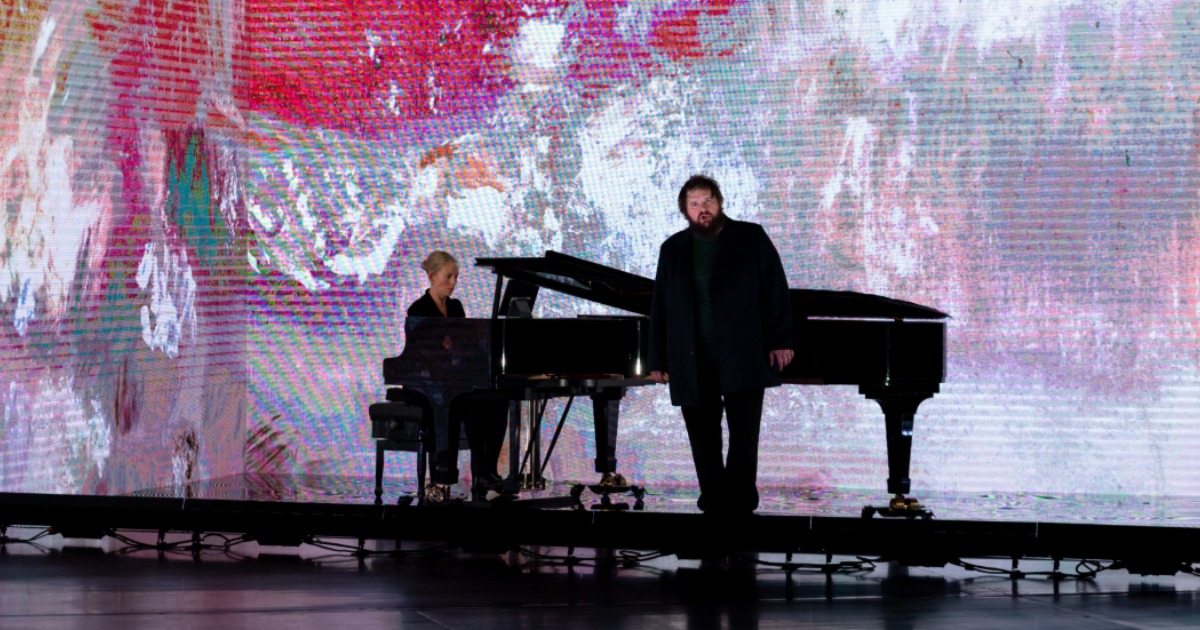
British tenor Allan Clayton and pianist Kate Golla embarked on a road less travelled in Schubert’s Die Winterreise (A Winter’s Journey), Op. 89, presented by Musica Viva Australia under Artistic Director Paul Kildea, in a production that reimagined the Lieder recital as immersive theatre. In a near-capacity Elisabeth Murdoch Hall, the result was a rare synthesis of music, text and stagecraft that clarified the cycle’s internal tensions rather than merely adorning its surface lyricism.
Poetic texts operate across three interpretive layers: the literal, the symbolic, and the authorial voice. Traditionally, a Lieder recital relies almost exclusively on singer and pianist to negotiate these dimensions within the spare architecture of a chamber platform. Here, director Lindy Hume, video designer David Bergman and lighting designer Matthew Marshall expanded that framework into a hybrid form somewhere between Lied, opera and contemporary theatre.
A three-sided projection chamber was constructed upon the stage, its open face framing a contained interior space animated by sequenced images drawn from Australian landscape painter Fred Williams’ œuvre. The piano stood within this scenic enclosure like an elegiac monolith, the shifting projections transforming walls and floor into a psychological terrain. Clayton’s minimal costuming — a traveller’s coat that at one moment even suggested the wings of a crow — foregrounded the literal dimension of Wilhelm Müller’s poems. Landscape, weather, exile: these were not left to imagination alone but rendered visually.
Such theatrical augmentation carries risk. One might fear that the visual co-opts the singer’s responsibility for articulating the literal layer. Instead, the opposite occurred. The staging enhanced rather than diluted the narrative. Clayton inhabited “The Traveller” not as recitalist but as figure within an interior world. From the opening “Gute Nacht” (Good Night), the unstable psyche was established, sharpened immediately by the quicksilver shift into “Die Wetterfahne” (The Weathervane). The mood swings between resignation and agitation felt organically embodied.
The greater risk lies in preserving the symbolic and authorial layers. Winterreise lives in its liminal spaces — between memory and hallucination, hope and derangement. Without fidelity to these thresholds, the cycle collapses into pictorialism. What emerged here was genuine synergy between sight and sound. The projections did not dictate meaning; rather, they created a container within which the music could resonate subliminally.
Clayton navigated Schubert’s intimate landscape with a finely calibrated palette of vocal colour, daring to shade the line with risk and texture while never straying from the inward, poetic spirit of the Lied. His timbral range was striking: pure and lilting softness, rasp and grain for bitterness or sarcasm, nasal edge for cynicism, full lyric bloom in moments of passion. Where the text required it — “Rückblick” (A Backward Glance), “Der stürmische Morgen” (The Stormy Morning) — he allowed a full, open sound to surge without inflating the scale beyond proportion. Conversely, in “Der Lindenbaum” (The Linden Tree) and “Die Nebensonnen” (The Phantom Suns), the softest dynamics retained core tone and diction, floating effortlessly into the hall.
Projection was never an issue. Even at hushed dynamic levels, Clayton’s voice filled the space with clarity. His ability to sustain tone while lying down in “Rast” (Rest) and “Frühlingstraum” (Dream of Spring) — physically vulnerable positions — spoke to formidable technical control.
The value of Kate Golla’s contribution cannot be overstated. She was the sublime presence underpinning the entire enterprise — the landscape itself. Her playing propelled and augmented Clayton’s vocal lines without ever competing. Completely focused and still within the scenic enclosure, she became the cycle’s gravitational centre. The tremulous unease of “Die Krähe” (The Crow), the brittle agitation of “Erstarrung” (Frozen), and the hollow inevitability of “Der Leiermann” (The Organ Grinder) were sculpted with restraint and structural awareness. The partnership between singer and pianist, despite the atypical staging, felt profoundly cohesive.
Dramatically, Clayton avoided the trap of performative excess. Movement and gesture felt naturalised rather than stylised. The arc from the first “Good Night” — a farewell to love — to the final encounter with the organ grinder in “Der Leiermann” achieved genuine sublimity. In “Die Nebensonnen”, existential recognition dissolved into acceptance; by the close, The Traveller stood beside the hurdy-gurdy player like a disembodied bard bidding farewell to earthly happiness.
German pronunciation occasionally leaned towards Italianate vowels — “Tod”, “mehr”, “sehr” and the “ch” of “mich” and “ich” were not always idiomatic — and rapid-fire passages lost some syllabic clarity. Technical distractions, including audible backstage thuds and dropped cups from within the hall, momentarily fractured concentration.
These minor imperfections aside, what unfolded was a rare and persuasive synthesis. By integrating theatrical design without compromising musical integrity, this production illuminated the literal, symbolic and existential strata of Schubert’s masterpiece with striking coherence. Rather than projecting the drama outward, it turned the journey inward, revealing Winterreise not as a succession of exquisite songs, but as a fully inhabited psychological descent.
Photo supplied.
____________________________________________________
Stephen Marino reviewed “A Winter’s Journey”, presented by Musica Viva Australia at the Elisabeth Murdoch Hall, Melbourne Recital Centre, February 17, 2026.