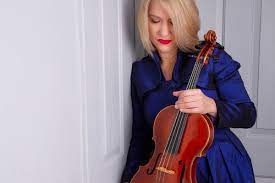
The Melbourne Symphony Orchestra conducted by Leonard Weiss provided an enjoyable concert featuring the mellow voice of the viola at the City of Whitehorse’s The Round in Nunawading on Friday 7 November 2025.
The role of the viola in the concert to act as the top string voice went to the soloist in the first work on the program. Eminent MSO violist Fiona Sargeant gave a moving rendition of the seldom-heard work Der Schwanendreher (“The Swan-turner: Concerto After Old Folksongs for Viola and Small Orchestra”) by Paul Hindemith (1895–1963). Written when Hindemith’s view of German culture conflicted with the dominant Nazi ideology, the concerto was premièred with Hindemith as the viola soloist in 1935. The work was based on four German songs derived from Altdeutsches Liederbuch, an extensive compilation of melodies and texts with notes and references published by German musicologist Franz Magnus Böhme in 1877. Hindemith’s explanation for the work’s inspiration asked the audience to imagine that they were being entertained by a minstrel with his hurdy-gurdy.
The composer stretched the musical possibilities of the older material in a work in three movements. The solo viola was accompanied by modern orchestral instruments, drawing from two flutes (one doubling piccolo), an oboe, two clarinets, two bassoons, three horns, trumpet, trombone, timpani, harp, four cellos and three (in this performance, four) double basses. The orchestral palate resulted in a diverse range of timbres in the orchestration by the skilled composer.
The title of the first movement, “Zwischen Berg und tiefem Tal” (“Between mountain and deep valley”), is the first line of a song from c. 1512. The heading in Böhme’s version can be translated as “Good advice for lovers”. The concerto’s opening demonstrated Hindemith’s flair, with an introduction of evocative solo viola followed by the song melody stated by horns and trombone, accompanied by a stirring orchestral rhythmic pattern. The second movement continued the timbral variety with a restful duet between solo viola and harp based on “Nun laube, Lindlein, laube!” (“Bloom, little linden, bloom!”), a song from c. 1555. A later fugato section based on a jaunty tune, “Der Gutzgauch auf dem Zaune sass” (“Cuckoo sat on the fence”) (c.1540), was initially played by the first bassoon. The third movement with variations based on a dance song “Seid ihr nicht der Schwanendreher” (“Are you not the Swan-turner?”) (c. 1603) brings the concerto to a forceful close.
A piece for solo viola by Jolivet was played as an encore by Fiona Sargeant. The second advertised work on the program, Serenade No. 2 for Small Orchestra in A major, Op. 16 (1859) by Johannes Brahms (1833–97) was in a lighter vein than Hindemith’s more complex work. Written while Brahms was aged in his twenties and working in the princely court at Detmold, Serenade No. 2 was dedicated to Clara Schumann. It predated Brahms’ symphonic output but revealed his developing talent. The strings were led by the viola section, complemented by cellos and double basses, together with a piccolo and two each of flutes, oboes, clarinets, bassoons and horns. Brahms provided an array of five contrasting movements, with changes of mood, tempo and other musical elements to keep the audience’s attention.
The conductor for the evening, Leonard Weiss, directed the orchestra with panache. He showed his technical and emotional versatility, using a baton with precision for the Hindemith concerto and expressive hand gestures without a baton in the Brahms Serenade. His infectious enjoyment inspired the audience as well as the performers.
I expected to find the program too brief with only two advertised works taking just over an hour to perform, but the emotional range and diversity of the Melbourne Symphony Orchestra’s “The Voice of the Viola” concert was satisfying. I also attended the pre-concert performance by Blackburn High School String Orchestra, which had previously participated in a workshop with MSO musicians, as well as an informative talk by Miranda Hill.
The venue at The Round, which opened in 2023, presents advantages for residents in the eastern suburbs of Melbourne, including comfortable seating and adequate carparking. Its design as a theatre with a proscenium arch suits music theatre and dance concerts, allowing modern amplified sound to engulf the audience’s sensibilities; however, it poses problems for performance of classical music, because much of the unamplified musical details disappear into the space above the musicians’ heads. Sightlines from the audience to musicians seated towards the back of the stage can also be obscured. Experiments with seating configurations for the musicians, such as placing the wind players where the violins are usually seated and then spreading the other players on the same level to maximise their interactions, may help to ameliorate some of the issues.
Audiences for programs of classical music at The Round may benefit from comparing the sound at venues such as Melbourne Recital Centre in Southbank, where the Melbourne Symphony Orchestra repeated the program the following night, with the viola encore composed by Britten instead of by Jolivet. Nevertheless, the opportunity to hear musicians from the Melbourne Symphony Orchestra conducted by Leonard Weiss with viola soloist Fiona Sargeant in a performance of “The Voice of the Viola” at The Round was a worthwhile experience.
Photo supplied.
________________________________________________________
Rosemary Richards reviewed “The Voice of the Viola”, presented by the Melbourne Symphony Orchestra at The Round, Nunawading on November 7, 2025.