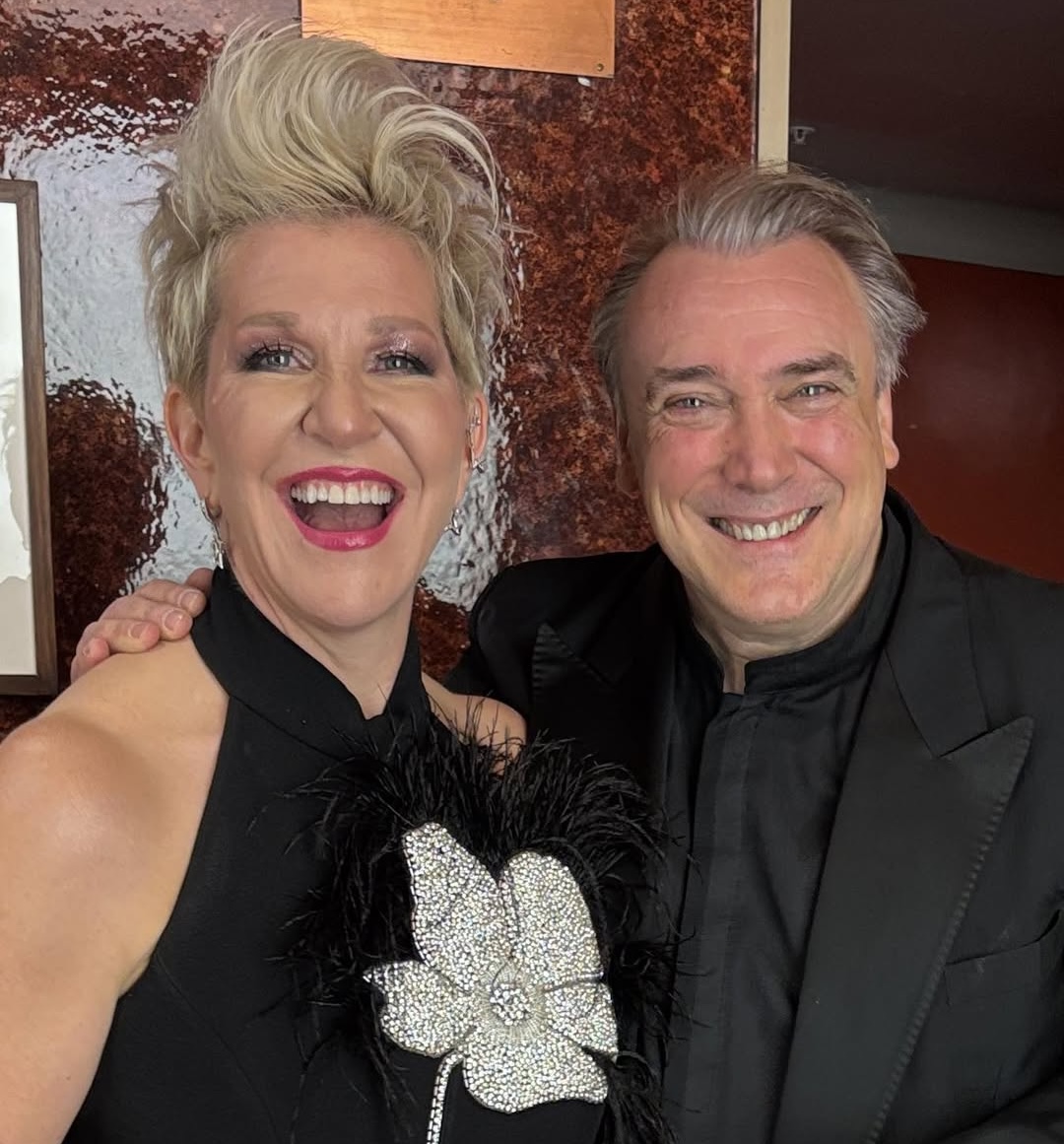
Following the beautiful and now customary musical Acknowledgement of Country (Deborah Cheetham Fraillon’s Long Time Living Here), the Melbourne Symphony Orchestra’s Spring Gala program, conducted by Chief Conductor and Artistic Advisor, Jaime Martìn, began with Rossini’s William Tell Overture, performed by very large forces. The stage was filled with extra desks of string players, and the music shone in a manner that is impossible from within the cramped pit that would house the musicians for a staged production of the opera Willian Tell.
This overture could be described as a tone poem, using the resources of the orchestra to set the scene of the opera to follow. Although the overture contains no melodies from the opera, the rousing theme is widely familiar in popular culture. Perhaps less familiar is the magical opening where five solo cellos intertwine to evoke sunrise over the Swiss Alps. We could hear thunder in the distance, and a procession of cows, courtesy of a Swiss folk melody on the cor anglais, before the call to arms of the trumpets, and the famous and thrilling gallop.
Jaime Martìn used his broad range of conducting gestures economically but effectively, his eye contact with the orchestra clearly also an important part of his communication. He almost danced too, and the orchestra responded to the way he threw his body into the weight of accents, and to his playfulness with the subtleties of what is often heard purely as a mad dash! This performance was certainly deserving of the thunderous applause it received.
The loyal MSO regular audience members were joined by many from the singing community – performers, teachers and students – for this opportunity to hear Joyce DiDonato. Her acclaimed performances not only in concert, on stage, and in recordings, but also her success as a producer and advocate for the arts have established her as a major presence in the music world. Her repertoire spans four centuries, and her engagement with many musical styles is legendary. She is truly a singer for the 21st century.
Once a few of the extra desks of strings were removed, the stage was set for mezzo-soprano DiDonato and the MSO to perform Les Nuits d’été (Summer Nights), with six poems by Théophile Gautier set to music by Hector Berlioz. This was not originally composed as a song cycle; the songs were composed for various singers and performed originally at separate occasions, with piano. Woven together as a cycle, they form an emotional journey of love – from the “longed for” of the first song, to the unattainable “eternal” of the last.
DiDonato’s entrance to the stage immediately conveyed a strong presence and commanding composure. From the first song to the last, she demonstrated the courage to take risks, with enormous variations of colour and dynamics, and the most artful of phrasing. In the first song Villanelle she seemed to be almost inhaling the sound. The second song, Le spectre de la rose, is a slow waltz in which the ghost of the rose plucked to adorn a beautiful woman’s breast recalls the joy of dying for such a noble purpose. Using the text to shimmer a starry night at the top her voice, the darkness of death at the lower end, and all the shades and dynamic variations in between, DiDonato’s huge palette of colours was on display. Her impeccable vocal line, combined with the total support of conductor Martìn and the MSO, afforded the final “Here lies the rose…” the most delicate and beautiful conclusion, and resulted in spontaneous applause.
The following four songs demonstrated DiDonato’s technique in which she could show darkness and heaviness (and the lowest pitch) in the lament Sur les lagunes, and the recurring “Come back, come back my beloved” painted in different colours each time in Absence. Au cimetière (The Cemetery), another lament, brought more bodily gesture and story-telling from DiDonato, and ghostly harmonics from the upper strings. The final song L’Île inconnue (The Unknown Isle) was given a bold and forward-looking feel by soloist and orchestra, though it is something of an ironic journey to the unattainable.
DiDonato’s free, easy and healthy vocal quality allowed her to infuse these beautiful songs with a vast array of colours and dynamics, and her approach to the text infused it with the range of phrasing that gave shape and meaning to these effects. Martìn and his outstanding orchestra supported her in every way, complementing DiDonato’s interpretation sensitively, unobtrusively, and very musically.
Genuine and sustained applause showed the audience appreciation for what we had just witnessed, and as the brass players (absent from the Berlioz orchestra) filed onto the stage it was clear that we were about to hear an encore. The Habañera from Bizet’s Carmen allowed us to see more of Joyce DiDonato’s skill and musicianship, and her theatrical flair.
Yet another dimension was unveiled when she spoke to the audience, introducing herself as a “girl from Kansas”, and communicating freely and thoughtfully about her first visit to this part of the world. I wonder how many of us guessed that the second encore from the girl from Kansas would inevitably be “Somewhere over the rainbow”. With a lush orchestral accompaniment, two upward modulations, and a conductor who was relishing every moment, this was a lovely way to arrive at the interval.
In fact, it would have made a fine conclusion to the program. There were quite a few empty seats after interval, left by those who had apparently been there mainly for the opportunity to experience Joyce DiDonato “live” or were still upstairs wishing to meet her. The second half of the concert was perhaps “brave” programming. The two Respighi orchestral works – Fountains of Rome and Pines of Rome – showcased the skills of the extended orchestra in presenting sensations through music, although they were “captioned” by Respighi’s librettist after their composition.
The colours of two harps, sparkling tuned percussion, shimmering strings, and often muted brass afforded the audience a journey of soundscapes, sounding to me like film music without the film, so requiring the listener to imagine the visual elements.
The final section of The Pines of Rome, The Pines of the Appian Way, introduced even more brass, surrounding the audience, some playing in the balconies above. The decibel level was raised considerably, and those perhaps having fallen into a trance of their own imaginations were now roused and ready for the glorious conclusion. This was something you needed to hear in the concert hall. Even the best of hi-fi systems could not afford the listener this sonic experience!
Photo supplied.
_______________________________________________________
Margaret Arnold reviewed The Ryman Healthcare Spring Gala: Joyce DiDonato, presented by the Melbourne Symphony Orchestra at Arts Centre Melbourne, Hamer Hall on Thursday, November 20, 2025.