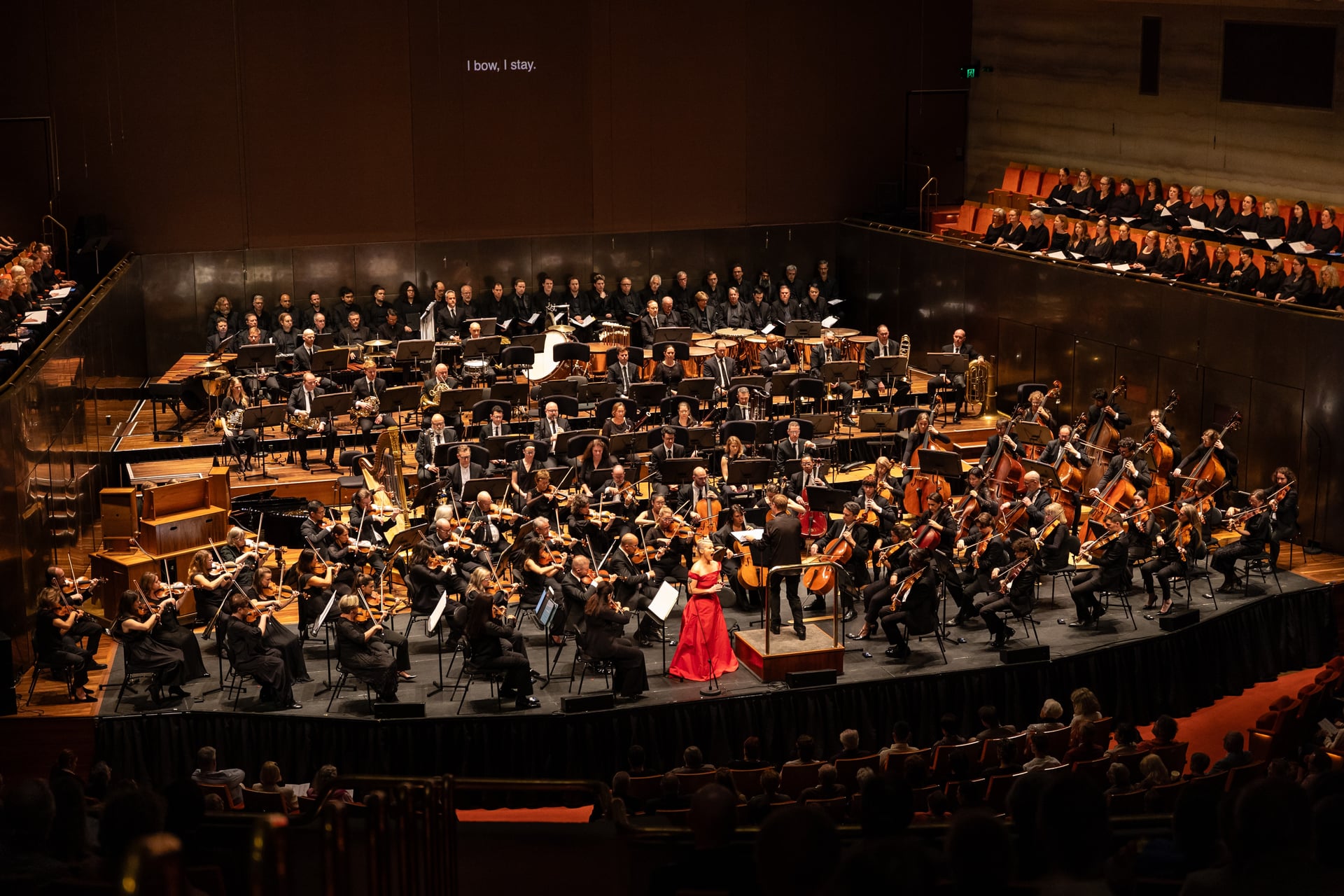
Under the direction of Benjamin Northey, the Melbourne Symphony Orchestra presented a program centred on the figure of the sacrificed woman, explored through two major works that interrogate power, ritual, and agency. In Joe Chindamo’s new work, Are There Any Questions? – A Requiem for the Vanishing Self, and Stravinsky’s The Rite of Spring, female sacrifice is not only represented but examined as a condition shaped by systems of belief, obedience and control. The evening positioned these ideas within a broader musical trajectory, beginning with the measured restraint of Ravel and moving toward increasingly direct and embodied forms of expression.
Ravel’s Pavane pour une infante défunte (Pavane for a Deceased Princess, 1899, orch. 1910) opened the program with clarity and control. Northey’s approach avoided excess, allowing the work’s long melodic lines to unfold over a steady pulse. The MSO maintained a transparent texture, with careful attention to balance across the ensemble. This was a reading that understood the work as one of poise rather than sentiment. A slight broadening in the central section introduced a momentary warmth in the strings, though it remained contained and did not disrupt the overall restraint. The performance functioned effectively as an opening gesture – measured, refined, and free from unnecessary weight.
The MSO’s 2026 composer-in-residence Joe Chindamo’s Are There Any Questions? – A Requiem for the Vanishing Self is a premiere work commissioned by the MSO and arts patron Michael Aquilina, and formed the conceptual core of the program. Conceived for orchestra, chorus, mezzo-soprano and organ, the work draws on the structure of the Requiem Mass while addressing contemporary concerns around the erosion of individual agency. Its textual framework draws explicitly on Margaret Atwood’s The Handmaid’s Tale, alongside broader dystopian references, presenting a society in which submission is normalised and internalised. The figure of the woman, central to this world, becomes both subject and symbol of that process. The work’s primary tension lies in the relationship between text and music. Chindamo sets language that articulates submission and ideological control against a musical language that is often polished, tonal, and immediately appealing. This creates a deliberate disjunction: the critique is explicit in the text, but the music does not always mirror its severity. At times, this appears intentional. The attractiveness of the sound world – its cinematic sweep, its devotional clarity – suggests how such systems might sustain themselves, not through overt coercion alone but through seduction.
This tension is established early in the opening movement, Voices in the Ash, where chant-like textures are set against darker orchestral undercurrents. The layering is effective, particularly in the low winds and strings, where instability is suggested without being overstated. As the movement expands, the choral writing moves toward a more consoling sonority, raising the question of whether the music affirms or undermines the text it carries. This ambiguity recurs throughout the work and is central to its impact. In Of Wrath Made Holy, Chindamo shifts toward a more overtly cinematic idiom. Martial rhythms and percussive drive introduce a sense of momentum, supported by orchestration that draws on the language of large-scale film scoring. The effect is immediate and engaging, though it also highlights one of the work’s underlying challenges. Where the text seeks to critique structures of power, the musical language can at times align too closely with the very aesthetics it might be expected to question. The result is a tension between intention and effect that remains unresolved.
Jessica Aszodi’s performance in O Gentle Eye provided one of the evening’s most focused moments. Her stillness and controlled vocal delivery established a clear dramatic presence without overt gesture. Positioned as a Handmaid figure, her performance conveyed a form of submission that was both convincing and unsettling. The restraint of her delivery allowed the implications of the text to register without exaggeration, and her placement within the broader texture of the work was handled with care.
The MSO Chorus, prepared by Warren Trevelyan-Jones, was a consistent strength. Their secure intonation and ability to sustain blend across a range of textures allowed the choral writing to function with clarity. The orchestral movement Canticle of the Bound introduces a more processional character, built around a repeating structure that suggests inevitability rather than development. Here, the music comes closer to articulating a sense of irony, with more forceful interjections disrupting the underlying continuity.
This material returns in the final movement, Divine Dystopia, where the full forces of the ensemble combine in a culminating statement. The closing sections are effective in scale, though they also reinforce the central ambiguity of the work: whether the music ultimately critiques or participates in the structures it presents. If there is a limitation, it lies in the degree of musical risk. The work’s conceptual framework is clear and its intentions well defined, but the sonic language often remains within a polished and familiar idiom. This does not diminish its ambition, but it does temper its capacity to unsettle. The result is a work that engages intellectually, even as its musical surface retains a degree of accessibility that complicates its critical stance.
Stravinsky’s Le Sacre du printemps (The Rite of Spring, 1913) brought the program to a close, returning the theme of sacrifice to its most direct and physical expression. The MSO delivered a performance of high technical standard. Ensemble was secure, balances were carefully managed, and solo contributions – particularly from bassoon, horn, and clarinet – were executed with confidence and clarity. The orchestra’s control of Stravinsky’s complex textures was evident throughout. Northey’s interpretation prioritised precision. Rhythmic structures were clearly articulated, and the orchestral layers were presented with definition. However, this emphasis on control came at the expense of volatility. Tempi remained measured, and while this supported clarity, it also reduced the sense of unpredictability that is central to the work’s impact. The performance did not lack energy, but it rarely felt at risk. As a result, the work unfolded with consistency rather than urgency. The cumulative effect was one of assurance rather than confrontation. In a score that depends on tension, disruption, and release, a greater degree of flexibility – particularly in tempo and dynamic contrast – might have allowed the music to assert itself more forcefully. What was presented was accurate and well-executed, but not always compelling.
Taken as a whole, the program offered a coherent exploration of female sacrifice across different musical contexts: Ravel’s distanced evocation, Chindamo’s interrogation of agency within ideological systems, and Stravinsky’s ritualised violence. While the performances did not always press beyond control into greater expressive risk, the conceptual framework was clear, and the MSO realised it with consistency and discipline.
Photo credit: Laura Manariti
______________________________________________
Stephen Marino reviewed” Stravinsky and Chindamo”, presented by the Melbourne Symphony Orchestra conducted by Benjamin Northey at Arts Centre Melbourne, Hamer Hall on March 19, 2026.