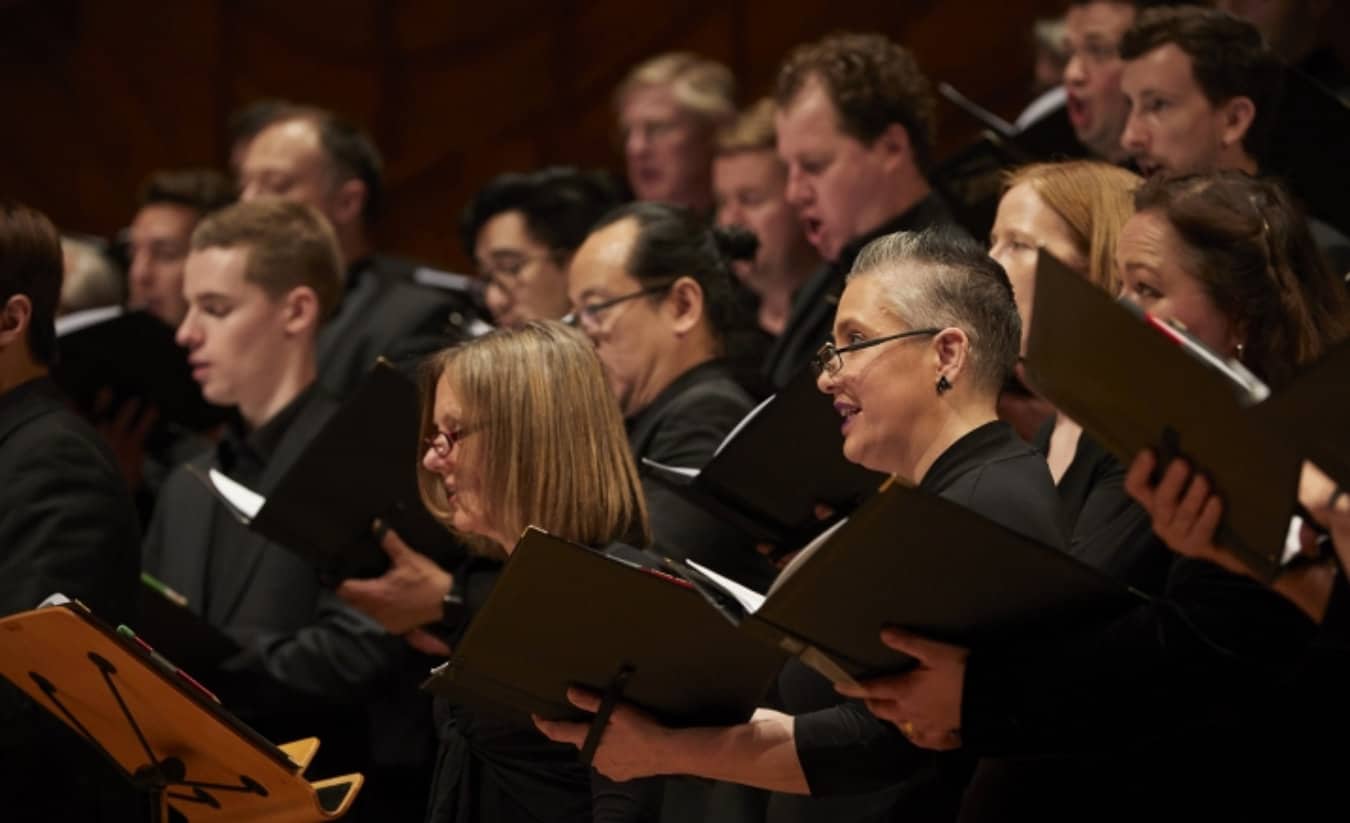
One of the most notable features of Rossini’s Petite messe solennelle from 1864 is how lacking in solemnity much of it is. With a running time of approximately 90 minutes it is not exactly “petite” either. What Rossini called his “unpretentious piece” is perhaps made even more deceptively unassuming in the setting chosen by the Melbourne Symphony Orchestra.
The original instrumentation for two pianos and harmonium remained Rossini’s preferred version, as opposed to his own orchestral version, which he claimed to have composed chiefly in order to deter others from doing so. There is no doubt that a mere three instruments – even fewer in various sections – allow for greater clarity of the vocal lines, and conductor Warren Trevelyan-Jones made every effort to observe details of dynamics and cohesion.
The Kyrie opens with a quiet A minor running bass part in the piano followed by a hushed choir entry and a series of crescendos and diminuendos – expertly negotiated by the choir – that soon changes to a sunny major key. Even in a minor key Rossini’s gift for a good tune lifts the spirits. The first of the a capella sections came with a very well blended “Christe Eleison” in the style of Palestrina. Good intonation continued in the unaccompanied choral outburst of the Gloria that followed the grand piano flourish.
Many of the sections for the four soloists begin with the bass and Jeremy Kleeman’s strong voice and confident musicality led the way, introducing fine work by all soloists throughout. Beginning the succession of what are essentially operatic arias, Nicholas Jones used his attractive tenor voice for a vibrant “Domine Deus”. Soprano Kathryn Radcliffe and mezzo-soprano Deborah Humble were splendid in the “Qui tollis”. Radcliffe’s voice has great beauty in softer sections and floated with resonant ease over the top of Humble’s richly textured voice. Much of the writing for the mezzo-soprano is set low, putting this line in danger of being overwhelmed by other voices. Humble’s substantial, unforced, flowing tone projected with satisfying power in all ensembles, and doubtless would have done so even in the orchestral version. Kleeman sang the rather jaunty “Quoniam” firmly and with even tone throughout an extensive range – the vitality of his singing always a pleasure to hear.
The MSO Chorus managed to successfully capture the dancing lightness of the “Cum Sancto Spiritu” extended fugue, concluding the Gloria on a happy note with cleanly delineated agile Amens. The Chorus was in wonderfully emphatic form for the beginning of the Credo, soon interleaving quieter moments with the soloists, with restatements of “Credo” and exclamations from the piano. After the “Crucifixus”, sung with sincerity and generally gorgeous tone by Radcliffe, Chorus and soloists continued until a buoyant “Et vitam venturi” concluded the section.
The instrumental Prélude réligieux, began with a short piano solo, continued with a more extended harmonium solo, played with considered musicality and a range of interesting registrations by Donald Nicolson, and finally led into the choral beginning of the Sanctus. Rossini has made some unusual ensemble combinations with the soloists, the repetitions “Hosanna in excelsis” with unaccompanied unison pairings of mezzo/bass and soprano/tenor being examples. The ability of the Chorus and soloists to maintain pitch in such a long unaccompanied section was extremely impressive. The ensuing tuneful soprano solo with piano “O salutaris hostia” was followed by the highlight of the evening: an outstanding performance of the extended concluding section of the work, the Agnus Dei.
In more solemn mood, we heard an extraordinarily moving combination of a mezzo-soprano soloist, an interweaving chorus, and the warm underlay of the harmonium against a repeated throbbing figure from the pianos, played by Jacob Abela and Tom Griffiths. The depth and beauty of Deborah Humble’s voice and her musical passion seemed ideally suited to this arrestingly dramatic section.
It is a pity we don’t hear Rossini’s not-so-little masterpiece more often. At least enthusiastic applause at the end of the performance suggested that this outing was greatly appreciated.
Photo supplied.
________________________________________________________________________________
Heather Leviston reviewed Rossini’s “Petite messe solennelle”, performed by the Melbourne Symphony Orchestra Chorus at the Melbourne Recital Centre, Elisabeth Murdoch Hall on May 28, 2022.