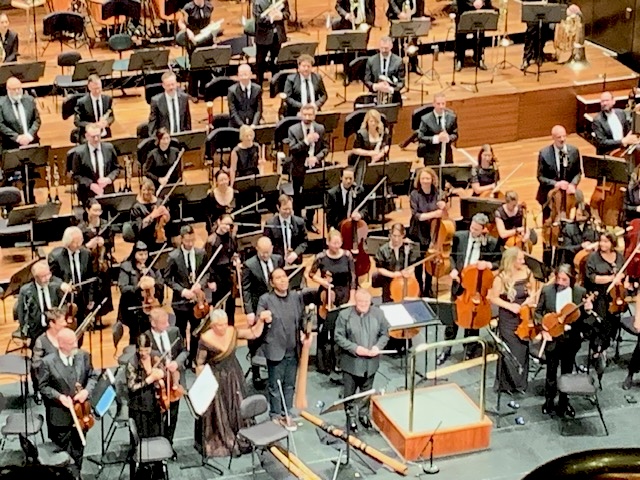
The title of the Melbourne Symphony Orchestra’s concert might have been “New Worlds”, but it seemed a misnomer in some ways given the implied Eurocentrism. Obviously, this choice stemmed from Dvořák’s Symphony No. 9, From the New World being the featured item and entailing connections with the other items on the program, particularly Concert Overture No. 2 by Black American composer, Florence Price. But the importance of Deborah Cheetham Fraillon’s role in this concert raises the question of whether Australia can be seen through a “New World” lens given the fact that our Indigenous culture is recognised as being the world’s oldest continuous culture.
Pre-concert talks in the Stalls foyer have become a popular part of MSO concerts, and there was a very large gathering for this one. Noongar man, viola player and conductor, Aaron Wyatt, has had a special relationship with both the MSO and Yorta Yorta/Yuin woman, soprano, composer, artistic director and trail blazer, Deborah Cheetham Fraillon; he was the first Australian First Nations person to conduct a major Australian orchestra, conducting the MSO’s performance of Long Time Living Here. Although Maestro Jaime Martìn had the privilege of conducting the last performance for some time of this work in the arrangement for orchestra and soprano on this occasion, Wyatt was the perfect person to interview Cheetham Fraillon for the talk. A gift for any interviewer, she held the crowd spellbound – I cannot recall such a quiet audience – as she spoke about her music and the struggle for proper recognition of First Nations people.
Nobody who was present at the MSO performance of Eumeralla, a war requiem for peace (2018) on October 14, 2023 will ever forget that night, which just happened to coincide with the Australian Indigenous Voice referendum. Despite the devastating news of the No vote, hope has lived on, with Cheetham Fraillon’s new work, Treaty, being performed just as the Treaty for Victoria had been given the parliamentary stamp of approval – something all Victorians should be proud of, even if implementation will have its challenges.
Given the interesting and splendidly articulate nature of the interview, it is a shame that it could not be broadcast along with the concert on the following Saturday afternoon. Cut shorter than we would have wished, the soprano had to rush off to be helped into another gorgeous Linda Britten creation of deep red with a black lace overlay. Marking the end of her five years as the MSO’s First Nations Creative Chair, Cheetham Fraillon’s performance of the musical Acknowledgement of Country, Long Time Living Here, was a song of hope and affirmation as it swelled to a vibrant climax of soaring voice and orchestra.
Another musical trailblazer of an earlier time and place, virtuoso pianist/organist, teacher and composer Florence Price (1888-1953), is noted as being the first African American woman to have a work performed by a major United States orchestra; the Chicago Symphony Orchestra premiered her First Symphony in 1933, albeit with some financial encouragement by Price’s supporters. Her Concert Overture No. 2 integrates folk tunes into the classical idioms of her own musical education and practice. In the opening half of this 15-minute work, we heard three spirituals in quick succession: “Go Down, Moses”, “Nobody Knows the Trouble I’ve Seen” and “E’vry Time I Feel the Spirit”. The second half works through fragments of these with an emphasis on the more serious strains of the Israelites’ quest for liberation from the Egyptian yolk. It begins quietly with a plaintive oboe, the winds, horns, trumpets and full orchestra in turn taking up the plea for liberation. Full of colour and musical interest, the Overture features solo instruments – the trombone slide a pleasant surprise in “Moses” – and presents a series of varied combinations. Each spiritual assumes a different character – the brass really feeling the spirit in the upbeat second one, and the trombones weightily mournful in portraying “the trouble I’ve seen”. It is an engaging work and was played expertly and dynamically.
Treaty is the second part of Cheetham Fraillon’s concerto for yidaki (didgeridoo), following on from Baparripna – Dawn, premiered by William Barton and the MSO in 2022. Commissioned by the MSO – one of seven commissions – Treaty was premiered in Edinburgh and reprised at Hamburg’s Elbphiharmonie during the MSO’s acclaimed recent tour. It was an excellent way to bring important elements of Australian culture to the international stage. Like Price, Cheetham Fraillon uses a framework of melodic layered classical music, incorporating the musical language of a People whose voice has been stifled by colonial oppression. Her detailed program notes describe the programmatic nature of a movement that “captures the journey from final moments of self-determination and sovereignty to the present day”.
Clap sticks and the yidaki are the primary expressions of First Nations experience, Barton’s four yidaki offering a wealth of possibilities in the hands of this virtuoso. The driving pulsing of the yidaki and Barton’s breathing, sighing, clicking and singing conjured up (mainly) alarm signals and sounds of nature: a kookaburra … wind through the sheoaks. There is the ambiguous presence of French horns, heralding both the arrival of colonisation and “the leadership of The People as they stare down the threat of invasion”. What is totally unambiguous is the “cannon fire” of the bass drum – the language of “destruction and decimation”. Various instruments interweave to portray a story of mourning, terror and courage in the face of computer-clicking (snare rim-shots) bureaucracy. Treaty ends on a hopeful, if questioning, note in its demands for Treaty. A most enthusiastic response from the audience and a genuine show of affection between composer and conductor followed.
After a short delay, Barton returned to the stage for a welcome encore, enthralling us again with his yidaki playing and a fine voice that has a timeless resonance speaking of something beyond ourselves. Whereas the yidaki was amplified for Treaty, his voice was not.
Dvořák’s “New World” Symphony is probably his most popular work, and for good reason. Memorable melodies for a start; someone was singing the “Going home” tune (played with distinction by Principal Cor Anglais, Michael Pisani) as we were walking along the street, going home after the concert. The first thing that struck me right at the beginning of the symphony, with its slow, quiet Adagio introduction, was the precision – every player acting as part of a single entity. Then I remembered that an important current MSO project is the recording of Dvořák’s complete symphonies. These performances are for posterity. The performance on Thursday night was exceptional from all players, with Martìn allowing them to give of their best. The gentle song and moments of drama in the first two movements were followed by the joyous dancing rhythms of the third movement Vivace, while the fourth movement Allegro con fuoco, which reprised some of the previous material, concluded the symphony on a more wistful note. If the sound engineers are able to eliminate an unfortunate loud cough at a crucially quiet moment, this performance warranted preserving.
Saturday afternoon’s performance can be heard live from Hamer Hall on ABC Classic FM at 2pm, but if you can be there in person it would be well worth making the trip. This was an exceptionally satisfying concert.
_____________________________________________________________________
Heather Leviston reviewed “New Worlds: Jaime conducts Cheetham Fraillon and Dvořák”, presented by the Melbourne Symphony Orchestra at Arts Centre Melbourne, Hamer Hall, on November 27, 2025