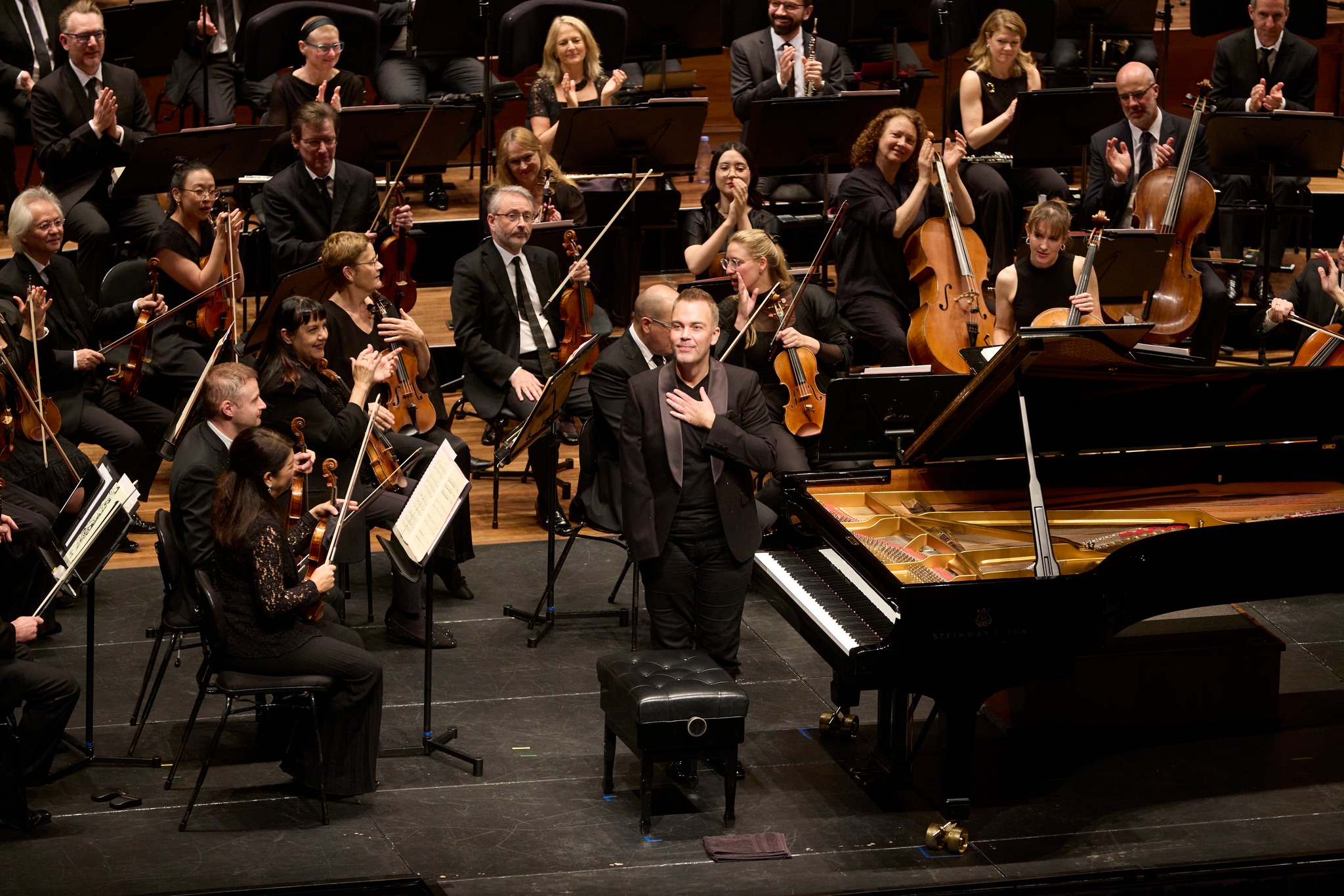
“Impressions of Paris” is a curious title for the Melbourne Symphony Orchestra concert at Hamer Hall on Thursday 23 October. Three works featured on the program: Newport Lakes by James Henry; Piano Concerto for the Left Hand’ by Maurice Ravel; and Symphony in D minor by César Franck. The conductor on the night was Venezuelan-born Rodolfo Barráez.
The concert was outstanding, but, apart from two of the works being by French composers, there were no particular “impressions” of Paris. Sometimes concert programmers must scratch their heads for a theme.
To begin with, the MSO premiered a work by their First Nations Composer in Residence, Yuwaalaraay/Yorta Yorta man James Henry. The program notes said Henry wanted Newport Lakes to: “offer an impressionistic perspective of place that holds deep meaning for me, my family and our wider neighbourhood”.
This is puzzling as the musical language throughout seems derived from very traditional, Romantic tropes. Henry wanted to give an impression of walking lakeside trails and did this by running a continual triplet motif, like an ornament, that rippled throughout. Over the 10 minutes of the work it would have been welcome if that idea was developed, rather than repeated. As an impressionistic work Newport Lakes sounds like Smetana’s Ma Vlast reworked through a John Williams’ filmic lens. Overall, it was a beguiling journey, just not much of an impression of Paris or Newport.
The jewel in the program undoubtedly was the Piano Concerto for the Left Hand by Maurice Ravel. Written over the same years (1929–1931) as his Concerto in G,
Ravel responded to a commission by Paul Wittgenstein, a pianist who lost his right arm in World War I. The Piano Concerto for the Left Hand is a somewhat broody and challenging work for the pianist, a challenge Nicholas McCarthy more than rose to. McCarthy came onstage wearing a dinner jacket infused with discreet stars, little pinpoints that gleamed, but did not distract from the blazing performance he gave. He also had diamantes on the heels of his shoes, and we were able to see how judicious his use of the sustain pedal was.
The concerto begins with notes in the lowest possible register of low strings and contrabassoon, leading to an explosive cadenza right away for the piano. Apparently, Ravel refused to compromise on the technical difficulties of the work, resulting in a 20-minutes pianistic tour de force. McCarthy had to execute scale and arpeggio passages of extraordinary rapidity and to play smashing chords that sounded like they needed at least two hands to deliver. There was a sense of cool fury in the stormier passages, alleviated by the confident sweep of McCarthy’s one hand across the keyboard.
The density of the work was lifted at times by moments of high-register passages for orchestra and piano that could have come from Ravel’s L’enfant et les sortilèges – music that is often characterised as typically French of the period: witty and whimsical. But the complexity returned and, with another diabolic cadenza, the whole thing came to an abrupt end.
For the final work on the program, César Franck’s Symphony in D minor, conductor Rodolfo Barráez kept the tempi fresh throughout, which was a welcome change from some of the more solemn (ponderous) readings on record, especially of the last movement.
With a quickened pulse, the symphony feels like a massive yearning for love, the themes weaving in and out of minor and major tonalities. When the themes do reach up to a major resolution, it feels like a little climax each time. Make of that what you will. No one could claim that the Symphony in D minor is a paean to love, but the MSO under Rodolfo Barráez presented a youthful work, as fresh as spring and, perhaps, with a nod to the Paris of lovers.
Photo credit: Laura Manariti
_____________________________________________________
Nick Tolhurst reviewed, “Impressions of Paris”, presented by the Melbourne Symphony Orchestra at Arts Centre Melbourne, Hamer Hall, on October 23, 2025.