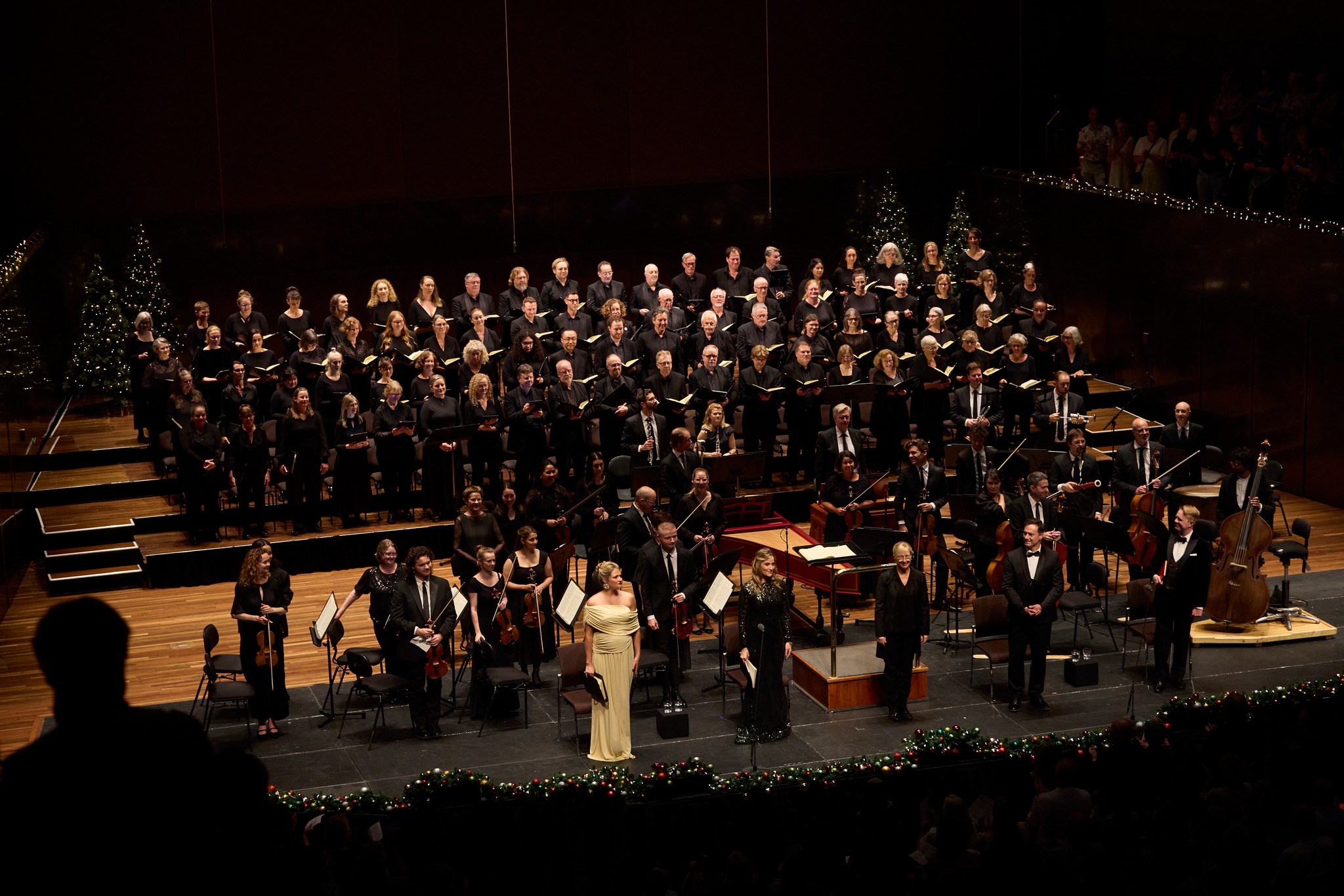
A near-capacity Hamer Hall audience gathered for the Melbourne Symphony Orchestra’s 2025 performance of Handel’s Messiah, an annual ritual that continues to invite both devotion and reassessment. Under the direction of Swedish-born conductor Sofi Jeannin, this reading pursued line and sustained lyricism over rhetorical sparkle. It was a Messiah shaped by inward reflection – sombre, carefully weighted, and often beautiful, though rarely theatrical in the overtly Baroque sense.
Jeannin’s interpretive priorities were evident from the opening Sinfony. The overture unfolded with poise and restraint, its phrases shaped in long arcs, beginnings and endings tinged with a wistful gravity. The French overture style was softened rather than articulated, establishing a contemplative tone that coloured the evening as a whole. Throughout the performance, Jeannin favoured continuity of line and blended textures, at times allowing momentum and contrast to yield to an overarching sense of stillness.
Tenor Andrew Goodwin, Australian-born and long admired for his lyrical refinement, brought immediate warmth to “Comfort ye”. His sweet, even tone and effortless messa di voce established a consoling presence, sustained through a gentle “Ev’ry valley”. The aria unfolded with poise rather than exuberance, aligning closely with the conductor’s preference for balance over buoyancy.
The MSO Chorus, prepared with evident care by Warren Trevelyan-Jones, sang with polish and cohesion in “And the glory of the Lord”, its madrigalian lilt finely judged. “And he shall purify” revealed the soprano line as a leading force throughout the evening, the upper voices projecting confidently while lower parts contributed clarity rather than weight. The choral sound favoured refinement and blend, producing an overall impression of control and restraint.
Kiwi/Australian baritone Morgan Pearse emerged as one of the performance’s strongest dramatic anchors. Singing off book throughout the entire work – a notable achievement – he brought authority and conviction to “Thus saith the Lord”. His sequence of “For behold, darkness shall cover the earth” and “The people that walked in darkness” was shaped with acute sensitivity to text, dynamic shading and word-painting, the descent into shadow rendered with hushed intensity before emerging into light.
Mezzo-soprano Ashlyn Tymms, an Australian artist of growing presence, favoured directness and grounded tone in the recitative “Behold, a virgin shall conceive” and following air “O thou that tellest”. Her singing conveyed steadiness and sincerity, contributing to the pastoral calm of Part I rather than its celebratory aspects.
The nativity chorus “For unto us a son is born” was phrased with elegance and care, the chorus producing a luminous, blended sound. Jeannin’s emphasis on linear flow was particularly evident here, shaping the movement as a continuous span rather than a series of rhetorical gestures. “His yoke is easy” brought lighter articulation and buoyancy, offering one of the clearer glimpses of joy in the opening part of the work.
The Pifa emerged as a moment of repose and warmth, its rustic tempo and glowing string tone lovingly shaped. Jeannin’s gestures visibly encouraged lilt and continuity, allowing the pastoral scene to unfold with unforced grace.
Australian soprano Samantha Clarke brought a gentle, almost maternal quality to the evening in her singing “There were shepherds abiding in the fields”, and her “Rejoice greatly” contrasted controlled and steady coloratura with emphatic supplication.
The sombre atmosphere deepened in Part II, where the absence of double dotting reinforced a sense of lament. The sequence of choruses – “Behold the Lamb of God”,” Surely he hath borne our griefs”, “And with his stripes” and “All we like sheep” – benefited from this restraint, particularly in the expressive suspensions that coloured the close of “All we like sheep”. Here, line and ensemble blend communicated tragedy with quiet eloquence. “Lift up your heads” was a chorus that stood out for its rhetorical clarity, crescendi effectively illuminating the textual dialogue. “The Lord gave the word” revealed some imbalance in the men’s voices, though the overall choral discipline remained intact. The celebrated “Hallelujah” chorus was delivered with confidence and splendour, buoyed by fine brass playing and received with enthusiasm by the audience.
Ashlyn Tymms offered her most compelling contribution in “He was despised”, shaping the aria with depth, sincerity and expressive focus. Her da capo embellishments were sensitively judged, and the final repetitions carried a tender inwardness that held the hall in stillness. Goodwin’s elegiac recitatives – “All they that see him laugh him to scorn” and “Thy rebuke hath broken his heart” – reaffirmed his gift for lyricism, his tone remaining supple and cantabile even in moments of anguish. Clarke’s “How beautiful are the feet” was a highlight: poised, caring, and deeply communicative, tone and text aligned with natural ease. Pearse’s “Why do the nations” injected fierce energy, the aria shaped with urgency and dramatic bite.
The opening air to Part III, “I know that my Redeemer liveth” unfolded with luminous calm. The unison upper strings shimmered beneath Clarke’s seamless phrasing – transcending the text while remaining grounded in serenity. Pearse’s “The trumpet shall sound” recovered from a brief early stumble to deliver some of the evening’s most committed singing, his dotted embellishments in the da capo restoring a flash of Baroque bravura. The closing “Worthy is the Lamb” and “Amen” were carefully shaped, dynamic repetition guiding the music from contemplation toward jubilation.
This Messiah did not seek to dazzle through theatricality or rhetorical fire. Instead, Jeannin offered a reading of inward reflection, prioritising line, balance and emotional restraint. While this approach occasionally softened the work’s inherent exuberance, it yielded moments of genuine beauty and sustained seriousness – a Messiah that invited listeners not to marvel, but to listen inwardly and contemplatively.
Photo credit: Laura Manariti
__________________________________________________
Stephen Marino reviewed “Handel’s Messiah”, presented by the Melbourne Symphony Orchestra conducted by Sofi Jeannin at Arts Centre Melbourne, Hamer Hall on Sunday, December 14, 2025.