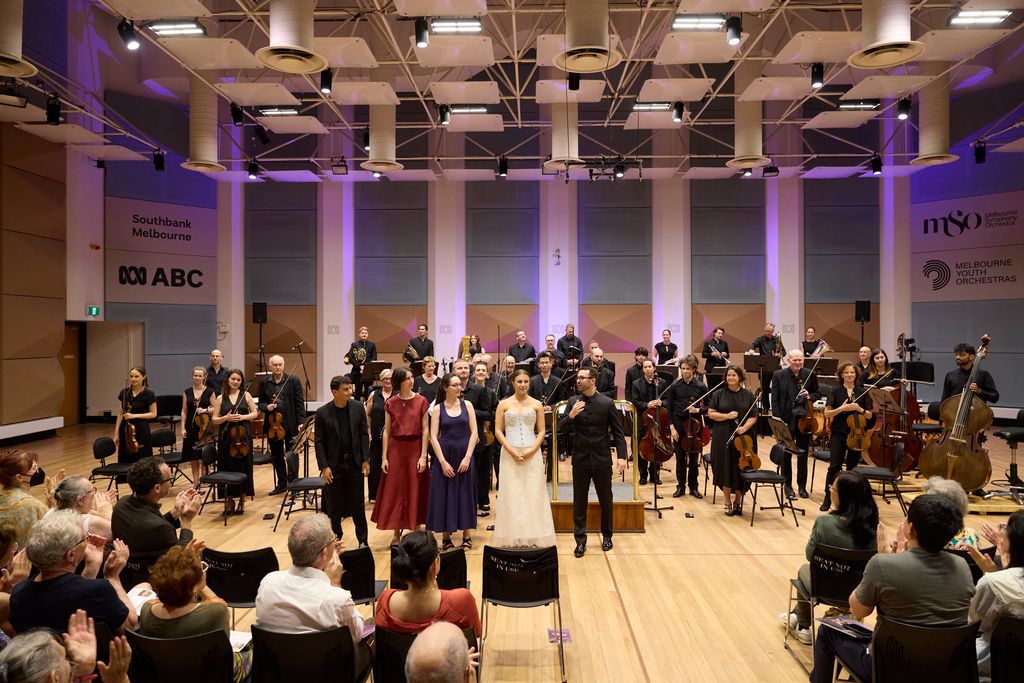
Always fresh and exciting, always enthusiastically attended by an audience of friends and passionate supporters of new Australian compositions, this event is a terrific and colourful way to introduce young composers and their music to the public. It was presented tonight after months of specialist tutorials and orchestral mentoring with the Melbourne Symphony Orchestra.
The CYBEC Foundation has supported the careers of more than ninety young composers over 23 years, with one composer selected each year to be Young Composer in Residence with the MSO as part of its Educational and Development programs.
With a passionate involvement with the MSO in varied career roles as a musician, conductor, presenter and developer of educational programs and concerts for youth, Nicholas Bochner tonight hosted this special annual event, introducing each young composer and reminding the audience that these were all premiere performances – a celebratory occasion for everyone involved.
While the program notes provided are a most welcome description of the music, where significant instrumental signposts are described by the composer, it is always more connecting for the audience to hear “from the horse’s mouth”, the unique inspirations that have brought each orchestral score from personal dream to real performance.
In her introduction to Stellify, Madeleine Hammond referred to the poet Chaucer, for his word describing a transformation of a person or things into a celestial, starry place, with a slightly programmatic idea of the Hero in Greek mythology rising, falling, rising. In a dramatic opening, powerful bass drum and golden percussive brass rhythms gave a sense of cinematic colour and ceremony, with short motifs repeated often and in a colourful orchestral frame. In a calming development section, the work developed lyrical and stylish phrases for elegant strings, repeated in woodwind instruments, with the orchestra producing smoothly increasing crescendos and scenic warm colours. A fine harmonic change brought a rising sense of closure with a somewhat Hollywood-flavoured close, with Hammond’s music showing careful portrayals of the colourful personality of solo instruments in a mature and pleasing orchestration.
Quite a contrast was Georgina Bowden’s Catalyst. She spoke of her fascination with the overtones produced by the bass drum, which produced new pitches and timbres with symbiotic instruments. We were mesmerised right from the initial vibrant bass drumbeats and dynamic rhythmic percussion, whose bare notes sent echoing, floating auras through the performing space. Although Bowden called her work at times experimental, this was a splendid new design, fascinating us with a thoughtful and multi-dimensional “experience” for the listener. Sustained notes were bent as definite pitches shifted with changing dynamics as illusory overtones were spread and combining around the orchestra. Growled notes on lower brass, an unexpected sustained silvery note from the piccolo, and a supersonic upper string effect first on solo violin, then two, then three, then four violins joining seamlessly, then shifting pitch and moving across the string sections, adding visual and aural intrigue. A highly memorable composition.
When Lucy Blomfield introduced her work to the audience, she answered the question of how a new composition begins, describing her “brainstorming of ideas”, assembling them, then commencing with a single note, building tones to a four-note cluster that would draw the listener in. The Door in The Wall, inspired by HG Wells’ story of the same name, unfolded, as the structure of the chord expanded, I felt, like an artist’s tall sculpture, growing and intensifying with fuller brass and percussion building the orchestral chord, tonal blend and solid texture – perhaps a response to the image of the door that stands in front of us. Timpani crescendos added to this wall of sound, and a brief section of frenetic activity brought lively firecrackers and sparks in scattered staccato colours – brief, spontaneous, then gone, as the work resolved with more peaceful sustained sounds from lower brass. Did the work’s varying sections answer the question: Was the door really there?
Alexander Maltas also explored the idea of doors, with his work Towards The Door We Never Opened, inspired by T.S. Eliot’s first poem Burnt Norton from his celebrated Four Quartets, where the opening lines of “Time present and time past, are both present in time future…” influenced Maltas’ reflective and creative path. Alternative fingering on woodwind instruments, brought us multiphonics, fascinating sounds from solo instruments, particularly the oboe, with an opening cluster/chord being sustained through time, then becoming busy and worrying as instruments were added with short solo fragments of discordant activity and irregular shapes. Single note interjections, brass flutter tonguing and clusters of repeated notes with unexpected interruptions held our fixed attention in a piece that was colourful, edgy at times, and full of new tonal effects as sounds seemed to be imploding, fractured seconds of time present, time past.
How inspiring and joyful is Cybec’s project showcasing Australia’s young composers; in the hands of the MSO and the finely communicated leadership of conductor and host Nathaniel Griffiths, this annual concert opened the MSO program for the year with a fine celebration of four young Australian contemporary composers.
Photo credit: Laura Manariti
________________________________________________
Julie McErlain reviewed Cybec 21st Century Australian Composers’ Showcase, presented by the Melbourne Symphony Orchestra at the Iwaki Auditorium on January 24, 2025.