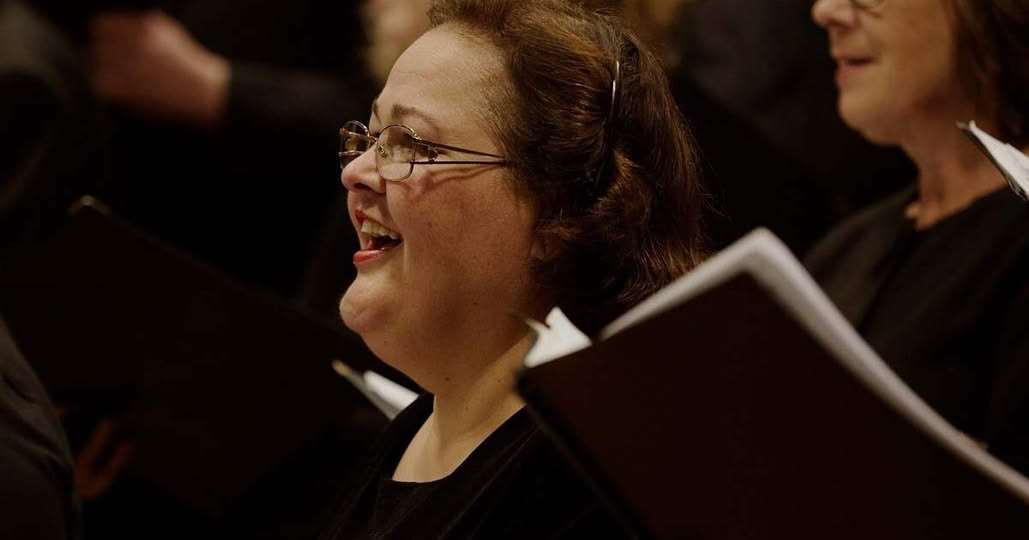
The Melbourne Symphony Orchestra Chorus marked its 60th anniversary with Journeys – an aptly titled program that invited listeners to travel through sacred soundscapes spanning centuries. Under the assured direction of chorus master Warren Trevelyan-Jones, the concert unfolded as both a celebration of history and a meditation on musical evolution – from the spiritual intensity of Tomás Luis de Victoria to the luminous modernity of Gabriel Jackson, and including a lament from Australian composer Joseph Twist. Held in the Iwaki Auditorium, the event brought the MSO Chorus to the foreground as a feature ensemble. The space, while acoustically dry for Renaissance polyphony, encouraged an intimacy that revealed the ensemble’s collective precision and expressive unity.
The program’s backbone was Victoria’s Missa pro Victoria, a work that embodies the composer’s deeply personal take on the Roman liturgy. Where Palestrina’s sacred music embodies serene balance and restraint, Victoria infuses passion, chromatic colour, and harmonic boldness. His short, fervent phrases and shifting textures express an interior spirituality – a mystical devotion that feels almost proto-Baroque in its intensity. The MSO Chorus navigated this terrain with skill and sensitivity. From the Kyrie’s poised entries to the confident interplay of antiphonal groups, the ensemble demonstrated admirable intonation and blend. Occasional imbalances between the two “choirs” in the double-chorus sections hinted at the challenges of performing Renaissance music with large forces, yet these moments were outweighed by the expressive conviction of the performance.
The Gloria was particularly compelling – dynamic, shaped, and alive – more emotionally vibrant than the historically restrained approach often associated with this repertoire. The Credo moved seamlessly through its shifting meters, while the Sanctus and Benedictus revealed the tenors at their most agile, their entries clean and buoyant. The Agnus Dei closed with overlapping lines that blended with luminous smoothness, supported by the sensitive continuo playing of Timothy Mallis, whose chamber organ interludes sustained a reverent atmosphere throughout. Despite a touch of fatigue in the soprano line near the end of the Mass – an inevitable result of Victoria’s tessitura demands – the choral sound remained full and confident.
The inclusion of Joseph Twist’s Versa est in luctum provided an elegant modern counterpart to Victoria’s mysticism. Drawing on texts from the Book of Job, Twist creates a sound world of shimmering clusters and poignant contrasts. His use of the Lydian mode evokes consolation and transcendence, offset by darker, minor inflections that mirror lamentation. The MSO Chorus captured this duality beautifully, with a radiant soprano solo delivering lines of aching clarity. Soprano soloist Michele de Courcy’s pure tone singing provided a suitably ethereal conclusion to this haunting work.
Victoria’s own motet O Quam Gloriosum followed, glowing with confidence and rhythmic vitality. The chorus’s bolder phrasing here felt apt – an interpretation that aligned with Victoria’s expressive temperament rather than the cool detachment of some historically informed readings.
The evening culminated in a sweeping reading of Gabriel Jackson’s To the Field of Stars, a work of celestial imagination. Commissioned by the MSO Chorus in partnership with European ensembles to mark the 400th anniversary of Victoria’s death, Jackson’s seven-movement cantata honours the pilgrimage route to Santiago de Compostela – a journey of faith, endurance, and wonder. Blending elements of Renaissance polyphony, minimalism and world-music sonorities, the piece evokes both ancient ritual and modern transcendence. The choir rose to its technical and emotional challenges with conviction. Ariel Volovelsky’s cello solos glowed with fluid phrasing and poised restraint, creating an elegiac thread between movements. The choir’s refrains shimmered with modal warmth, underpinned by handbells and tubular bells that lent a halo of sound. Tenor James Dipnall gave a confident recitation of the history lesson in movement II (Pilgrim’s Song).
Movement VI, Campus Stellae (Field of Stars), was a particular highlight – the chorus intones overlapping the names of stars in free time, forming a cosmic tapestry of sound reminiscent of Ligeti’s Lux Aeterna. Here, contributions by sopranos Michele de Courcy, Natasha Lambie and Ariane Vrisakis contributed to the diverse array of instrumental and vocal combinations, textures and embellishments. Soprano Natasha Lambie’s solo performance was noteworthy. Her soaring tone lifted the movement to a radiant, transcendent climax. Jackson’s work, with its religious and humanitarian undertones, felt like a fitting modern reflection of Victoria’s spiritual vision – music that transforms personal faith into collective experience.
The MSO Chorus demonstrated not only its longevity and versatility but also the artistic vision that continues to shape its legacy. While the acoustics of the Iwaki Auditorium offered less resonance than ideal for polyphony, the ensemble’s commitment to clarity, expression, and dynamic nuance carried the evening. Journeys was more than a retrospective; it was a statement of identity. In celebrating its 60th anniversary, the MSO Chorus continues to unite past and present in performances of integrity, insight, and beauty.
Photo supplied.
_____________________________________________
Stephen Marino reviewed “Journeys”, presented by the Melbourne Symphony Orchestra Chorus and Soloists at Iwaki Auditorium on Saturday, October 11, 2025 at 7:30pm.