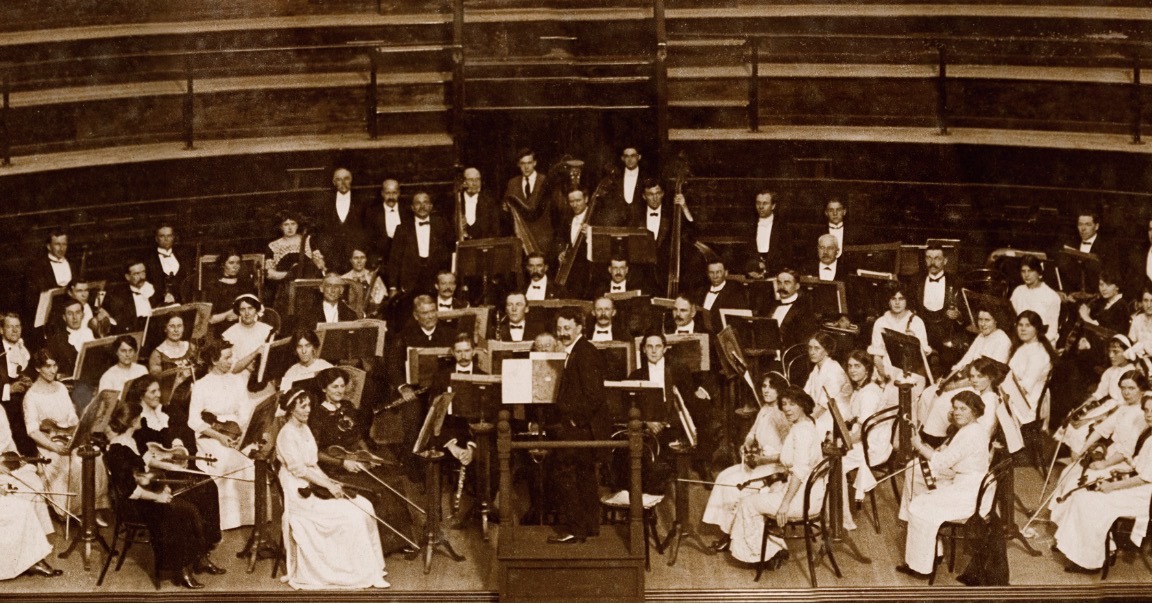
Thursday night’s concert, part of the Melbourne Symphony Orchestra’s (MSO) celebration of its 120th anniversary of the founding of its predecessor organisation in 1906, exemplifies a history showing the depth of talent and dedication to orchestral music in Melbourne. Examples from the past include theatrical orchestras, the Melbourne International Centennial Exhibition in 1888 and the Marshall-Hall Orchestra (1892–1912). Today, Melbourne has a wealth of orchestral music to complement the MSO, including Orchestra Victoria, schools, tertiary institutions, community groups, private teachers and students, supported by business, philanthropic and community sponsorship.
Changes over time have included designs of musical instruments and auditoriums, as well as the inclusion of women as performers and demarcation between professional and amateur status. The Zelman Memorial Symphony Orchestra (ZMSO), which began in 1933 to represent amateur players after the MSO became a professional orchestra, was named after former conductor Alberto Zelman Junior (1874–1927). Thursday’s commemorative performance in the welcoming acoustics of Robert Blackwood Hall was the first time the two orchestras have performed together since their split in the 1930s.
The opening half of Thursday’s program featured the MSO, beginning with the Acknowledgement of Country, composed by MSO Cybec First Nations Composer in Residence James Henry. The three main pieces before interval were popular crowd-pleasers derived from nineteenth-century operas.
The Overture to Ruslan and Ludmilla by the Russian composer Mikhail Glinka (1833–97) was first performed in Saint Petersburg in 1842. Thursday’s performance was conducted enthusiastically by MSO Cybec Assistant Conductor Daniel Corvaia. He was introduced by the conductor in charge of the concert, MSO Principal Guest Conductor Benjamin Northey, who conducted the rest of the program. In the Overture with its fast tempo and driving rhythms, Glinka used a standard nineteenth-century instrumentation of woodwind, horns, trumpets, trombones, timpani and strings. Varied tone colour in the Russian-inspired composition provided opportunities for different sections of the orchestra to be highlighted.
The Méditation from Thaïs by French composer Jules Massenet (1842–1912), an orchestral intermezzo first performed in Paris in 1894, was a contrast to Glinka’s work. Northey conducted the piece with empathy and care, while the violin soloist, MSO Concertmaster Natalie Chee, played with intense expressiveness. The version performed on Thursday featured a harp but dispensed with the wordless chorus that was scored in Massenet’s original composition.
A rousing rendition of Suite No.1 from Carmen (1875) by French composer Georges Bizet (1838–75) showed the versatility of the MSO. Five of the six orchestral selections in the Suite are thought to have been compiled around 1885 by Ernest Guiraud from Bizet’s opera, with the fourth excerpt “Séguedille” added in around 1905. The Suite includes some of Bizet’s most memorable melodies, ending with “Les Toréadors”. The Spanish flavour of the composition is enhanced by a liberal use of percussion instruments.
After interval, players drawn from both the MSO and ZMSO under the impressive baton of Benjamin Northey combined well to perform Symphony No.7 in A major, Op. 92 (1812) by Ludwig van Beethoven (1770–1827). The symphony was first performed in Vienna in 1813 in a charity concert with noted guest performers including Salieri and Spohr. Beethoven’s classical orchestral instrumentation had similarities to that used by Glinka, but its deployment over the four movements of the symphony showed many subtle differences. An enjoyable performance with contrasts of tempo, key and mood kept the audience’s attention throughout this well-known work.
Both MSO and ZMSO, together with many other performers around the world, are performing works by Beethoven in preparation for celebrations next year of the 200th anniversary of his death. 2027 will also be the 100th anniversary of the death of Melbourne’s Alberto Zelman Junior. Hopefully, the MSO and ZMSO will continue to provide Melbourne audiences with inspirational performances for many years to come.
Photo supplied
________________________________________________________
Rosemary Richards reviewed “Beethoven’s Seventh”, presented the Melbourne Symphony Orchestra and Zelman Memorial Symphony Orchestra at Robert Blackwood Hall, Monash University, on April 2, 2026.