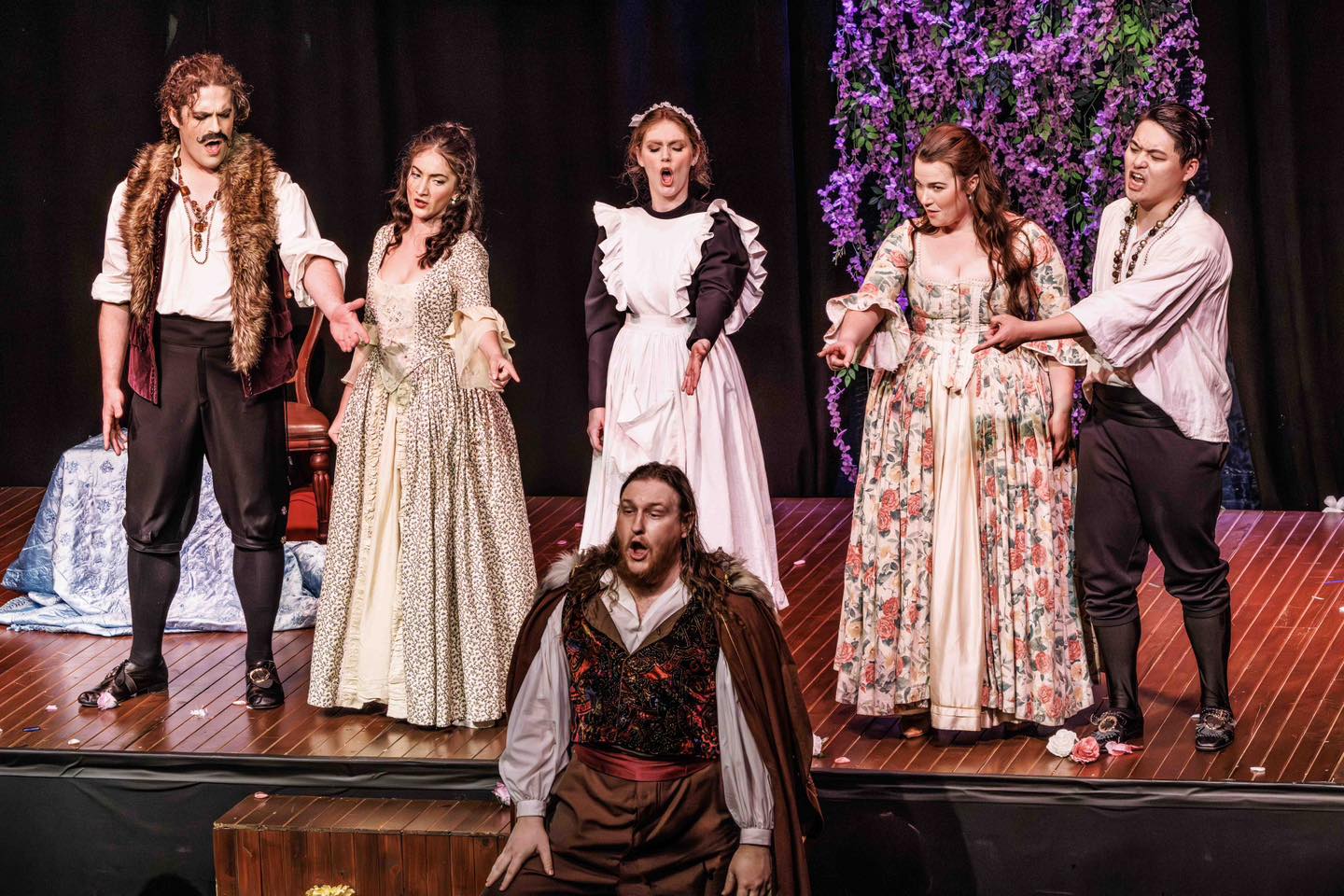
For anyone interested in hearing the cream of young “developing and emerging” opera singers, upstairs at the Athenæum was the place to be last week. As a major supporter of the Richard Divall Program, Melbourne Opera continues to provide its Program members with the valuable experience of performing operas with orchestra. In March last year we heard a rollicking performance of The Marriage of Figaro; this year another Mozart opera, Così fan tutte, was given four performances, again with Suzanne Chaundy as Director, and Raymond Lawrence and Greg Hocking taking care of things musical.
Judging by the capacity-sized audiences for the two final performances, word had spread that this Così should not be missed. In addition to be highly entertaining, the cast comprised exceptionally gifted young singers, some of whom have been winning major singing prizes galore around the country. Mozart’s music is notoriously demanding requiring singers with a well-developed vocal technique. A Chaundy production also benefits from singers with fearless theatrical skills – with an emphasis on comic flair for these two operas. The buffa aspect of Così was accentuated in this production, the absurdities exaggerated, which deflected from the opera’s perceived misogyny and general decadence that many have deplored; all six characters present as lacking moral fibre in their way.
Even so, there were moments when Chaundy supplied a motivation for money grabbing cynicism, notably for Despina. When she sang her first aria about men’s (particularly soldiers’) lack of virtue and fidelity, there was a moment when a subtle faltering suggested that she had been a victim of same. Both Heulen Cynfal and Uma Dobia conveyed this serious fleeting moment successfully while maintaining the overall light-hearted vitality of the aria.
Establishing the sibling rivalry of Fiordiligi and Dorabella as they compared portraits of their fiancés, with Dorabella in particular lingering over her sister’s beloved, set up the final scene well. Although the switch was harder to make as convincing for the Ferrando and Guglielmo, they were so ridiculous in their wooing, that in the end it didn’t matter, you just went along for the fun ride.
Both Figaro and Così featured bass-baritone Henry Shaw as the central character: the title role of Figaro and as the cynical Don Alfonso who sets up the testing of women’s fidelity in Così. With an emphasis on physical movement, there was never a dull moment as Shaw moved from stage to seating areas, energizing the production and the audience. Singing with a voice that seems to grow in strength and stature with each role he clearly enjoyed the expansive, playfully inventive nature of this manipulative Don Alfonso.
Hartley Trusler made a most attractive rich-voiced Guglielmo, his ballet training physicality an asset as he wooed the sisters and interacted with the audience. His “women, women, women…” drew even more smiles from the delighted ladies as he sat among them on the stairs. Both he and Sidra Nissen sang all four performances, creating a delightfully comic pair. Nissen’s acting was wonderfully engaging as she trotted along after her sister and showed little compunction about switching her affections. Her lovely, evenly produced mezzo-soprano voice was secure and expressive.
The role of Ferrando was shared between tenors Joshua Erdeyli-Götz and Cen Wei, both managing the arias very capably; in fact, it is the Act 1 tenor aria that has stayed with me as an earworm – a good indication that both tenors delivered it with musical sensitivity and vocal skill. Livia Brash and Breanna Stuart were exceptional as Fiordiligi. Brash possesses a lyric soprano voice of luxurious warmth and a resonant power that she is able to harness to produce a floating tone of refined beauty. Her singing during the Act 1 quartet, with Erdeyli-Götz as Ferrando, quite literally gave me goose bumps. (Her tremendously moving performance of “Sola, perduta, abbandonata” for the 2025 Herald Sun Aria was also a musical experience to remember.) Breanna Stuart is a highly musical singer with a most pleasing, well-controlled powerful voice, and has an appealing manner. She and Brash managed the coloratura and wide-leaping range of Fiordiligi’s famous “Firm as Rock” aria with distinction.
Whatever misgivings one might have about the plot of Così, the masterful quality of the music is undeniable. The Act 1 trio, where the sisters farewell their beaux as they supposedly go off to war, is one of the most exquisite pieces of music ever composed. Underpinned by the soothing warmth of Shaw’s bass-baritone and the ease of the women’s spinning top notes it was a satisfying oasis in the middle of the general mayhem. There is no doubt that the orchestra was an essential ingredient in this special moment as well as being a major contribution to the experience of the singers and audience enjoyment.
Outstanding singing and acting, inventive direction, and a professional 16-piece orchestra (complemented by the excellent Raymond Lawrence on keyboard for the recitatives, even when he was also acting as conductor), plus brief but hearty contributions from members of the Melbourne Opera Chorus, illustrated just how well an opera can succeed without elaborate staging. A simple floral panel formed the backdrop and minimal furniture and props were deftly handled by the singers. The focus was on the music and the interactions between the characters – and the audience. Perhaps the comedy might have been a little beyond the pale for some members of the audience, but Uma Dobia’s flourishing of a mock-up of the Kama Sutra was done with a level of sophistication that worked splendidly, and Sidra Nissen’s reactions were hilariously spot on.
So, what does it take to ensure the future of the world’s greatest of art form: opera? We need talented, well-trained people in the host of skills that contribute to operatic performances, from composers and librettists, directors and technicians to the performers themselves. Opportunity to perform is also essential. Training institutions such as the Melbourne Conservatorium of Music, development projects such as the Richard Divall Program and performances by independent opera companies such as Melbourne Opera, IOpera, Lyric Opera, BK Opera and ACOCo are all invaluable parts of the mix alongside the State companies and Opera Australia. And we need audiences. Although it seemed a shame that Figaro and Così were sung in English rather than in the original Italian, which sounds better and is more internationally portable, there is no doubt that the audience found the English version much more accessible and enjoyable. Productions such as these, combined with the formidable talent displayed by the nine singers in these performances, are sure to bring new audiences back for more.
Photo supplied. Back left to right: Hartley Trusler, Sidra Nissen, Uma Dobia, Breanna Stuart, Cen Wei; foreground: Henry Shaw
_____________________________________________________________________________
Heather Leviston reviewed “Così fan Tutte”, performed by the young artists of the Richard Divall Program, and presented by Melbourne Opera at the Athenæum 2 on November 8 and 9, 2025.