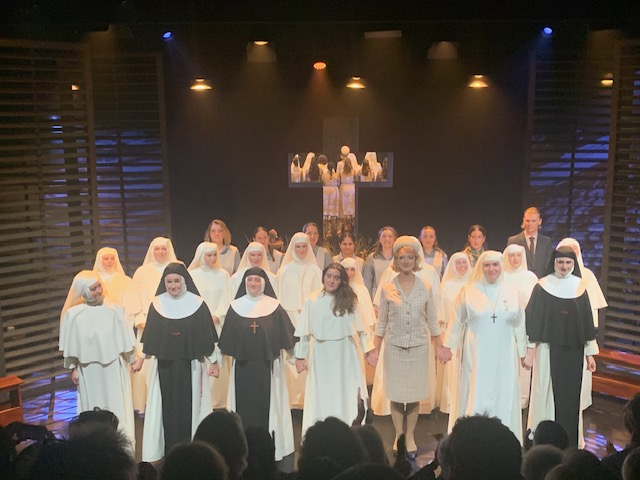
For many years now productions by the Melbourne Conservatorium of Music Opera Performance have been notable for the exceptional musical and dramatic talent of the young singers and for high quality staging. The pairing of Mahagonny Songspiel (1927) by Kurt Weill and Berthold Brecht with Puccini’s Suor Angelica (1918) for their Opera Double Bill at Grant Street Theatre, was no exception.
While keyboards comprised the “orchestral” accompaniment for both operas, the expertise of key staff, who also trained the singers, compensated for the lack of orchestral colour to the point where it was easy to forget its absence. Minus a conductor, it was a huge credit to Shauna Beasley on electronic keyboard (Weill) and Andrea Katz on piano (Puccini) and the singers that both operas ran so smoothly. The inclusion of a second electronic keyboard, played by Ricardo Roche Idini (Weill) and Leyland Jones (Puccini), added important substance and texture.
As Suor Angelica has an all-female cast, it presents a question of what best to pair it with in order to give male singers suitable roles. Weill’s Mahagonny Songspiel or Das kleine Mahagonny is far from being an obvious choice, but it was an inspired one. Although composed a mere ten years apart, they are markedly different in style and aesthetic; yet they share certain themes. As Director Jane Davidson says, in both, “morality, greed and power pervade”.
A 25-minute “scenic cantata” of six songs, Mahagonny Songspiel was the first collaboration between Kurt Weill and Bertholt Brecht, and was a foundation for the full-length opera The Rise and Fall of the City of Mahagonny. It can be viewed as a critique of capitalism – a world where everyone is on the make, eager for a quick dollar. Cynicism reigns as the characters’ lives of decadent self-indulgence lead to a Hell of disappointment. A tuneful work drawing on jazz, ragtime and cabaret idioms, it has immediate appeal. Although a couple of songs are in English the rest are in German, making it difficult for an audience to follow whatever plot there might be without the help of surtitles. The wisdom of omitting them in this production is debatable; the story might be unpleasantly decadent but composer and librettist intended them to be heard. They wanted to make a point, albeit an ugly one. Even so, there was probably enough English and a number of inventive production elements to convey the gist.
The set was a brilliant start. Dimly-lit slatted panels, were clean, stylish and functional. The open louvre-like walls provided a neutral background, perfect for the series of black and white projections that harked back to movie images of the time: the title frame, a steam train engine and crowd scenes as well as images of the singers playing poker or lounging provocatively. They culminated in giant close-ups of a quasi “Big Brother”, ready to lead the revolutionaries – to Hell.
Following the cinematic introduction, the four would-be fortune makers: Martyn Arends (Charlie), Matthew O’Leary (Billy), Zhuoyang “Sunny” Li (Bobby) and Leyland Jones (Jimmy) bounced onto the stage with swirling suitcases to begin a series of songs in close harmony as they moved with choreographed precision. They were a class act as a group, with Arends particularly suave and stylish on the upper line and in his solo work. A versatile performer, Jones immersed himself in his roles with confident ease, his voice complementing Sonny Li’s equally sonorous bass voice. I have seen these four young men excel in other roles, but was surprised at the new set of skills they displayed so admirably in this opera.
Zoe Lancaster (Jessie) and Phoebe Tait (Bessie) also worked well together. Lancaster sang the famous Lotte Lenya “Alabama Song” with an endearing sweetness, and Tait’s upper notes were pleasingly clear and shining. Languid ease was a feature of their interactions with the male quartet as they whirled around on a large velvet seat or were wheeled in on a packing case. The tableaux formed as part of these mobile sequences were seamlessly executed and visually striking.
During a short interval, the set was transformed into a convent with a “Magdalene laundry” behind one wall of slats and a chapel behind the wall on the opposite side. The back wall was removed to accommodate a flower garden, fountain and a huge mirror in the shape of a cross that reflected the action as well as the audience. Warm lighting illuminated these partially obscured inner spaces, amplifying the relatively small acting area of Grant Street Theatre to present the multi-faceted cloistered world of Suor Angelica.
Agonised wailing introduced the opening chorus, providing a chilling dramatic focus for what was to follow: the profound distress experienced by young women when having their illegitimate babies forcibly removed – verismo in its rawest form. It was echoed in Angelica’s anguished response to her aunt’s news that the son wrenched from her seven years earlier had died – a revelation that led to suicidal despair.
Two main casts of principals were heard over the four performances with some singers performing two main roles. On opening night, Kate Pengelly was an vocal . She has a rich, powerful soprano voice that rode the heights of Puccini’s sumptuous music with assurance. It was a thrilling performance augmented by an emotionally-charged portrayal of a woman totally at the mercy of implacable social forces. Davidson’s direction provided more heart-wrenching moments as Angelica farewelled aspects of convent life that brought her happiness, and presented her as a crucified figure, framed by the mirror with arms outstretched.
Although Emilia Gray’s voice has not reached the maturity of Pengelly’s instrument, her youthful portrayal of Angelica was affecting and her attractive soprano voice appeared to become stronger when she had more support from the chorus at the end of the opera.
Some productions present Angelica’s aunt, The Princess, in a sinister light – coldly remorseless and with the child seen leaving the convent with her after her encounter with Angelica; she had obviously lied about his death. In this production, the child appears as a hazy projected image – an image of Angelica’s desire to reunite with her son in death. Both Mia Koutsoumidis and Brittney Northcott were exceptionally impressive in this role in all respects. They were vocal powerhouses, successfully conveying nuances of character, including a more sensitive dimension to yet another figure straight-jacketed by social norms. It was chiefly in this scene when we realised that we were in the 1960s as the aunt’s clothing denoted a carefully curated well-heeled product of that time. While much has changed over the decades, certain social constraints endured – horrifyingly so, even now.
Northcott has a mezzo-soprano voice of astonishing depth and resonance, which lent extra weight to the role of The Monitress on opening night. Continuing their sharing of the two roles Koutsoumidis also brought individuality to this role. Erin Absalom as the Abbess and Emma Mueller as The Mistress of the Novices also gave strong performances. Lily Flynn’s Sister Genovieffa deserves a special mention, not just for her vocal prowess but also for the focused expressive quality of her acting. Her sympathetic response to Angelica’s plight made it all the more tragic.
The substantial chorus of nuns, novices and laundry girls could have filled a theatre ten times bigger with their splendid, disciplined singing, but they negotiated the confined acting space with equally well-controlled movement.
It is a pity that the size of the theatre prevented more people from seeing these excellent productions. They were a huge credit to the expertise of the faculty and technical staff involved – and, of course, this year’s contingent of committed singers in the Masters of Opera Performance program.
________________________________________________________________________________
Heather Leviston reviewed the “Opera Double Bill”, presented by the Melbourne Conservatorium of Music Opera Performance the Grant Street Theatre on March 24 and 25, 2026.