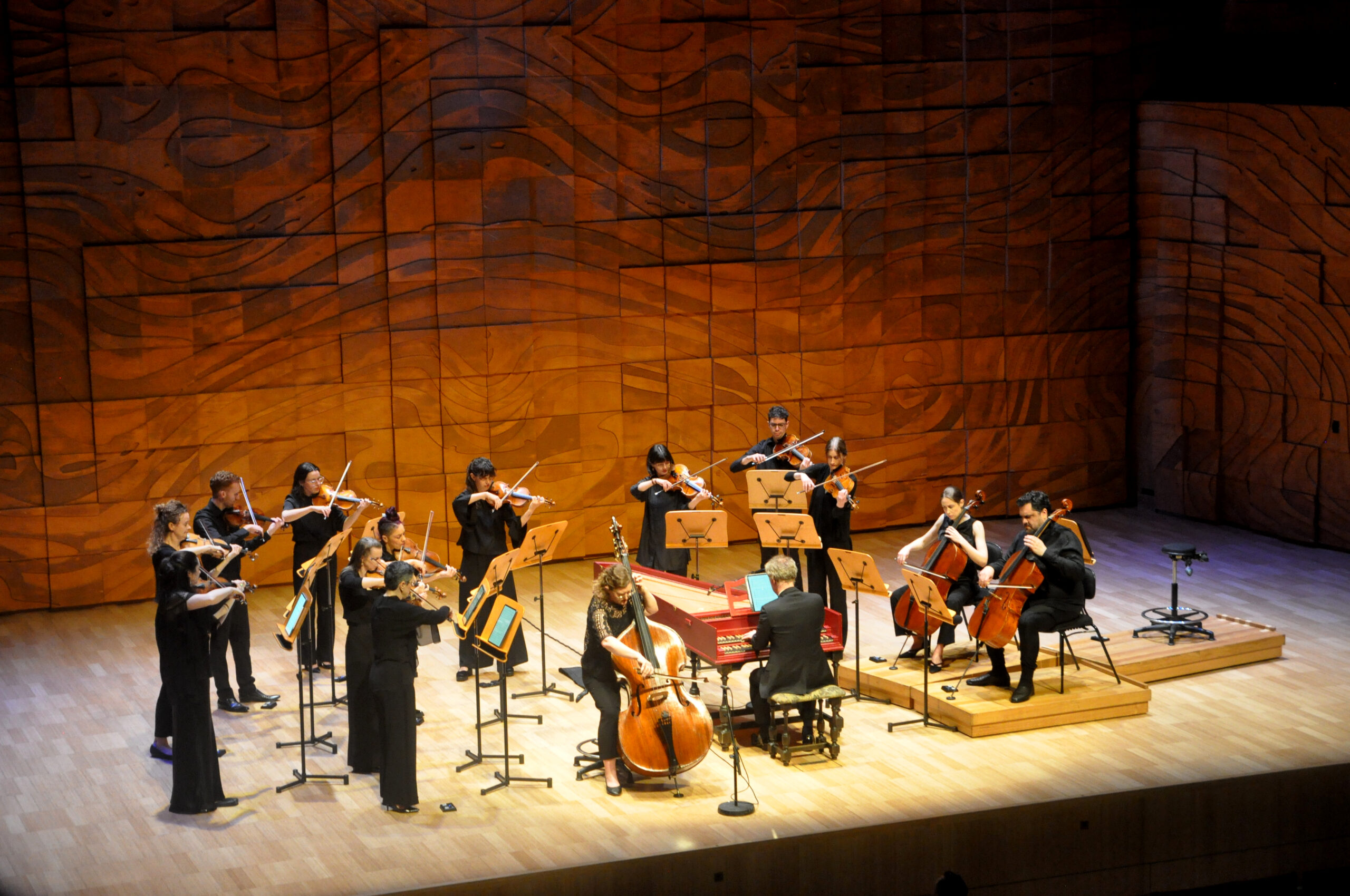
The joy of music is fully experienced with every Melbourne Chamber Orchestra Concert, and “Nightingale”, the final program for the 2025 concert season, once again impressed with artistic quality and a maximum amount of congeniality. We look forward always to being taken to a heavenly place with gorgeous string sounds, “hidden gems” of ensemble repertoire, and stimulating new compositions.
A soothing, sedate and elegant opening work, Henry Purcell’s intriguing Fantasy Upon One Note, held our attention as we followed the single sustained pitch – appearing, blending and receding within weaving and lightly sunny and energetic ensemble textures. We could only feel relaxed, with good cheer and much appreciation for this fine ensemble in another textbook and classy concert in Melbourne’s best acoustic and the ambient lighting of the Elisabeth Murdoch Hall.
Welcoming the audience with her usual enveloping warmth and connection, Artistic Director Sophie Rowell spoke of the program choice tonight and pointed to the additional coloured baroque keyboard centre stage: “What fun we can have with a harpsichord!” She described the unifying elements in tonight’s program where the MCO would re-invigorate the old and the new, in the sense that Colin Brumby spoke of renewing his compositional thoughts in 1974 with The Phoenix and the Turtle. Poetic but not programmatic, the mythical bird was reborn in shimmering and reflective tone colours, a rounded and warm resonant unison blend, subtle rippling movement and punctuations on the harpsichord, and a most expressive and lyrical violin solo by Sophie Rowell. Gentle arrhythmic chords were like a still, summer haze, floating to a sustained and colourful close.
Harpsichord soloist and guest director, Donald Nicolson, brought his popular flair and energy to the stage for J. S. Bach’s Concerto No 1 in D minor. He spoke of the fusion of the Italian virtuosic style, the anguish and tension in the piece, and confessed to adding a touch of amplification to his instrument to balance with today’s modern strings. We received a performance that was well-balanced, a sheer delight and full of heart-lifting energy, the first and third Allegro movements highlighting both excitement of feeling and tempo and Nicolson’s scintillating technique. There was an improvisatory freedom and lighter timbre in a thoughtful second movement Adagio, making the final Allegro movement an exhilarating perpetual motion. Nicolson certainly brought his popular personality and Italian flair for life into this music.
Following interval, we heard Barbara Strozzi’s L’Usignolo (The Nightingale), a charming work first published in 1644 as a vocal quartet in a set of madrigals.
The MCO ensemble beautifully alternated “choruses” with solo, duo and trio linking passages, delightfully showcasing high artistry and musical expressiveness from each ensemble member. Much musical congeniality came from the composer’s Venetian style in this charming five-minute work. Next, cellist Blair Harris introduced Henry Eccles’ Contrabass Sonata in G minor (1720), a work tonight “turned into a concerto” with MCO’s Emma Sullivan starring. In the four-movement piece: Grave, Courante, Adagio and Vivace, Sullivan’s smiles, warmth, enthusiasm and technical artistry connected highly with the audience, and it was a joy to hear bass, cello and harpsichord as a trio featured with the MCO strings “accompanying” them. Well emphasised first beats of each dance movement were hearty, human and earthy, providing us with the enjoyment of another genre and another “rare gem”.
Audiences love to hear a new Australian work when the composer is also in the audience, so tonight The Apollo by Melody Eötvös, commissioned by MCO, was most highly welcomed. Eötvös introduced her work as a reflection on “the old and new”, which she felt in Melbourne, sensing the busy industrial streets, feeling the history and relics of the past, and the humoured awareness that “some days are cloudy and grey, others have brightness and a little sun”. This was a piece with a fascinating structure and coloured orchestration, with march-like pulses on harpsichord and lower strings, percussive shimmers and glissando string punctuation creating a visual scenario at times. Rising melodies and surging crescendos coloured the new ideas, which developed with increasing intensity. A single note drone in the bass underscored eerie interweaving high patterns, with short shapes blending and forming most interesting sustained kind of motionless pillars of harmony. Sophie Rowell had said earlier how rewarding it was to be involved in the creation of a new work, and the rewards are shared too with Australian composers having ensembles par excellence to perform the score to a welcoming audience.
Corelli’s four-movement Concerto Grosso in D, Op. 6 No. 4 was a fitting 12-minute and glorious finale to this substantial program. The MCO showcased a bright string tone and excellent unity and balance in the ensemble, with Rowell’s expressive leadership and inspiring solo work enthusiastically applauded at the close. This carefully designed program with many connecting and thematic links, excellent program notes, top class musicians and, tonight, two outstanding musical directors, was indeed one of the year’s gems.
Photo credit: Catherine Turner
_________________________________________________
Julie McErlain reviewed “Nightingale”, presented by the Melbourne Chamber Orchestra at the Melbourne Recital Centre on November 20, 2025.