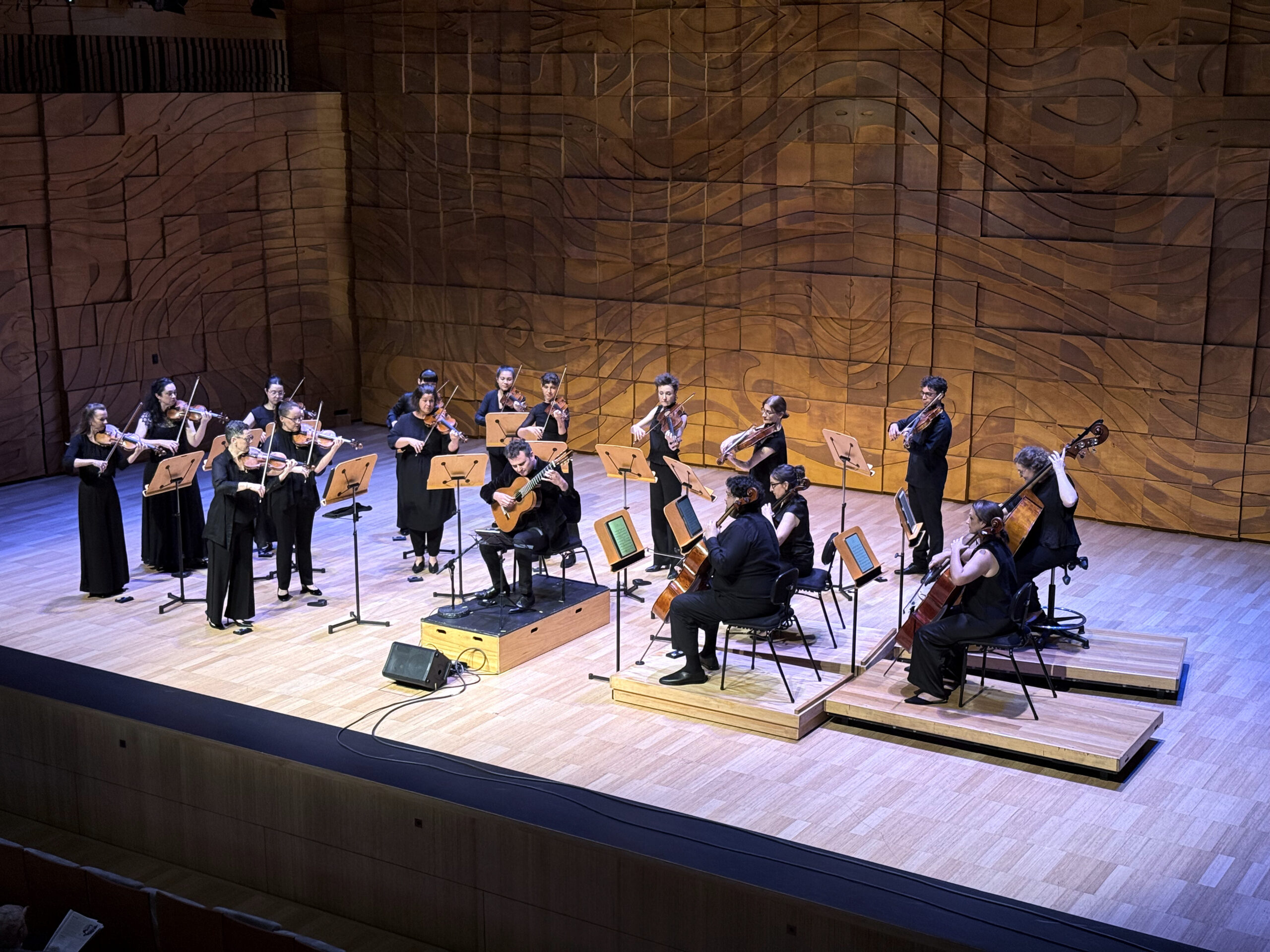
Every Melbourne Chamber Orchestra event can be anticipated with the same feelings of excitement that many music festivals inspire: the joy of hearing outstanding musicians sharing their expertise, an exciting repertoire of old and new, curiosity and stimulation from recently composed and commissioned Australian works. A satisfying early Christmas present on arrival was a colourful 24-page booklet describing the year’s concert program, and complimentary wines with friends and performing artists in the Melbourne Recital Centre foyer were enjoyed after the concert.
With five orchestral concerts at the MRC, three chamber concerts in smaller venues in North Fitzroy and Glengarry, and a weekend MCO Festival in Daylesford, we can anticipate the thrill of hearing composers introduce their new works and celebrate fresh settings of old and pre-loved familiar repertoire.
Opening this year’s bold and adventurous season, the concert’s title “Flexible Sky” caught our curiosity and imagination. Artistic Director Sophie Rowell welcomed national treasure and notable pianist and composer Joe Chindamo, to introduce his MCO commissioned work Machiavelli’s Mirror: A Renaissance Suite for String Orchestra. In a series of eight musical “portraits” we felt the essence of each character musically mirroring the spirit of the Renaissance, and imaginatively taking on suggestions of futuristic and modern musical touches as if time travelling had been allowed. The first part, I Medici – Whispers in the Court, showed strength and power described in a grand, courtly march, then became affected by light jazz elements with changing metres and touches of modern tones. Palestrina – Sacred Harmony was an audience favourite, with strong hymn-like Renaissance chordal imitation, imbibed with some unexpected and “modern” visions. The final gem Leonardo da Vinci – The Art of Wonder, was a most joyful allegro, exciting and full of splendid string colour with changing modern metres and strong accented pulses creating a most exciting finish. Chindamo truly brought his fascination for historical heroes of the Renaissance along for a modern ride into this century, with the musical question: What if?
Always heart-warming and popular is the joyful Concerto in D by Vivaldi. Originally written for solo lute, 2 violins and continuo, it is always a delight hearing this familiar old work played by Slava Grigoryan, in a newly coloured setting, his guitar being given a distinctly new tonal flavour, dynamic and breadth of sound by amplification, necessary with the strength of sound coming from his accompaniment. In the richly coloured Largo, reduced string accompaniment allowed the soloist to add gentle improvisation and embellishment, strongly coloured in tone by the enriching amplification.
New and surprising was the arrangement of Beethoven’s (“Moonlight”) Piano Sonata No. 14 in C-sharp minor Op. 27 No. 2 by Polish composer Jakub Kowalewski for string orchestra. So well known for piano, we were curious – could it work? How connected all players needed to be to maintain the unified flowing beauty in the triplets of the first movement. With its steady minuet tempo and orchestral chords, the second movement was ideal for strings, and what a surprise the third movement Presto Agitato was. With the MCO’s very affirmative bass strings, Beethoven’s stormy power was well-projected, with cello and double bass delighting with lead melodies and drum-like rolling repetitious bass patterns. These players enjoyed being the left hand of the piano and led to impress. Definitely a source for debated discussion during interval.
Bartok’s six Romanian Folk Dances Sz. 56, are a beautiful expression of humanity, their modal melodies evoking the timeless vocal, violin, and flute melodies of the Middle East. Most poignant was Sophie Rowell’s exquisite solo work, with the finest bowing and harmonics, producing a celestial and eerie highpoint in Dance No. 3 – Pe Loc/Topogo (In One Spot). Dance No. 4 (from Bucsum) was delightfully rhythmic and sensuous, and in the robust No. 5 (Romanian Polka), the lower strings added the earthy colours of modal pipe music.
Slava Grigoryan returned to centre stage to perform Wolfgang Muthspiel’s acclaimed, highly inventive work, Flexible Sky Redux. Described as having a lot of musical language that is unfamiliar to most audiences, the work breaks new ground, bridging many musical worlds together, with elements of modern jazz, inventive extremes of non-conventional techniques, heavily plucked notes and weird and wonderful glissandos. Surprising harmonies, virtuosic guitar solos, and vibrant irregular jazz meters combined well in the last part of the four-movement work. Superbly performed, challenging on a first hearing, this was a new adventure and a well-received premier performance.
Completing this exciting and most stimulating concert, a closing piece by Australian composer Matthew Hindson contrasted two representations of enduring human experiences : 1. Song – an elegiac and solemn flowing texture of sustained veils of sound, and 2. Dance – a combination of melodic excitement, agitation, and final bars of galloping and slapdash eccentricity, sending the audience away on a very highly satisfied note, knowing that many more inspiring MCO programs are to come.
Photo credit: Catherine Turner
_____________________________________________________
Julie McErlain reviewed “Flexible Sky”, performed by Melbourne Chamber Orchestra and Slava Grigoryan at the Elisabeth Murdoch Hall, Melbourne Recital Centre on February 26, 2026.