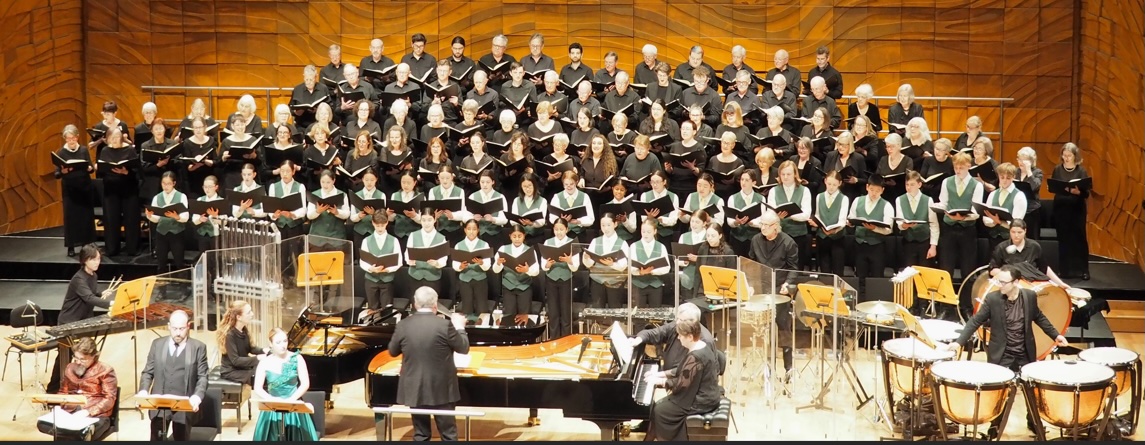
Melbourne Bach Choir and Carmina Burana? Now that does seem a very odd coupling. On the one hand we have Bach, a deeply religious composer of sublime sacred music; on the other, one of the most rampantly secular works by a composer, who turned his back on the Roman Catholic Church (though not religion) in his youth. An important factor that does connect Johann Sebastian Bach and Carl Orff is the immense popularity of their choral works – or in Orff’s case one particular work – indicated by frequent performances in Melbourne alone. Only last year the Royal Melbourne Philharmonic performed Carmina Burana featuring the same impressive baritone soloist, Christopher Hillier.
The appeal of Carmina Burana is apparent from its explosive beginning as the choir exclaims “O Fortuna”, and timpani, bass drum and percussion (including pianos) launch the cantata’s driving rhythms. The role of the timpani is so central to the thrust of this work that the instrumental version used in this performance provides the essence of Orff’s musical language. It is really only the absence of the bassoon for the “Roasting Swan” tenor aria that makes a significant difference; it is impossible to replicate the special mournful timbre that a bassoon contributes to this movement. Robert Macfarlane, however, did his best to supply plenty of colour, both visually and aurally. He entered as a flapping swan and exhibited all the anguish of the swan’s fate using full voice and falsetto, from strident to strangled to sobbing, until collapsing back onto his chair. His enthusiastically theatrical performance was very much appreciated by the audience.
What can perhaps provoke more disquiet than an agonised roasting swan in its death throes is the inclusion of child choristers in Carmina Burana. The Australian Children’s Choir joined the Melbourne Bach Choir for the sections requiring children’s voices. Orff’s cantata (1935–1936) is based on 24 poems from the medieval collection also entitled Carmina Burana, a compilation that includes some plainly adult material. It could be that the Latin and archaic German texts were simply treated as a series of nonsense syllables – there were plenty of progam-less audience members, who may also have been none the wiser – with the focus being on exciting rhythms, captivating melodies and enthralling performances. The capricious nature of Fortune, the sensual joys of Spring, life in the taverns, drinking, gambling, more drinking, and more joys of sex, plus a parody of the “Ave Maria” are not exactly G-rated material. Still, their light soprano voices added sweetness at key moments and, along with the young male choristers, contributed to the general texture and weight of sound, particularly in the stirring reprise of “O Fortuna”, which concludes the cantata.
Along with the sweet tones of the young soprano voices in “Floret silva nobilis” a small contingent of MBC sopranos handled the difficult and exposed high “Ah!” very well at the end of each verse. The girls’ delicate singing of “Amor volat undique”, which began the Cour d’Amours section, provided a strong contrast to the enthusiastic drinking songs of the previous “In Taverna” section sung with gusto by the tenors and basses.
In fact, Carmina Burana is notable for extremes of contrast between and often within its five major sections and 25 movements, and for the vocal extremities of pitch, colour and dynamics demanded of both the choir and soloists. The soprano soloist is required to sing a top D in “Dulcissime” (Sweetest one), the word suggesting that the soprano should sing as sweetly as possibly, melting with desire. That’s quite an ask! While Jane Magão managed most of the high tessitura with graceful clarity, the top D was a stretch. This actually fulfilled Orff’s aim of increasing musical tension since he wrote the part for a lyric rather than a coloratura soprano. In less extreme movements, Jane Magão’s fresh, youthful soprano shone in “Stetit puella”, her pure tone and breath control a delight in the final drawn out ”Eia”, and her “In trutina” was infused with a gentle warm lyricism.
Perhaps the most extravagant of Orff’s vocal demands are for the baritone soloist, and Christopher Hillier did a great job measuring up to them. His voice was resonant and full-bodied when required, even employing Wagnerian heft and focus for the cries of “Wafna, wafna!” (Woe! Woe!). But it is in “Dies, Nox et Omnia” where the capacity to jump between three separate vocal registers really tests a singer’s flexibility. To his great credit, Hillier was able to shift between full-voiced baritone, steady falsetto and manly bass with apparent ease.
The Melbourne Bach Choir also stepped up to the exacting musical plate commendably, the men in particular seeming to gain confidence and strength as they went. All choir members managed the tongue-twisting patter of the text successfully, and were obedient to conductor Rick Prakhoff’s firm rein, with careful observance of dynamic contrasts and modulations. There was also good rhythmic cohesion with spot-on final notes.
Elyane Laussade and Kathryn Pisani provided secure underpinning on the two pianos, and timpanist Brent Miller – the hero of the hour for some listeners – was simply terrific as he ensured the thrilling dynamism that makes this work such a winner. They were most ably abetted by members of the Percussion Ensemble.
This was a happy occasion that brought a great deal of enjoyment to all concerned, but I do wonder what Bach would have made of it all.
________________________________________________________________________
Heather Leviston reviewed “Carmina Burana”, presented by the Melbourne Bach Choir at the Melbourne Recital Centre’s Elisabeth Murdoch Hall on September 19, 2025.