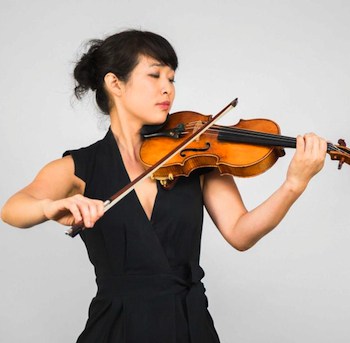
It was a bicycle mishap worthy of Mulga Bill, William Hennessy explained, that led him to assume his position as conductor of the Melbourne Chamber Orchestra without his trusty violin in his hands. But with Rebecca Chan filling in as leader of the orchestra and the soloist pianist Stefan Cassomenos all was in place for a most enjoyable concert at the Melbourne Recital Centre.
The concert was entitled Mozart in Prague, and due deference was paid to Dvorak to begin, with his Nocturne for string orchestra Opus 40. The lower strings established the theme – in B major but still rather melancholy even when the upper strings joined in. Hennessy had an ensemble of 14 to conduct at this point, and was restrained in his direction, yet managed beautifully controlled dynamics and a gradually attenuated melody. Built on a structured harmony, the sound was fluid with beautiful interweaving of the melodies or strands of the same one, the two cellos and one bass lending a warm depth to the sound.
The first of the two major examples of Mozart’s genius was the Piano Concerto No.25 in C major K503. The orchestra was supplemented by winds and brass, and the pianist Stefan Cassomenos was warmly received by the audience. He had to wait, however, as the strong opening statement was developed in quite symphonic style. Hennessy did well as the conductor to combine the various elements (but it was hard to see how he managed this, as he was obscured by the lid of the grand piano!)
The piano entry was in response to the orchestra, with Cassomenos at first using only the right hand. But a classic Mozartian pattern followed with solo passages built on classical lines of scales and trills, echoed by the orchestra. This pattern suited Cassomenos’s easy, assured style which lends itself to strong flowing music, but also to more delicate passages in between. Technical challenges were so well met throughout the work that one hardly noticed their difficulty! Cassomenos’s achievement was to seamlessly become part of the orchestra rather than the focus of attention in the long development of the first movement. However, he was of course the centre of attention in the cadenza – by Hummel, a blend of technical work and a delicate reprise of the central melody. Interest was added with echoes of the tune of La Marseillaise and embellished with plenty of trills.
In the second movement, Andante, winds and brass were important in articulating the theme. It began reflectively, but despite the overall tempo there was a lot of movement in this part of the work. Delicacy and precision were the key words here as the piano arpeggios and runs were embellished and the winds showed what they were made of. The Allegretto, well known as a standalone piece, is quintessentially Mozart, repeated phrases ending in emphatic cadences. This suited the pianist who appeared to relish the delicate charming phrases he had to play with the orchestra (a duet with the winds being particularly lovely) He was so absorbed in the music that one felt he would have happily conducted at a moment’s notice!
The ending of the concerto had an air of playing games about it but there was great accuracy at speed from all. Nevertheless, the ending was something of a romp – something the composer would surely have approved.
After interval, the appetiser was a gem of a work – or part thereof. The Adagio from Serenade for string orchestra by Suk suited this ensemble very well and, being Czech and of a later date (1892), provided a contrast to the crisply Classical emphasis of the program. The first few entries were not as certain as they might have been, (perhaps the players were not used to looking to Hennessy on centre stage!). But the music was well articulated with Rebecca Chan doing a great job as the leader, and Hennessy warming to the task of conducting, albeit seeming a little lost without his violin. Cellos and bass underpinned a sweet evocative sound from the upper strings, with the melody both original and immediately captivating. This performance made me want to hear the complete work – perhaps in a future concert?
Finally, the work that gave the program its title: Mozart’s Symphony no. 38 in D Major K 504 Prague. The number of players on stage doubled, with winds and brass immediately establishing a pleasing synchronicity with the strings. Hennessy made much of the contrasting dynamics, with good strength where it was needed. The Andante, this time with a precise entry from all, also had consistency in the understated theme, with lovely phrasing and dynamics, thanks in large part to the conductor’s sensitivity to individual players.
The MCO demonstrated that it didn’t need to be a full symphony orchestra to convey the composer’s intentions. This was never more so than in the Finale: presto. It needed volume, spirited winds, a full sound from the strings with accents from the brass – and a lilting dialogue with the flute. All this was achieved as the music moved apace to a triumphant finish and well-deserved applause.
Suzanne Yanko reviewed the MCO’s concert at the Melbourne Recital Centre on Sunday afternoon, March 1, 2015.
The photo of Rebecca Chan with the Australian Chamber Orchestra’s Joseph Guarneri violin was taken in 2014 by Jack Saltmiras.