If we look at a map of the world we may wonder at the size of the country of Ireland and marvel at the immense treasure troves of vocal and instrumental melodies passed through centuries, which have enriched the hearts and souls of people living within its varied landscapes and travelled far beyond its borders.
From rural County Clare, Martin Hayes is a unique and legendary fiddler, a humble artist and an extraordinary performer, who has absorbed the best of all musical genres and traditions. As we expected, his mostly sold-out Australian tour brought an excited and very reverential concert audience to the Melbourne Recital Centre for an unforgettable program.
A Celtic festival atmosphere was established very early in the MRC foyer, where pre-performance entertainment was given by Maggie Carty, her angelic soprano lyricism accompanied by her own very neat banjo picking, with supportive rhythm guitar and a mellow didgeridoo bass in a heart-warming folk trio.
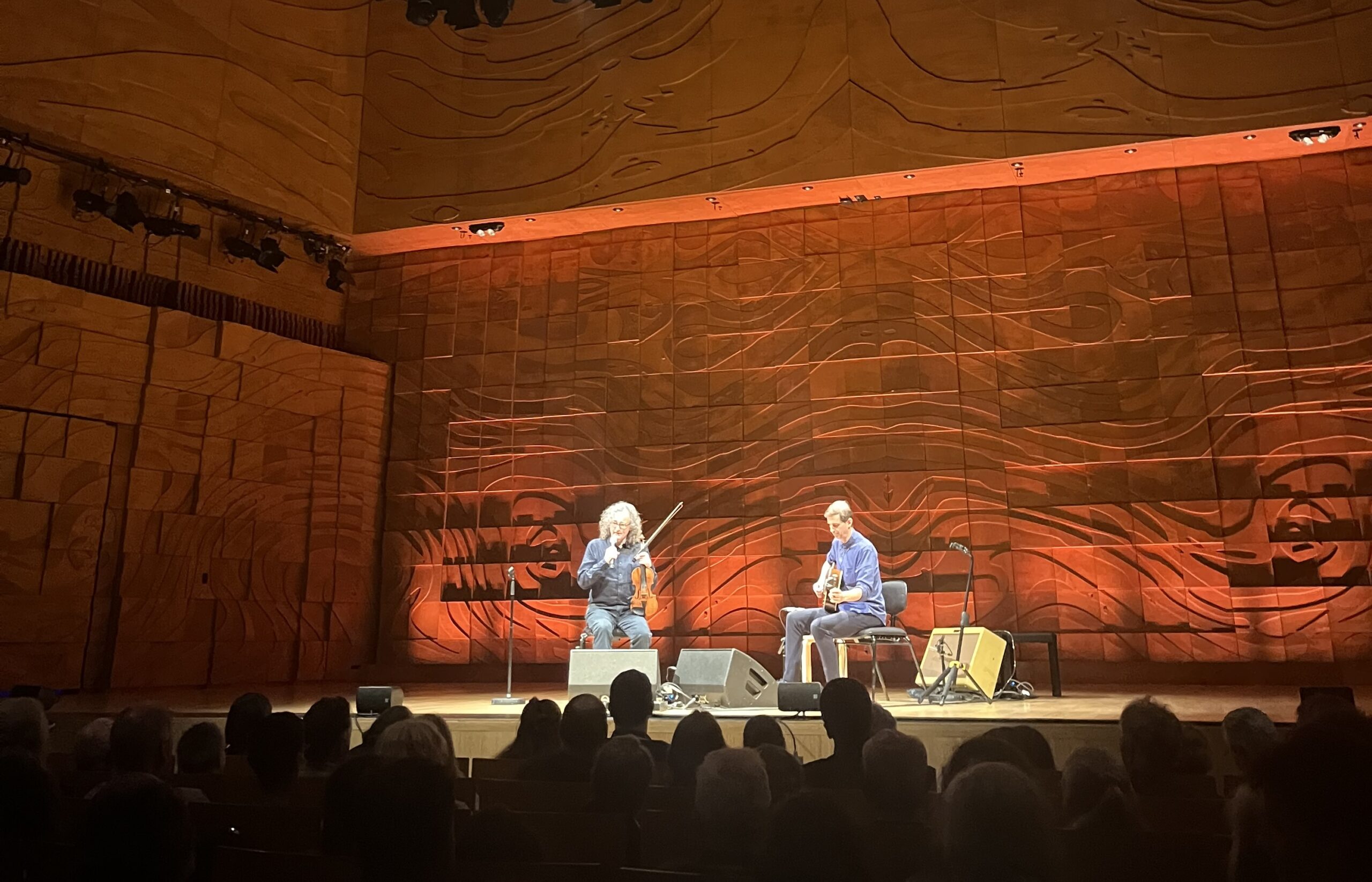
The atmosphere within the packed concert hall was transformed immediately the lights dimmed, with just the barest of essentials on stage for a timeless instrumental performance. Melody meets soul – the heart and roots of Irish traditional culture, amplified just enough in this excellent acoustic, projecting full and colourful string timbres. Just as Miles Davis brought classical, romantic and impressionist elements to the jazz world, just as Vikingur Olafsson has brought new heartfelt expression and shaping of Baroque music on the modern piano, improvisation is now a huge part of classical art forms and altered “genres” are indeed “the go”. The winds of change.
Yet Irish music seemed “preserved” in its traditional folk delivery around the world, until in the late 1970’s, a remarkable musician, Michael O Suilleabhain, showed the world a new style we never thought possible on the piano: “Irish Jazz”, and it is Martin Hayes who stands supreme as a unique and inspirational fiddler who has reshaped the Irish music art form with his creative synthesis of diverse genres.
Coming directly to centre stage, no words were needed to introduce the music. With creative guitarist and composer Kyle Sanna, sets of traditional tunes, old and new, were arranged in a stunning and most heartfelt way in a full 90-minute performance of timeless Celtic melodies and rhythms. One simple resonating guitar chord opened the first set, adding just gentle punctuations as Hayes mesmerised us with the traditional lament The Wild Geese, played freely like a sad vocalise, a poignant and expressive lyrical recitative. We were immediately totally silent and spellbound by his magic.
The ballad Lord Leitrim followed, Hayes’ expressive tone and heartfelt expression supported by Sanna, whose finger-picking techniques evoked the colours of historic harps and ancient modes. As the five tunes in the set flowed as one, with increasing light-footed energy, in the folk song My Mary Ann and the final slip jig The Boys of Ballisodare, Hayes added quirky, subtle sliding glissando notes and refined colourful melodic variations, with Sanna adding increased syncopation. Spontaneous gentle toe tapping from some audience members joined with Hayes’ soft percussive foot-taps, as performers and audience were truly connecting in an exciting spirited dance tempo. Having been silent and spellbound, after the final resonant chord the audience really brought the house down.
Most fresh and contemporary were three contrasting modal pieces: Music on the Wind (1972) Lucy Farr’s tune for tin whistle, and two tunes by Peadar O Riada – Harpsichord Louise (2014) and the TG 4 Reel. Contemporary, popular and rhythmic, guitar accompaniment added varied plucked drones or variation in chordal and bass line texture, with Hayes adding richly coloured weighted bowing, shifting the colour from historic classical beauty and refinement to an earthy modern feel. There were fine exchanges of melodies between both performers, addition of colourful airy harmonics, subtle shifts in modal harmonies and shifting key centres, and admirable stamina and unity from both players.
Two beautiful laments followed, the first dedicated to the most famous Irish harpist, O’Carolan, in his traditional Farewell to Music, and a melancholic and eerie lament Garrett Barry’s Jig, where the guitar’s drone-like patterns and sympathetic overtones added a sad touch to the touching historical lament. Hayes added some Irish dark humour – describing this sad music as like the blues – pointing out that Sanna was wearing blue, and his guitar solo was like contemporary American blues, with slides and bent notes colouring both instruments’ solos.
More gentle humour followed as Hayes described The Glen of Aherlow as “a very slow tune which softens until it nearly disappears”, adding, “But please don’t leave – the music will come back”. Hayes showed extraordinary technique, brilliantly shifting the tone and weight of bowing on strings, emphasising principal melodic notes while accompanying patterns around them in his own string accompaniment, with the guitar adding gentle pulses imitating a soft bodhran. Were there really only two musicians playing?
Further works by contemporary composer Peadar O Riada brought an increasingly modern harmonic and rhythmic feel, as jazz improvisation and modern elements added new drive and electricity. As the closing Maghera Ban Reel brought a lengthy standing ovation, a most gentle encore followed described by Hayes as being “a tune we have been fiddling with” – a reflective, slow air that shifted gear smoothly into a traditional reel enhanced by contemporary guitar chords and rhythms that turned the piece into a flamboyant and virtuosic gallop. The true heart and soul of Ireland.
Pho credit: Julie McErlain
____________________________________________
Julie McErlain reviewed “Melody Meets Soul” performed by violinist Martin Hayes and guitarist Kyle Sanna at the Melbourne Recital Centre, Elisabeth Murdoch Hall on February 24, 2026.