Billed as “An evening of music, dance & opera, AAO live sets, sunset interlude & the Australian premiere of Laxlan Petras’ Humanities”, what unfolded at the TarraWarra Museum of Art was a four-hour mini festival in three parts that showcased both artistic creativity and the delights of an idyllic corner of Victoria’s Yarra Valley.
Part 1 was an improvised set of pieces directed by Aaron Choulai, Artistic Director of the Australian Art Orchestra, in response to Rose Nolan’s major current exhibition, “Breathing Helps”. Having been registered and issued with an identifying wristband, the sizeable audience entered the first room of the exhibition, some sitting on chairs, many on stools and more again on a huge circular red and white carpet (with shoes off) that formed part of the stunning artwork.
Aaron Choulai and his band of five musicians: Ryan Williams (Recorders), Andrew Saragossi (Alto Clarinet), Lizzy Welsh (Violin), Biddy Connor (Viola) and Zoë Barry (Cello) took their places against the long wall, and so began, for those lucky enough to see it, improvised music-making guided entirely by Choulai’s precise hand gestures. The only exception to this was Williams’ contribution as he responded more freely, sometimes leading and sometimes interweaving an enormous variety of sounds into the musical texture. His recorders ranged from a sopranino recorder to a long, square sub-great bass recorder with attachments such as bell clusters – all of which enabled him to produce high notes of birdsong, didgeridoo-like qualities and a range of percussion effects.
Unfortunately, it was not possible to follow all of Choulai’s explanations between the handful of pieces, but the music in its shaping and use of flexible dynamics and tempi spoke for itself, reflecting the graceful curves and undulations of Nolan’s impressive long-lined constructions and small repeated details. Harmonics, pizzicatos and glissandi were just some of the string techniques used to create highly organic music that required absolute concentration and awareness on the part of the musicians as note cells evolved. The final piece in particular contained a momentum and sense of wholeness that the audience responded to with enthusiasm, feeling on the same conceptual wavelength as the music.
A less structured form of improvisation featured in Part 2. Audiences were invited to wander around the TarraWarra Museum precinct and encounter the musicians – sometimes in unexpected places or just heard at a hidden distance. Those with wristbands could gather around platters set on tables within a raised confined area, and sit under the peppercorn trees to enjoy a delicious array of cheeses and dried fruit with plentiful glasses of wine (or water) while watching the sun set. With the weather gods on side, it was truly a feast for all the senses.
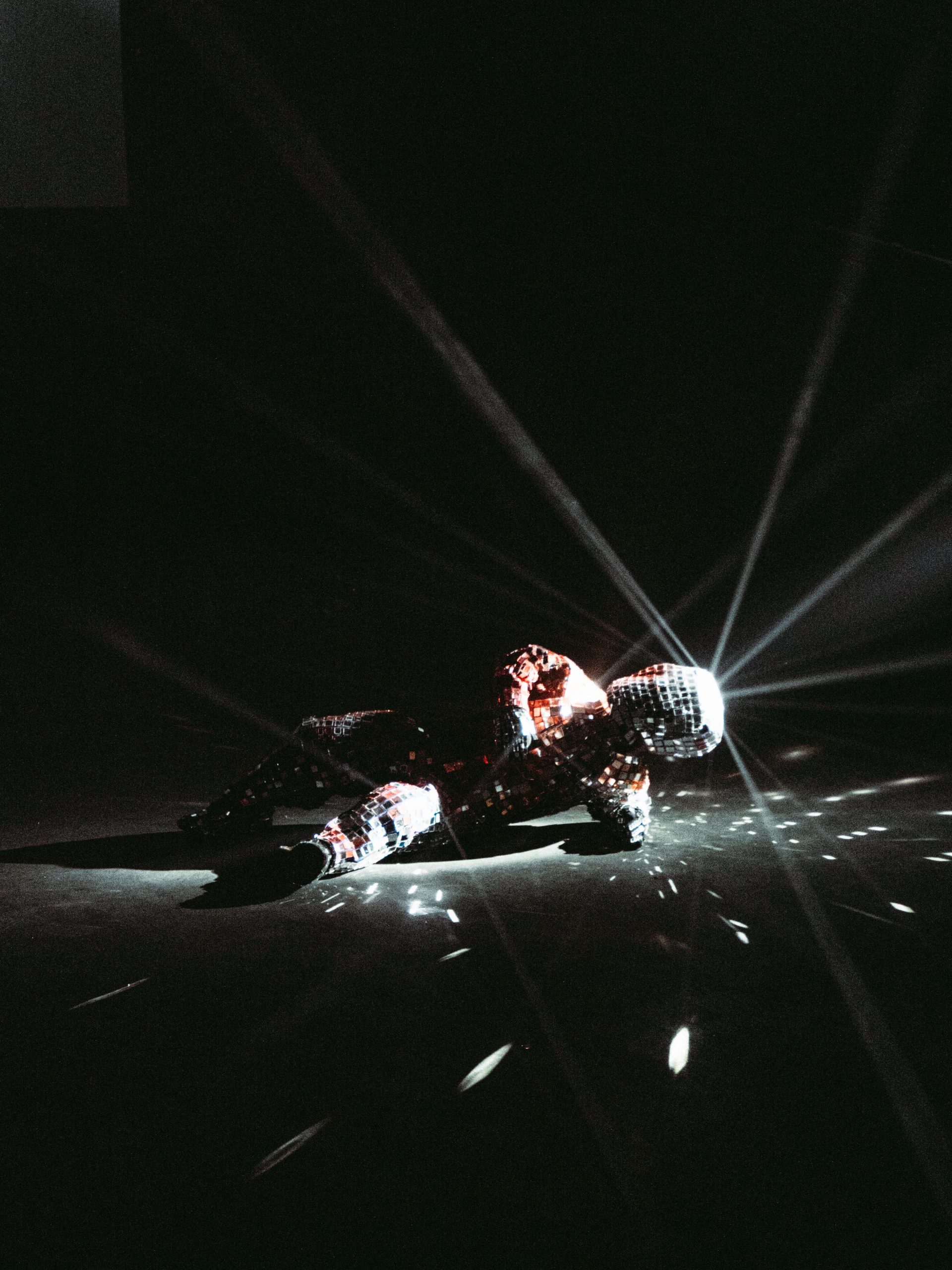
Moving indoors to the Eva and Marc Besen Centre – a new multi-purpose learning and performance space – the evening culminated in the Australian premiere of Humanities, a new 40-minute experimental opera and performance work by Melbourne-born Berlin-based artist Laxlan Petras. A collaborative live performance originally conceived by Petras and artists Yasmin Saleh and Amber Fasquelle, Humanities premiered at the Institute of Contemporary Arts (ICA) in London in August 2025. The work is described as presenting “scenes of birth, death, and resurrection. The artists create a sonic metropolis using minimal staging that references street scenes with all their emotional interdependence and political urgency”.
The abstraction and ambiguity suggested in notes for this and earlier performances were apparent in this performance, but the intense emotional impact was the most powerful factor. As audience members entered to sit on three sides of the performance space they were offered earplugs; however, although the electronic soundscape led to a dramatic crescendo, they were not really needed. The city noises, anonymous recorded voices were a backdrop to the heart of the work: the figure of Yasmin Saleh. A person of short stature, Saleh could be seen earlier in the day in the exhibition space. Her transformation into the robotic figure enclosed in mirrored fabric was a revelation. She slowly made her way to the centre of the space, spotlit by torches held by looming figures, and “danced” with superb control, her body movements subtle and expressive.
Although it was difficult to make out what was being said, the figure of torch-bearing Petras registered as an inexorable danger to a vision of beauty and vulnerability. It was not only the final overwhelming of this glittering creature that made the effect so deeply emotional and poignant, but also everything that led up to it. Amongst these was the voice of soprano Rachael Joyce, who sang with great warmth and purity of tone as she slowly entered to stand near the threatened figure. Sung in Italian, words such as “dormi”, “amato” and “pace” suggested her sympathetic role, which contrasted with the dark, assertive male voice.
An enthusiastic ovation followed this singular, highly skilled performance. It was a day to remember on so many levels.
Photo credit: Agustin Farias
_______________________________________________________________
Heather Leviston reviewed “Humanities”, presented by Laxlan Petras and the Australian Art Orchestra at the TarraWarra Museum of Art on October 4, 2025.