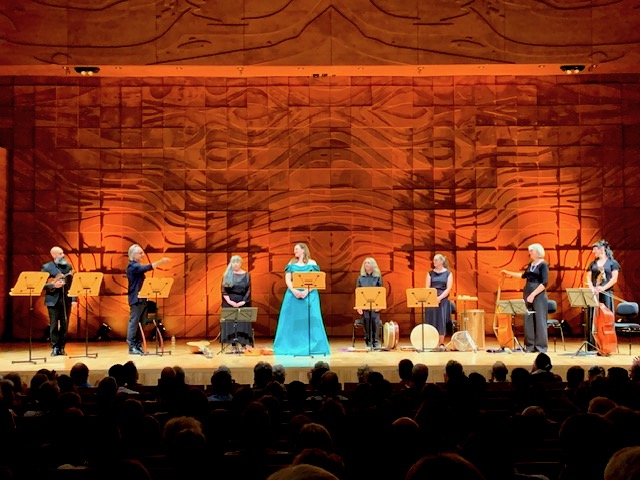
Considering the huge number of classical music performances on offer in Melbourne on Saturday night, the fact that La Compañia attracted such a sizeable audience to the Melbourne Recital Centre’s Elisabeth Murdoch Hall for a one hour concert indicates the popularity of this local ensemble specialising in Renaissance and early Baroque music. Choice of repertoire, the high standard of historically informed playing on period instruments, and a succession of outstanding featured guest artists has ensured ongoing support since La Compañia’s director and cornetto player, Danny Lucin, founded the ensemble more than ten years ago.
This time, the repertoire was not quite the customary fare of works by Italian and Spanish composers; it was music from the British Isles that took centre stage – along with soprano Jacqueline Porter, wearing a gorgeous emerald green gown to take us to the Emerald Isle with two songs by “Anonymous”. The lyrics of all songs were made available in a handout, with the original Gaelic supplied along with translations – all most appreciated. Óró Mhór a Mhóirín & Reel (from the early 17th C) and An Drumadóir (The Drummer) were the first of many songs that, ballad-like told a story, usually about romantic relationships presented with a humorous twist. Porter conveyed the text with crystal clear tone and buoyant musicality, her winning personality expressive of text and sentiment, although perhaps greater differentiation could have been made between Drummer and Woman in the second song. All members of the eight-strong band accompanied Porter for the first song, with the second being accompanied by guitar.
The variety of instrumental combinations was an important feature of this performance, with percussionists Denis Close and Christine Baker playing several types of drums and percussion instruments. Close even borrowed one of Rosemary Hodgson’s guitars for John Playford’s Never Love Thee More, a work for instruments alone. Prominent in the set of five traditional Irish jigs and reels that followed the opening songs, Stephanie Eldridge’s violin took us on a spirited ride that would have set many feet tapping.
From Ireland we moved to Scotland with violin, Hodson’s theorbo and Lucin’s cornetto paving the way for Lochaber by William Thomson. In this song of farewell, the singer is in a more melancholy, nostalgic frame of mind. Between verses instruments repeated the tune, adding stylish ornamentation along the way. Singer and players conveyed the plaintive nostalgia of the song most effectively. Another extended introduction by all players – including Arun Patterson on baroque violin, and Victoria Watts and Laura Vaughan on viola da gambas – introduced John Anderson My Jo, by Thomas Oliver and George Boyd. A light-hearted, smiling song of contentment as an older, worldly-wise woman addresses her husband towards the end of a life well lived, it was sung in just the right spirit. Then it was time to set the feet tapping with another traditional reel set – in this case, six reels from Scotland, with Patterson’s violin ably leading the way.
It seemed a pity that on St David’s Day, Wales didn’t get a look in – after all, “Praise the Lord, we are a musical nation”, according to Dylan Thomas – but it was off to England for the final items, with two pieces by the great Henry Purcell (1659 1695) and three by the far less well-known John Playford (1623–1686). “If Love’s a Sweet Passion” from Purcell’s The Fairy Queen began with a graceful extended instrumental introduction, followed by Porter leaning into the notes as she expressed the mixed pleasures and pains of love. Guitar and theorbo were a complete pleasure between the two verses, as was the full ensemble in the concluding recapitulation.
Two pieces on the program would have been familiar to the audience, the first, Playford’s Greensleeves to a Ground with Divisions was an ideal way to display the players’ virtuosity because the tune could be easily tracked and the ornamentation better admired. There was some particularly impressive gamba playing here. Purcell’s “Strike the Viol” was considerably faster than is sometimes played but was quite exhilarating because of the quick tempo, both Porter and Lucin negotiating the florid passages with admirable agility.
A jaunty, but less familiar song by Purcell saw some interesting percussion clicking and gamba plucking introduce How Vile Are the Sordid Intrigues. The fast tempo made the lyrics sometimes difficult to follow, but thanks to the handout, we were able to appreciate the humour concerning the difficulties of snaring a husband.
The final work, Playford’s Drive the Cold Winter Away, revealed further colourful musical effects, particularly from the violins with their evocation of winter chill. The softest drum beat and even a triangle added further atmospherics until the voice introduced a more positive note of love and good cheer. We had an instrumental jig at the end to send us on our merry way, happy that we had shared such excellent singing and playing with an appreciative audience.
_______________________________________________________________________________
Heather Leviston reviewed “Baroque Echoes”, performed by La Compañia and guest artist Jacqueline Porter at the Melbourne Recital Centre on March 1, 2025.