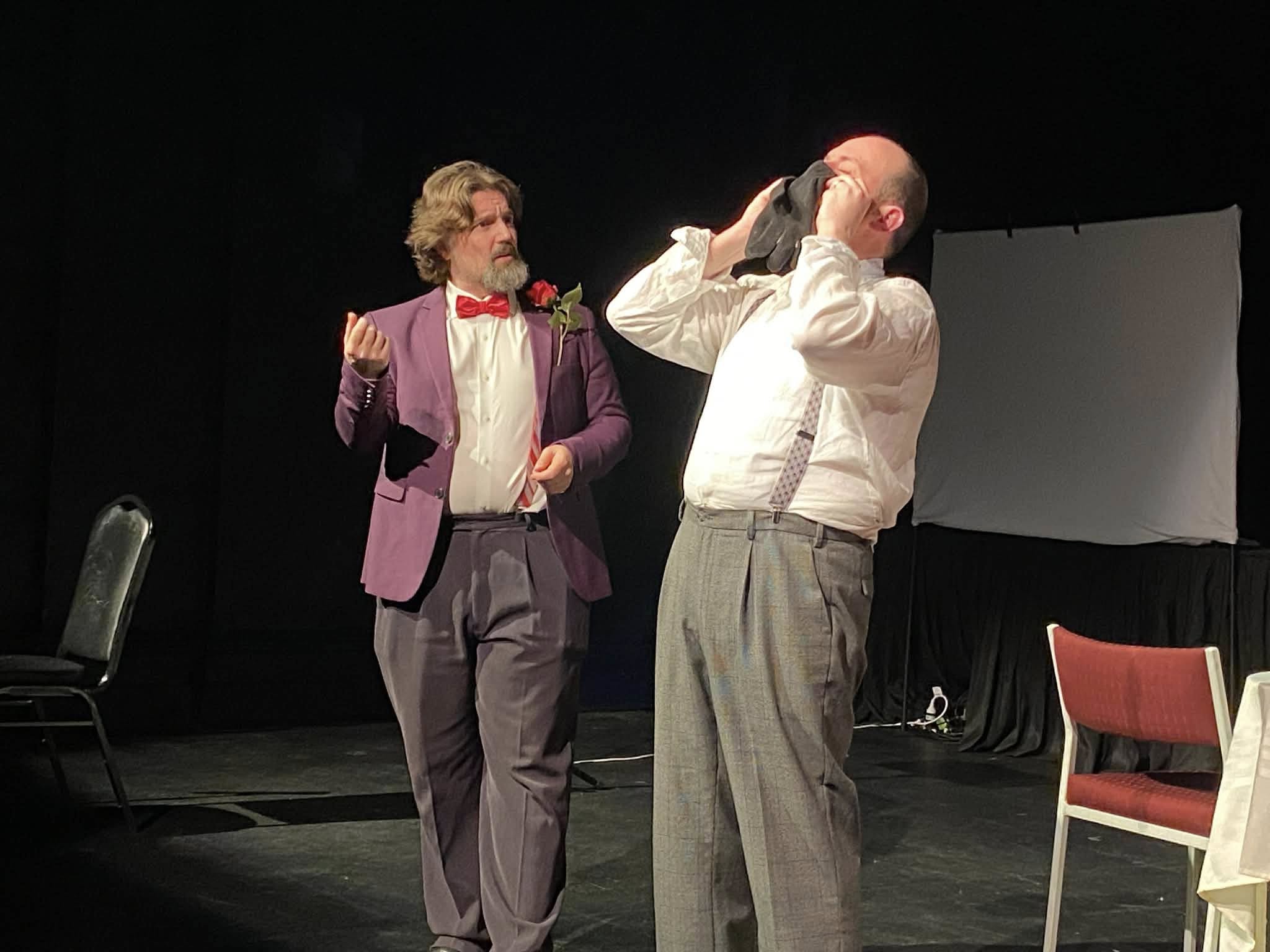
In celebrating the 40th anniversary of Michael Nyman’s one-act chamber opera, The Man Who Mistook His Wife For a Hat, IOpera in collaboration with Melbourne Opera have brought one of music’s more fascinating and thought-provoking rarities to Melbourne audiences. With a libretto by Christopher Rawlence, based on the book of the same name by famous British neurologist Oliver Sachs, Nyman has used the eponymous “Clinical Tale” to offer an insight into a neurological – and very human – predicament.
A “key” to this work lies in the Prologue as Dr. S (read Sachs) begins the Tale by speaking about Dr. P’s loss of accurate visual perception. “Neurology’s favorite term is ‘deficit’. … Deficit. Loss. Everything that patients aren’t and nothing that they are. … To restore the human subject at the center … we must deepen a case history to a narrative or tale. Only then do we have a who as well as a what, a patient in relation to disease, a real person.” In this 70-minute opera of seven scenes, Dr. P’s mental capacity is examined, and we see how music plays a central role in enabling a real person, “a musician of distinction … a singer” to find a way to negotiate life.
The impetus for mounting the opera came when Robert Macfarlane’s father suffered from a similar but temporary neurological emergency, one that involved perceiving his son as the family’s pet cat. In undertaking the dual roles of Director and Dr. S, Macfarlane has made a notable contribution to the success of this production. Possessing a fine tenor voice, clear diction and assured dramatic skills, he made the wordy pivotal role of Dr. S a solid foundation for the story’s examination of man you mistakes his wife’s face for a hat. An absurdist bent in Macfarlane’s style of direction placed further emphasis on the humour that is an integral part of the story alongside its essentially poignant aspects.
It would be difficult to find a singer better able to inhabit the role of Dr. P than Christopher Hillier. His exceptional performances the previous week in another contemporary one-act opera, Emma O’Halloran’s Trade, was yet more proof of his versatility, musicianship, daring and sheer stamina. When Dr. S decides that he should see Dr. P in his home environment, Nyman’s score moves from his customary minimalism style to include a performance of “Ich grolle nicht” from Schumann’s Dichterliebe (Poet’s Life), sung in German. Hillier’s performance made Dr. P’s persona as a famous singer totally credible. Although some of the very low notes in Nyman’s music were barely within Hillier’s comfortable vocal range, his vibrant tone and efforts at clear enunciation conveyed the essentials of the text. He showed remarkable vocal agility in the scenes where a kind of pattering syllable repetition is needed as Dr. P answers visual identification questions and when eating. Pairing repeated musical phrases and movements with everyday activities enabled Dr. P to function – until the music stopped. Quietly focussed and almost imperceptibly vocalising, Hillier followed the line of music sheets laid on the floor to bring the tale to a simple but theatrically striking conclusion as the music stopped altogether.
As Dr. P’s wife, Elena Xanthoudakis was the personification of the dutiful, loving over-protective – and somewhat in denial – wife, as she praised, fussed and glossed over difficulties with assurances that nothing was wrong. An Australian soprano, who continues to have a flourishing international career, Xanthoudakis’ voice has a most appealing shining radiance. Beautifully resonant, she was clearly audible on even the softest notes, with gorgeous spin on several long, sustained notes that Nyman weaves into the musical texture to great effect; however, the tessitura tended to be high and it was often very difficult to decipher the words. Even the Blake poem “The Sick Rose” would not have been recognizable for many in the audience – a pity because the end of that section and the end of “Ich grolle nicht” contain a similar theme of insidious darkness. Although the original text calls for Mrs P to accompany her husband on the piano – a meaningful choice in itself – it was actually Macfarlane who did so, very creditably.
Nyman’s music is inventive within its minimalist framework with an unusual addition of a harp to the small string quintet (an extra cello) and piano/ keyboard. Music Director Peter Treloar ensured a tight ensemble with Konrad Olszewski a highly reliable asset, firstly as a solo pianist during the Prologue and later on electronic keyboard up on the small stage with the other players.
Dr. S’s three white-coated “supernumeraries” enabled smooth scene changes, and they came in handy for some of the mimed episodes during orchestra-only passages. Veronica Uribe Sokolov’s video sequences were an important and effective element as Dr. P’s visual perception and memory were tested.
This might not have been the most literal staging of this work – small independent opera companies would be hard pressed to lay hands on the Bösendorfer piano referred to in the libretto – but there was a great deal to admire in this production. Macfarlane and his fellow artists are to be congratulated for their initiative in bringing a significant work to our attention and mounting it in such an entertaining way.
As Dr. S says in the Epilogue: “My only prescription is more music. More music!” It’s sound advice for all of us.
Photo credit: Robin Halls
__________________________________________________
Heather Leviston reviewed “The Man Who Mistook His Wife For a Hat”, presented by IOpera in collaboration with Melbourne Opera at the Athenaeum Theatre 2 on March 20, 2026.