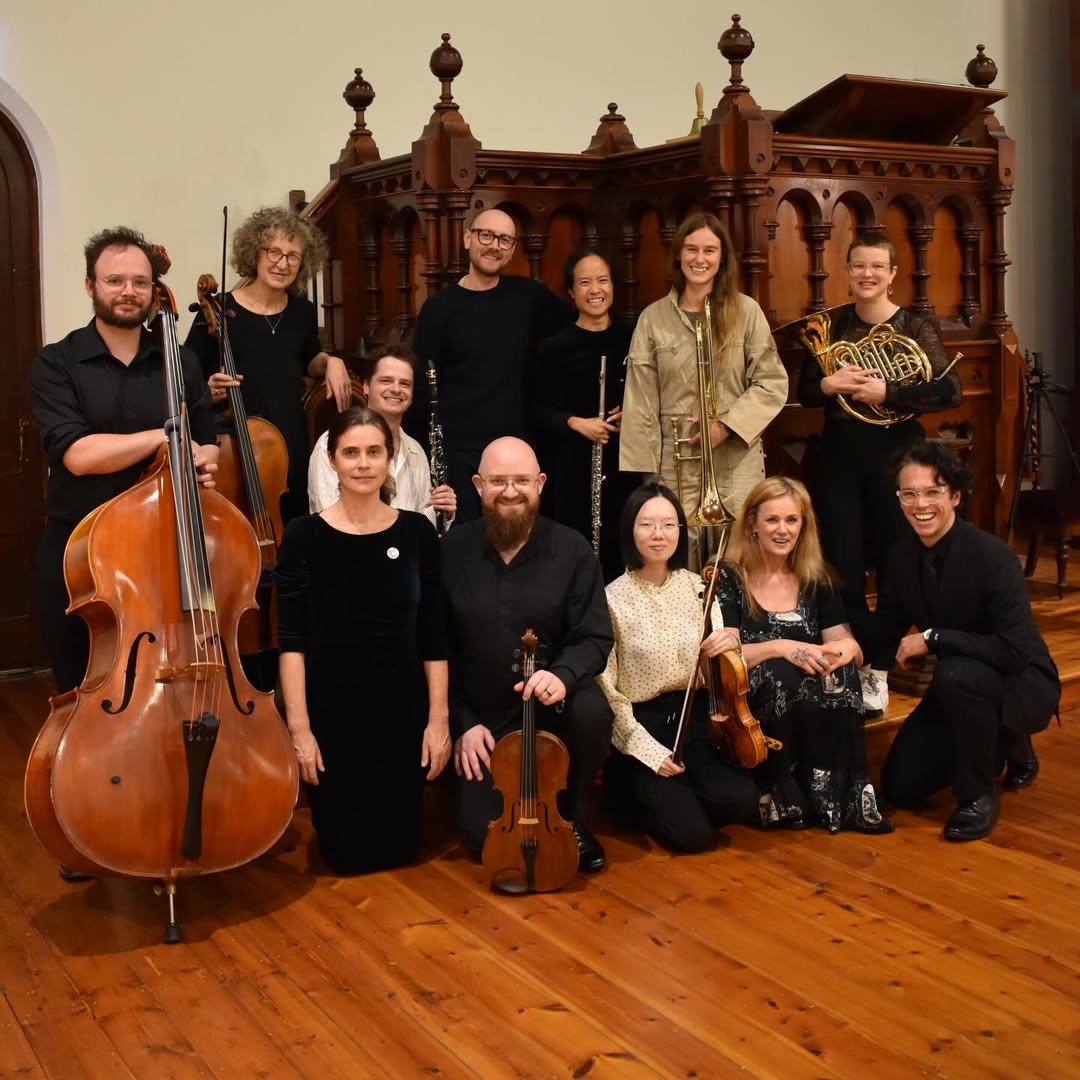
In the lead up to Forest Collective’s “Rubble Music” concert, this enterprising collection of musicians, directed by Evan J Lawson, published one of the best series of relevant Facebook entries of any musical organisation in Melbourne – bar none. Most focused on artists – mainly writers and composers – who responded to the devastation and horrors wrought by the Second World War, highlighting a quote from Berthold Brecht: “Art is not a mirror held up to reality but a hammer with which to shape it”. And there was some eloquent hammering and shaping in this concert.
Given the nature of this project, the opening piece, Fantasiestück: Des Abends, Op. 12 No. 1, für Klavier (1837) by Robert Schumann (1810–1856), came as a surprise; the dates seemed incongruous. Still, it was an evening (Abend) concert and it was also a reminder of a more serene era, even though Schumann did eventually suffer from an affliction that shattered his life. Played with graceful warmth by Danaë Killian, this short work encompassed both the surging pulse of soulful romanticism and meditative calm – the calm before the storm.
A complete contrast, we were immediately taken into the spiky chromatic tetrachords of Klavierstück III (1952), by Karlheinz Stockhausen (1928–2007). The smallest of the Klavierstücke cycle, it required a very different brand of pianism. Atonal in character and possibly alienating to the untutored ear, it was a completely different, aggressive sound world.
Killian was then joined by mezzo-soprano Aleise Bright for a work by German composer Isabel Mundry (b. 1963): Wenn: Lied, mit und ohne Worte /“If: Song, with and without words” (2006) with a text by Mundry after the poem Belsazar by Heinrich Heine. No translations from the German were provided for any of the sung items, but in his initial words of welcome, Lawson advised members of audience to approach the texts in terms of abstract music. In this particular case, it was good advice as Mundry’s music, as the title suggests, included vocalisations on vowels, beginning with a dramatic vocal crescendo. A most accomplished singer, Bright negotiated the sudden extremes of pitch and dynamics with ease, making gestures such as covering her mouth while stifling her breathing a convincing part of Mundry’s exploratory sonic language. The resonant acoustic of the Church of All Nations enhanced the vibrant fullness of Bright’s attractive voice.
After interval, Bright and Killian performed a second Mundry work: Lied für Mezzosopran und Klavier (2017) with a text by Inger Christensen (1935–2009). Part spoken and with the piano strings as well as the keys a part of the work, it did seem a shame to have no access to the text. Some performers – I believe Cathy Berberian was one – solved the problem of paper waste and having the audience looking at the text rather than the performers by having someone (usually the singer) read the text first. As it was, Mundry’s three-minute exploration of rhythm, harmony and pitch in this piece was another fascinating experience.
A key work in this concert was a piece of theatre – a true piece of Trȕmmerliteratur by one of its most important representatives, Wolfgang Borchert (1921–1947) in a translation by a core member of Forest Collective, Daniel Szesiong Todd. Borchert’s play The Man Outside: Prelude—spoken word between God, Death, the Old Man, and an Undertaker (1946) was originally a radio play and therefore well-suited to this performance, in English, by Todd and Bright. A belching Undertaker/Devil, grown fat on death and corpses, Todd conveyed with a certain relish the ghastly cynicism of a world where Death has become the new god. As God, in whom nobody believes anymore, and a sobbing, despairing Old Man, Bright was an effective counterfoil.
Preparation for Fünf Lieder (2006) by Aribert Reimann (1936–2024) required the dismantling of the section of the piano above the keyboard to enable Killian to make extensive use of the piano strings. A small snow dome had been placed on one end and fell to the ground as the board was being removed. The “Trümmerfrauen” /Rubblewomen immediately sprang into action, painstakingly mopping up water and glass with towels and brush and shovel, like a strange homage to the women who were left to clean up the destroyed remains of cities after the Second World War. It was amazing how much mess even a small snow dome could make. Borchert would have been proud of the symbolic imagery this entailed.
Then it was on to Reimann’s Fünf Lieder, after poems by Holocaust survivor Paul Celan (1920–1970). “Komm” began with Killian standing to strum the piano strings as well as play the keys. Again, it was regrettable that Celan’s words became instrumental music, but Reimann’s atonality was arresting in its variety of tempi, dynamics and musical effects, including melismatic passages for voice.
A very different work by Reimann from 1966 began the second half of the program: März (March), after a text by Günter Grass, for solo bass flute and narrator. It was initially presented in English, with Todd and Kim Tan often alternating – the flute generally spiky in solo work but soft and low beneath some of the narration. The repeated section had Todd almost spitting out the text in snarling over-enunciated German complete with gestures to emphasise meaning. It was chilling.
Danäe Killian was back on her familiar territory – “home” as she quietly called it – with Arnold Schoenberg (1874–1951) and his Suite für Klavier, Op. 25 (1923). The five movements: Präludium, Gavotte, Musette; Intermezzo, and Gigue were replete with the personality and imaginative dynamism that Killian habitually brings to Schoenberg’s work. What could be considered “difficult” 12-tone music made perfect sense under her technically and musically ultra-capable hands. Understandably, prolonged applause greeted this compelling performance.
Few might have connected Karlheinz Stockhausen (1928–2007) with Indian dancing, but Kim Tan’s performance of Ypsilon für ein Melodie-Instrument mit Mikro-Tönen (Version für Flöte) (1989) was just that. A slender figure made even more theatrical by the costume – black tights and leotard with rows of silver bells – she moved barefoot, wriggling, stamping and pausing to pose with the flute like a stylised dancing statue. Tan played the wavering lines of microtones just as Stockhausen specified moving in accordance with his exacting instructions, which also included mouth movements and kissing sounds. It was an unforgettable performance.
Requiring a chamber ensemble of nine instrumentalists plus voice and conductor, the performing area was rearranged for the final item: Fünf Lieder, Op. 4 for high voice and chamber orchestra by Franz Schreker (1878–1934), arranged from the piano version by Evan J Lawson in 1989. It is difficult to comprehend that Schreker was the most performed living opera composer after Richard Strauss in the early years of the Weimar Republic. The Nazis destroyed what was a brilliant career. In some ways we were back where we started – in a melodic world, even though Schreker had his own “experimental” version of same. Each of the five songs used texts by a different writer, beginning with the short song “Unendliche Liebe” by Tolstoy. Different instruments were featured in the songs – predominantly flute, horn, clarinet – until the yearning character of the final song. Under Lawson’s direction, the ensemble and Aleise Bright brought these appealing songs to vivid life.
It is heartening to see a full house for a concert of twentieth century music – a tribute to the passion and imagination that earlier this month also saw Evan J Lawson and Daniel Szesiong Todd awarded Outstanding New Australian Opera for Labyrinth.
Photo supplied.
______________________________________________________________
Heather Leviston reviewed “Rubble Music”, presented by Forest Collective at the Church of All Nations on March 27, 2026