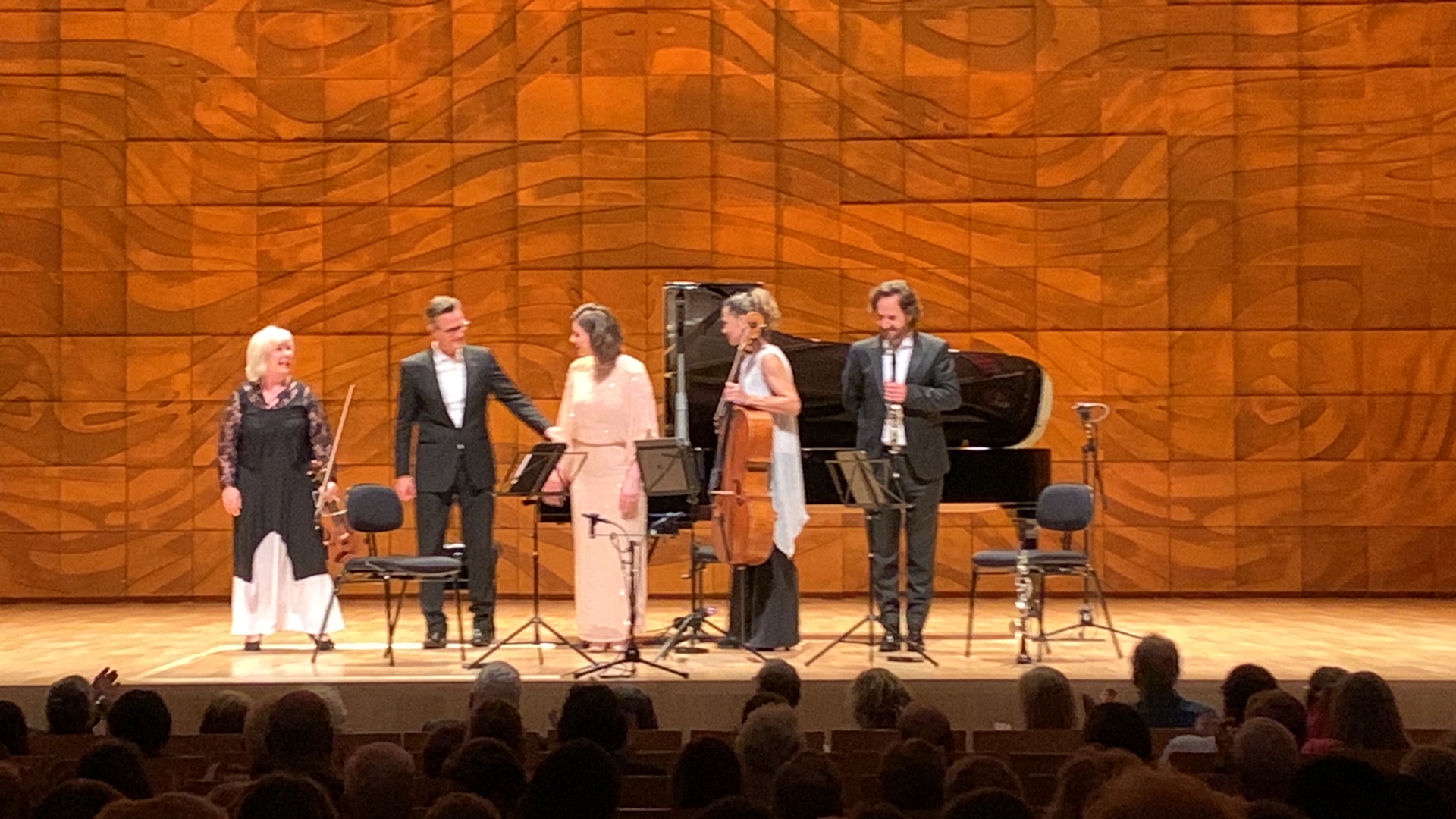
As Ensemble Liaison’s clarinetist extraordinaire and chief spokesperson, David Griffiths reminded us in his customary genial opening words of welcome that 2024 is the Ensemble’s 19th season. We would have to agree with him that this longevity means they “must be doing something right”; this concert was an excellent example of significant musical achievement both in terms of quality of the performance and a program that he called “self-indulgent for us” and “for you to enjoy”. That we certainly did.
In introducing the first piece, Beethoven’s Piano Trio No.4 in B-flat ‘Gassenhauer’, Op.11 (1797), Griffiths praised the ensemble’s pianist, Timothy Young, for recognising what a good fit this work is for them. It is hardly a work for three equal voices, but Beethoven places one instrument in the spotlight for each of the three movements. In the opening Allegretto con brio, it is the clarinet. Griffiths control of his instrument is masterly, but even his ability to encompass a huge dynamic range could not prevent the clarinet overwhelming the cello. It could be that the alternative scoring for violin would have avoided this, but Griffith’s joie de vivre and capacity for a melting tone gave this movement just the “brio” it needed. Timothy Young’s contribution on the piano was notable in this and the following movements for elegant clarity. It was a pleasure to hear Svetlana Bogosavljevic ‘s cello launch the second movement Adagio in a solo introduction, the warmth and sensitivity of her playing always appealing. The final Allegretto movement was indeed enjoyable as variations on a theme from a popular comic opera by Joseph Weigl gave the trio its name – the “Gassen” being the laneways of Vienna where popular tunes were whistled. Apart from the thematic material being catchy, Young’s virtuosity on some of the nine variations was exhilarating. With alternating combinations of instruments and some graver moments added to the mix, the whole movement romped in playful fashion to an ebullient close.
Following this energising performance by the core members, Eleanor Lyons, the first of two guest artists for the evening, joined Young for two lieder by Franz Schubert: “Ganymed” and “Abendstern”. Although the Lyons spoke about Ganymed after singing it, the practice of providing no translation when songs are performed in a foreign language is lamentable. I’m sure if opera companies did away with surtitles they would lose a substantial part of their audience; making a performance as accessible as possible makes it more engaging and rewarding. A listener can sit back and enjoy the sound of a voice simply as an instrument, but Schubert surely had a little more in mind – as did Strauss when he wrote Vier letzte Lieder (Four Last Songs), the final item on the program.
What immediately strikes the listener about Eleanor Lyons’ soprano voice is its resonance, accentuated on this occasion by the acoustic blinds of the Elisabeth Murdoch Hall being fully retracted. An expressive singer, her softer notes floated beautifully, and it was only when Griffiths joined them for “Der Hirt auf dem Felsen” (The Shepherd on the Rock) that the acoustic became somewhat problematic. The upper notes of those daunting upward leaps in the vocal line became overly emphatic and seemed even more out of place when Griffiths repeated phrases with smoother dynamic shape. Nevertheless, it was understandable that Lyons was keen to try out one of her long-time Schubert favourites with such skilled artists. The slow second section was especially affecting and featured some beautifully controlled diminuendos.
After interval, second guest artist and frequent collaborator, Elisabeth Sellars, joined Young and Bogosavljevic for another Schubert work, his Notturno in E-flat D.897. The soft, gentle opening passages of rocking spread chords against the melodic line of violin and cello were followed by crystalline piano work against plucked strings. More dramatic material alternated with calmer episodes in what was a most satisfying blend of instruments for this captivating ten-minute piano trio.
Any misgivings regarding the Schubert songs were totally absent for the Strauss; this transcendent work was given a remarkably compelling performance by all players, with Eleanor Lyons’ singing simply ravishing in every respect. Her physical composure and superb command of a controlled, supple vocal line were evident in all four songs. We might not have understood the literal text, but the emotional content could not have been clearer. Lyons possesses an instrument of natural resonant allure and her singing embodied Griffiths’ description of the work: “painfully beautiful”.
We are accustomed to hearing Vier letzte Lieder in its orchestral arrangement, but Strauss himself scored some works for various combinations of instruments, and altered instrumentation dramatically within works, so Timothy Young’s arrangement for violin, cello, clarinet and piano to accompany the soprano voice follows a well-trodden path. Even in this pared-down form the splendour of a full orchestra was present right from a surprisingly lush opening. Those familiar with the work will have anticipated (as a kind of pre-echo) the orchestral outburst at the beginning of the final song, “Im Abendrot”; what we heard had a fullness of sound and emotional intensity that conveyed Strauss’ musical intensity convincingly. The piano was used not just to emulate the trilling birdsong towards the end of the piece, but also to add texture and drama throughout. There was a subtlety to Young’s orchestration, and to Griffiths’ playing in particular, which worked admirably. Strauss provided the solo violin with some of the most exquisite, yearning passages that have ever been written, and Sellars performed these with persuasive emotional intent.
How Ensemble Liaison can possibly match such a memorable experience in their milestone twentieth season remains to be seen. It won’t be easy.
__________________________________________________________________________________________
Heather Leviston reviewed “Ensemble Liaison with Eleanor Lyons”, presented by Ensemble Liaison at the Melbourne Recital Centre, Elisabeth Murdoch Hall on November 20, 2024.