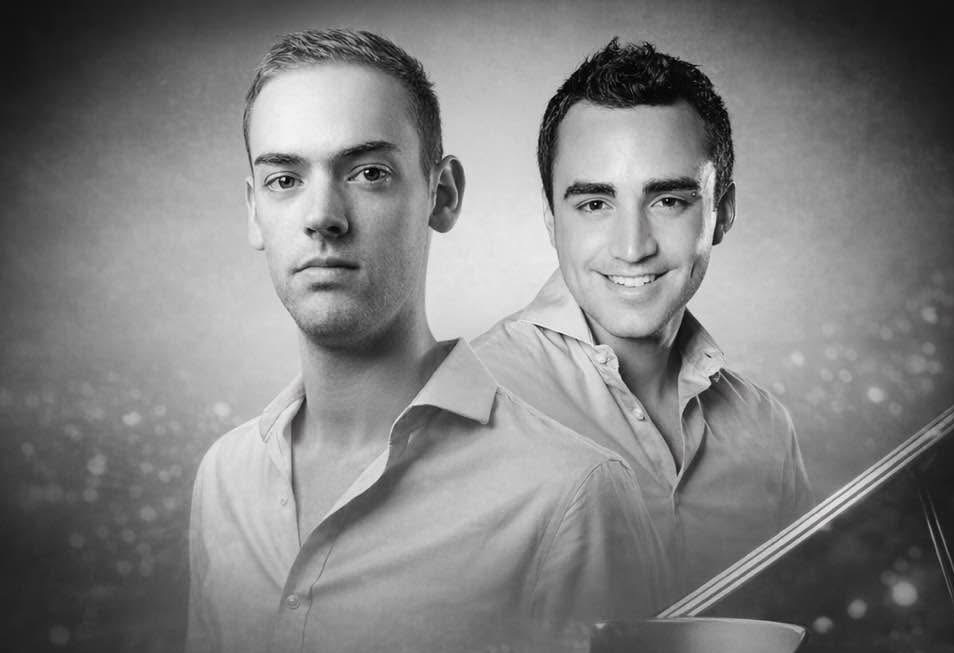
“Pianos en Pointe” was a concert of music for two pianos that brought together a wide range of repertoire, from Bennett and Kapustin to Adams, Ravel, Debussy, Muhly and Brubeck. Melbourne Piano Duo Chris Nankervis and Peter Toohey approached this variety with a consistent musical language: rhythm was handled with flexibility and control, articulation remained clear, and harmonic colour was shaped through careful voicing. The result was a program in which works of differing style were connected through sound and touch rather than treated as separate musical worlds.
Richard Rodney Bennett’s (1936–2012) “Samba Triste” from the Divertimento for Two Pianos (1984) opened the concert with an ease of tone and ensemble that immediately established the duo’s musical relationship. Bennett, an English composer who spent much of his later career in New York, absorbed elements of American and jazz idioms into his writing, and this is evident here in the relaxed samba rhythm and modal harmonic language. Nankervis and Toohey allowed the piece to remain unassuming, resisting any overstatement. The result was a warm and engaging opening that highlighted their ability to function as a unified ensemble rather than as competing soloists.
Peter Toohey’s solo performance of the Prelude from Nikolai Kapustin’s (1937–2020) Eight Concert Etudes, Op. 40 (1984) demonstrated a markedly different aspect of his playing. Kapustin’s music occupies a unique position: its language is drawn directly from jazz, yet it is fully notated and demands a classical precision of execution. Toohey’s rhythmic control and articulation in rapid passagework were handled with clarity, giving the music its necessary propulsion without sacrificing definition.
Chris Nankervis’ performance of John Adams’ China Gates (1977), an early solo work from the American minimalist tradition, was notable for its evenness of tone and sensitivity to subtle pattern changes. Much of the writing lies in the upper registers of the instrument, and Nankervis maintained a consistent clarity across these textures. The gradual shifts between patterns were allowed to emerge naturally, without overt emphasis, producing a continuous and gently unfolding musical line.
Maurice Ravel’s (1875–1937) Daphnis et Chloé, Suite No. 2 (1912), heard in the arrangement by Vyacheslav Gryaznov, formed the centrepiece of the first half. In “Lever du jour”, the opening textures were shaped with care, though the accompanying figures at times sat slightly too prominently in the foreground; a more recessed sonority—perhaps through more decisive use of una corda—may have allowed the opening to function more fully as an underlying layer. The upper-register figuration, particularly the birdsong-like gestures, was executed with brilliance and clarity. The “Pantomime” was handled with sensitivity, the principal melodic line given space and flexibility, avoiding any sense of middle-movement inertia. In the final “Danse générale”, both pianists maintained strong rhythmic propulsion through technically demanding passagework.
Following the interval, Toohey introduced Dave Brubeck’s (1920–2012) Points on Jazz (1961), a ballet score presented here in a two-piano arrangement. The first set (Prelude, Scherzo, Blues) revealed the duo at their most stylistically assured. The Prelude opened with an ambiguous tonal centre before settling into a more clearly defined jazz idiom. Throughout, the balance between the pianists was exemplary: roles were exchanged fluidly, with neither performer dominating.
Claude Debussy’s (1862–1918) L’Isle joyeuse (1904), performed by Nankervis, combined technical command with a clear sense of direction. The flexibility of rhythm was handled with care, and pedalling maintained clarity even in denser textures. The final build was sustained with energy without resorting to empty display. The second Brubeck set (Fugue and Rag) continued to demonstrate the duo’s affinity for this repertoire. The Fugue was rhythmically clear, though at times the subject could have been projected more prominently. The Rag that followed was more immediately effective, with crisp articulation and strong forward motion.
Nico Muhly’s (b. 1981) Eiris, Sones (2020) provided a striking contrast. Toohey’s control of dynamics within a restrained range allowed inner voices to emerge clearly, and the layering of sonorities was handled with sensitivity.
The final Brubeck movements (Waltz and À la Turk) returned to a more overtly rhythmic language, with confident handling of shifting metres and sustained momentum through the final movement.
The concert concluded with the Finale from Bennett’s Divertimento (1984), returning to the relaxed idiom of the opening. Its gospel-inflected harmonic language provided a fitting close to a program that balanced technical command with a strong sense of ensemble.
Photo supplied.
______________________________________________________
Stephen Marino reviewed Pianos en Pointe – Chris Nankervis and Peter Toohey, presented at Middleton Hall, Camberwell Grammar School on March 22, 2026.