There are ghost stories aplenty in Scottish legends, many involving malevolent spirits luring people to their doom. It is this aspect of Verdi’s Macbeth that director Kate Millet has chosen to emphasise in BK Opera’s latest production, now showing at the Kensington Town Hall.
This Macbeth is one of the outstanding operatic productions of the year, not only for Millet’s daring concept but even more so for Livia Brash’s phenomenal performance as Lady Macbeth. Her “partner in crime”, Henry Shaw, gave what is probably the performance of his life to date; his rich, manly baritone voice, coupled with a commanding presence, made him an impressive Macbeth. Brash and Shaw were a match in vocal weight, beauty of tone and convincing physicality. Many opera lovers will have admired their recent performances as Fiordiligi and Don Alfonso in Cosi fan tutte for the Richard Divall Program, but what they achieve in Macbeth is up a level. How they could prepare two major roles simultaneously and perform them end-to-end is testament to their energy, vocal health and commitment.
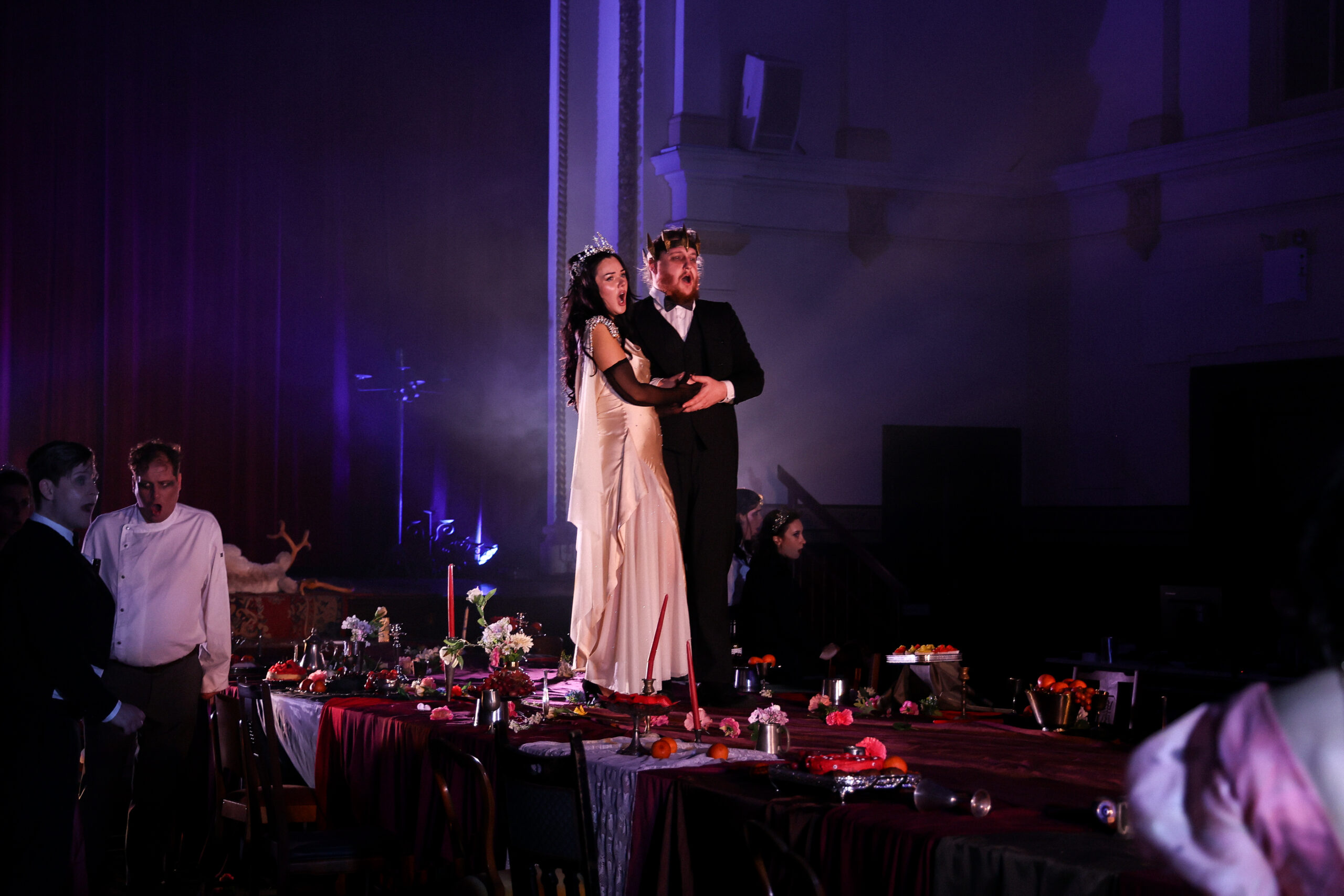
Apart from the vocal demands of Verdi’s score, Millett’s direction and Max Bowyer’s set design posed unusual challenges for the singers. Most of the action for the principal singers took place on a long banquet table with steps leading up to it on one end and a link to the edge of the hall’s proscenium arch stage at the other. The banquet table was decked out with goblets, candlesticks, flower arrangements and food – genuine food – you could smell fresh cake when the witches/forces of darkness created the mayhem of a disintegrating society as they sang a cauldron chorus while flinging food, flowers and objects around. Fortunately, the chorus band of witches was sufficiently controlled to avoid hitting any members of the capacity audience ranged in rows close to the banquet table. Millet’s productions seek to create a close connection between the audience and performers, and we did have a sensation of being extra guests at the banquet, intimate witnesses to the unfolding horrors.
These horrors began during the Overture. As pianist Konrad Olszewski played, a hunted figure ran along the hall, then a body (a real one!) was dragged and heaved across the floor, up the stairs, along the long, long banquet table and deposited on the stage only to be graphically stabbed to the dislocating accompaniment of serene music. It was a brutal image of the savagery of war, with a chorus of witches, masked and dressed in voluminous dark garments, swirling about.
Part of what made this work so effectively was Gabriel Bethune’s lighting design, which was tremendously atmospheric throughout the opera. The hall as such disappeared as were transported to another realm of spotlights and shadows. When the smoke machines worked overtime and the performers moved about, the two screens showing the “surtitles” were sometimes obscured, but, given the familiarity of the story, only a glimpse of the screens was enough to keep the audience on track. Besides which, the action detail was too riveting to miss by reading the text detail.
The other aspect of the opera that we came to forget about was the lack of an orchestra. Seated towards the end of the hall in front of a huge pale translucent curtain, Olszewski became an orchestra, playing the piano transcription with consummate skill. During the Overture, conductor Leonard Weiss (best known to local music lovers as the Melbourne Symphony Orchestra’s 2024-25 Cybec Assistant Conductor) sat quietly, only rising to conduct the performers. This was no easy task with chorus members spread about as witches or banquet guests. Although there were many strong singers among their number, it was really only when grouped together in one of Millett’s striking tableaux that they became a well-integrated vocal force – the three-quarter creature masks appearing to limit projection less.
Perhaps the most unusual aspect of the production was signaled in the main publicity image: a felled white stag. In Scottish myth, the sighting of one brings good luck, whereas killing one unleashes ghosts and misfortune. When Macbeth made his entrance he carried a white stag slung across his shoulders. After making his way across the table, he deposited it on the stage apron, where it remained as a succession of characters delved into it and came away smeared in blood. It was a powerful way to set the scene, and Henry Shaw maintained the intensity with Macbeth’s first aria as he set the virtual rafters ringing with his vocal might.
It seemed, however, that Verdi could have called the first half of the opera Lady Macbeth given the size and importance of her role. It was hard to fathom why costume designer Oliver Hall had chosen a pale lavender Disney princess dress for her opening scenes though. A female “wolf in sheep’s clothing”? Brash has uncommon beauty and looked inviting in an ultra-feminine way, but not the type to prompt Macbeth to say, “Bring forth men-children only; for thy undaunted mettle should compose nothing but males.” Other costume designs for Lady Macbeth worked well – appropriately regal for the banquet scene and delicately fragile for the sleep-walking scene. The latter was at once highly dramatic and devastating as Brash traversed a laid-waste banquet table while singing one of the great Verdi arias with astonishing vocal colouring and assurance, nailing that top D at the end. It was easy to see why people have said that Livia Brash was born to sing this role.
While other singers were bound to pale a little beside these two vocal powerhouses in the leading role, baritone Nick Beecher made a very creditable Banquo, singing musically and acting confidently. Although Daniel Szesiong Todd sounded uncharacteristically uncomfortable on some of the highest notes on the night, he sang strongly and passionately as Macduff. Members of the chorus undertook minor roles reasonably successfully.
This is a most interesting but complicated production, and it is a huge credit to all concerned that it flowed so well on opening night. While there were many visual revelations, it was Livia Brash’s performance in particular that will remain imprinted on the memory.
Photo credit: Kate Cameron
_______________________________________________________________________
Heather Leviston reviewed BK Opera’s production of Giuseppe Verdi’s “Macbeth”, presented at Kensington Town hall on November 21, 2025.