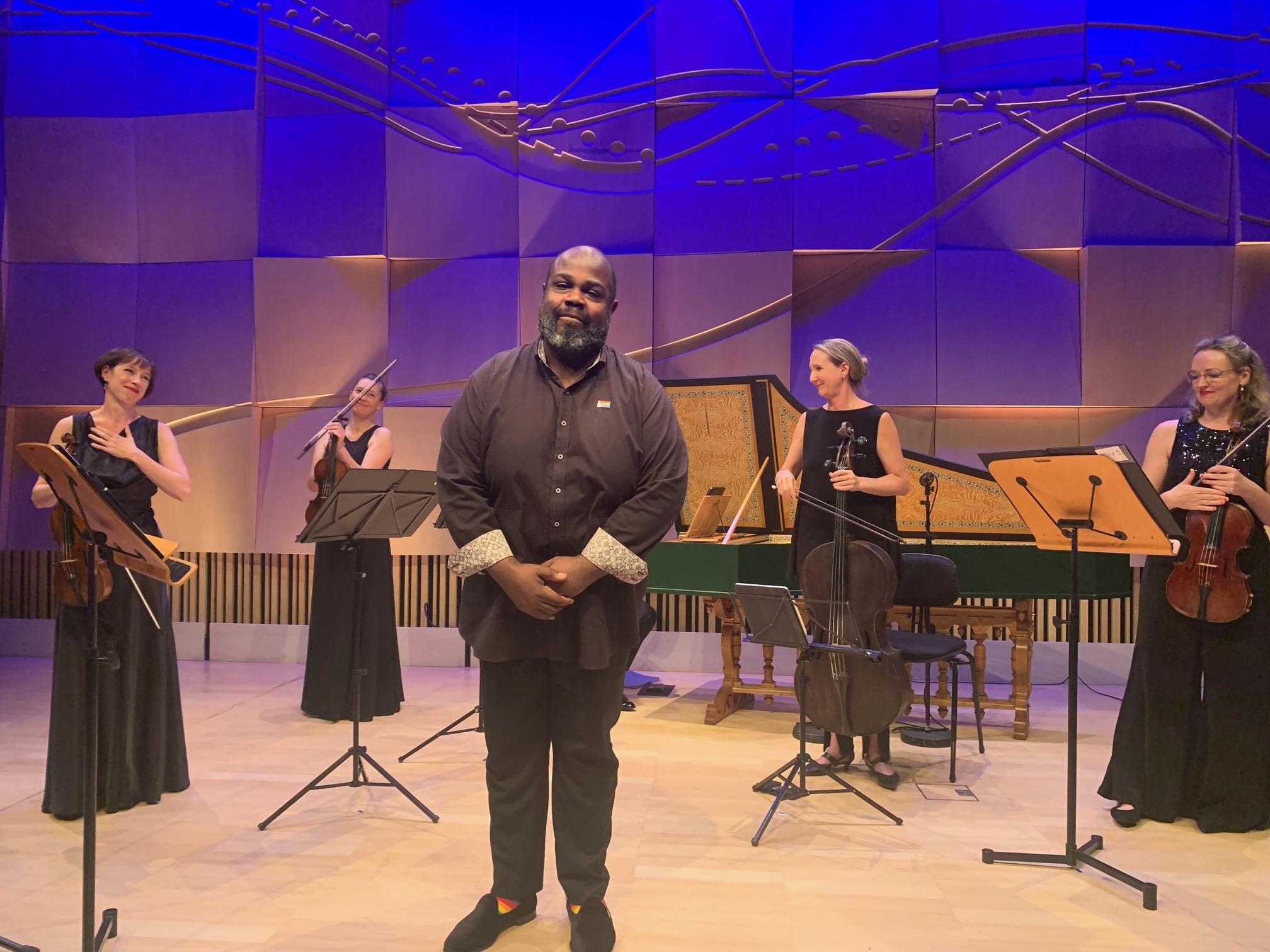
It’s not often that a prolonged standing ovation and enthusiastic cheering is heard at the end of a recital of classical music in the Primrose Potter Salon, but that is what happened on Saturday night, with some tears along the way. Word had spread that the Bach Akademie Australia (BAA) concert starring American countertenor Reginald Mobley was not to be missed.
Despite the disappointment entailed in missing James Ehnes’s masterclass at the Iwaki Auditorium or the Boulez extravaganza at the Australian National Academy of Music, this one promised to be an unforgettable experience. Sold out well beforehand, it was a pity not more people were able hear Mobley – possibly in the Elisabeth Murdoch Hall. As it was, the intimacy of the Salon was tailor-made for an artist whose connection with his audience is exceptionally warm and direct.
We have BAA’s Artistic Director, Madeleine Easton, to thank for bringing Mobley to Melbourne for this concert of Bach’s music. They met when he was asked to join the English Baroque Soloists and Monteverdi Choir for a worldwide tour of the St Matthew Passion in 2016. A planned Australian tour with BAA in 2020 had to be postponed five years. It was worth the wait.
Within a few bars of beginning the Aria “Vergnügte ruh” from Cantata BWV 170, the beauty of his voice coupled with Bach’s music was enough to inspire a visceral response – an impulse to burst into tears. Mobley’s voice has a velvety timbre – plush and smooth – that is intensely moving. The only comparable voice I have heard for breathtaking beauty of tone is when Derek Lee Ragin sang “Cara sposa” in the Great Hall of the National Gallery of Victoria several decades ago. Ragin’s performance was steadier and more flowing than might have been expected from some of his recordings, with a vibrato more similar to what we heard from Mobley. Vibrato is to some extent a matter of personal taste, but to this listener Mobley’s clean line with a relaxed tasteful vibrato seemed pretty well perfect.
Although in the final Cantata BWV 54 “Widerstehe doch der Sünde”, the lowest notes revealed a stronger more baritone quality, his voice is very even – of a piece from top to bottom without jerky transitions. There was ease on the lower notes of the Aria “Schlummert ein” (Fall asleep) from Cantata BWV 82a. Excellent control of breath and dynamics was apparent at all times and at all pitches. The way he spun out the soft beginning of the “Agnus Dei” from the Mass in B minor was wonderful. Diction was clear even though from one metre away it did seem slightly exaggerated occasionally. A short silence at the conclusion of this aria suggested that the audience as a whole felt it almost sacrilegious to applaud. The final Cantata calls for another major string to a singer’s bow: agility. Mobley nailed it.
Apart from the florid passages of “Widerstehe”, much of the musical excitement of this piece comes from precise instrumental vigour. In addition to being a gifted baroque violinist, Madeleine Easton is one of the most enthusiastic passionate musicians you could find; the way she led the first aria of this cantata displayed a fearless approach to the music, attacking with determined colour as we were exhorted to “Resist sin”.
Along with Simone Slattery (violin 2), Heather Lloyd (viola), Anthea Cottee (cello) and Neal Peres Da Costa (harpsichord), Easton provided a vivid accompaniment to Mobley’s artistry and gave a fine account of several instrumental pieces. In her introduction to the second item, Obbligato Sonata No. 2 in A, Easton spoke about the piece and how it was structured. Unfortunately, the power of her brilliant “obbligato” and a very resonant cello made the two lines ascribed to the harpsichord extremely hard to hear at times. It was only in softer passages with pizzicato cello that it was clearly audible.
Two pieces for solo violin, Largo and Allegro Assai from Sonata No.3 in C and the only non-Bach item, “Clans”, by Indigenous Australian composer, Troy Russell, arranged for solo violin by Easton, were played with grace and verve. Easton spoke at some length about her relationship with Troy Russell and some extraordinary connections they shared. Russell was commissioned by BAA to write a piece inspired by Bach and the Morning Star (Venus) – a star that unites both hemispheres and all people, races and clans.
In her friendly little chats between items, Easton also spoke about Bach’s use of the concept of four voice categories and their connections to the four elements (soprano/fire; alto/air; tenor/water; bass/earth) in his religious music, with the alto voice representing the Holy Spirit. She notes, “Bach uses the alto voice as the voice of consolation, as the bridge between Heaven and Earth, thereby completing the Trinity”.
The concept of connections and what unites us in our diversity – Mobley is a passionate advocate for human rights and the LGBTQI+ community – underpinned his encore, “Steal away to Jesus”. He spoke about the way music has been part of all cultures over millennia and how Gospel songs were also a way for slaves to communicate hidden messages as they sought freedom. It was also a reminder of those still trying to “steal away”, and a personal and tremendously moving finale.
______________________________________________________________________________________
Heather Leviston reviewed “The Countertenor – Bach’s Holy Spirit”, presented by Bach Akademie Australia at the Melbourne Recital Centre’s Primrose Potter Salon on April 11, 2025.