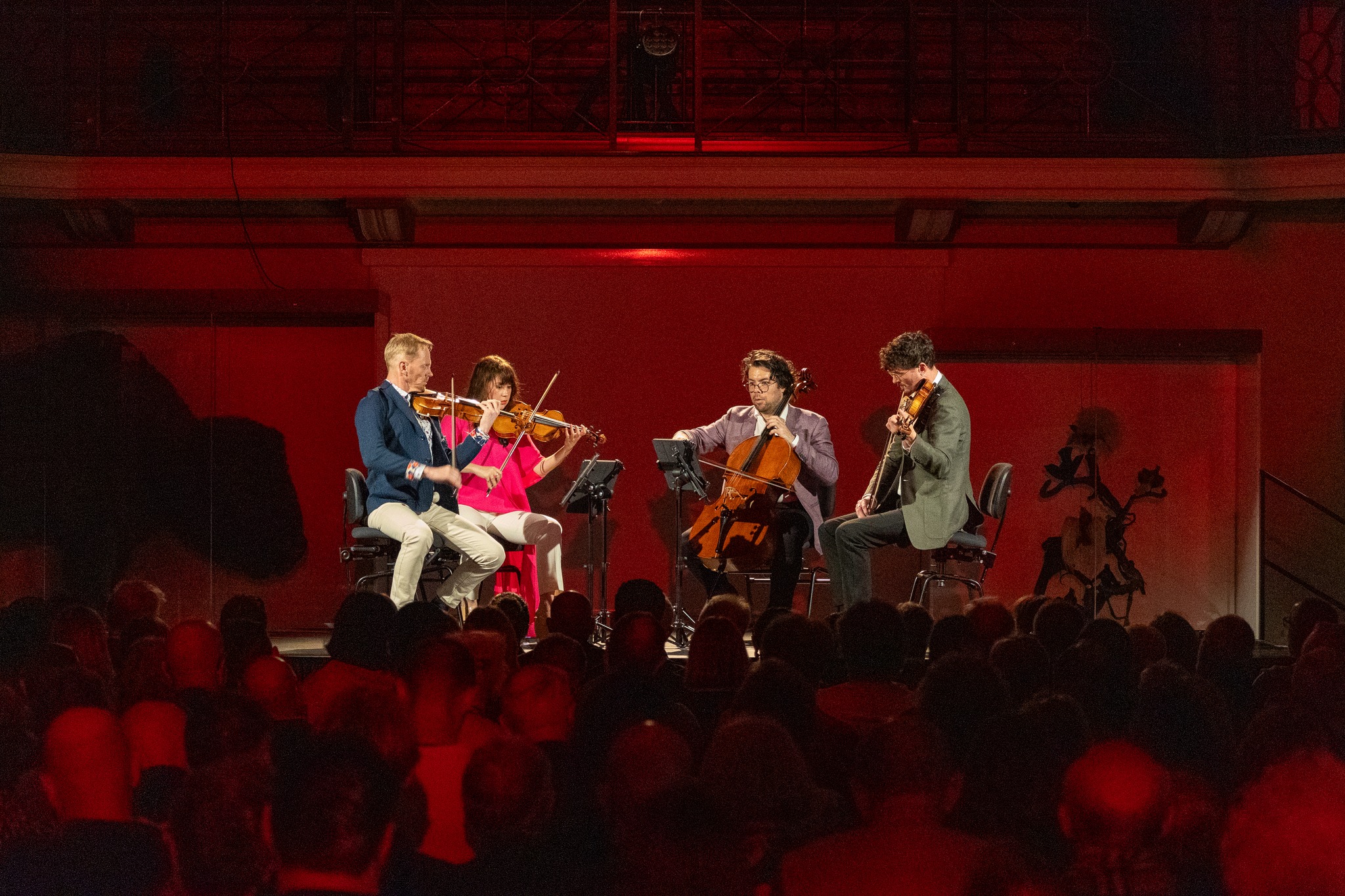
When the Australian String Quartet comes to town, the foyer of the Melbourne Recital Centre is quite abuzz in Hollywood style; the red carpet is rolled out for these most admired and loved string players, with their longtime admirers, colleagues and a dedicated audience stimulated by the electric atmosphere, eagerly anticipating tonight’s substantial and challenging musical offering. Post-concert complementary wines and busy photographers lining up the many dedicated support teams and creative managers, special colleagues and patrons added joy and sparkle to this celebration of the 40th year of the ASQ.
A splendid printed program briefly documenting the history of ASQ, came with photos of the 24 Quartet members to date, highlighting just a few of their many international and regional cross-art collaborations through the decades.
In 2010, Adelaide’s UKARIA Cultural Centre purchased four rare Guadagnini 18th century instruments, on loan to ASQ musicians – an unprecedented achievement. We know a unique sound quality has been developed, and the musical program is always substantial, with the best of classical and contemporary works on show, so expectations are always high.
Having recorded three String Quartets with the ABC by Sydney composer Paul Stanhope, ASQ’s choice of opening the program with his 12-minute single movement String Quartet No 1, Elegies and Dances, was a perfect way to engage the audience. With slow, dark, ominous tone colours taking us from low sliding and rising steps, short patterns searching for a rhythm or a lighter place, Dale Barltrop’s lead soon took the ensemble upwards, with increased energy, assertiveness, weird and fascinating glissando shapes coloured often with a new and edgy pizzicato percussiveness. A shimmering central resting place required great balance and connection between players; extreme violin celestial pitches rising high over earthy viola and cello themes held us in suspense, taking our musical vision to a dreamy, almost distant exotic land. Sensitive and captivating, requiring concentrated precision and intense storytelling tonal colours, this fascinating piece for strings was well received.
Benjamin Britten wrote his String Quartet No. 2 Op. 36 in the same year his opera Peter Grimes brought him international fame. Yet it was only first performed in 1946 after the composer had visited concentration camps in Germany and suggests a darker mid 20th century style. From a beautiful beginning of gentle unity and classical calm, new shapes surrounded sustained string drones, and searing, wide melodic two-note steps developed. Barltrop brilliantly held a most authoritative leadership role, sensitively and powerfully affective, soaring above agitated and defiant rhythmic accompaniments in the first movement, Allegro calmo senza rigore. Rhythmically complex, at times disturbing, each member of the quartet was distinctive with solo entries and contrasting timbres, or united with sounds melting together to end with softness over four-note cello chords and a fine morendo (dying away). Mutes were added for the Vivace second movement, a section requiring much energy and virtuosity from all players with double and triple stopping, sudden changes between pizzicato and legato playing and quite abrupt changes in dynamics. Dedicated to Purcell, “Chacony”, the third (and longest) movement was a set of sophisticated variations on the Baroque dance form. We admired the substantial cadenzas given to second violin, viola and cello, and the Quartet’s colour and beauty in an intense landscape.
Following interval, we were given more fabulous musical enrichment with a powerfully expressive performance of Schubert’s String Quartet No. 14 in D minor, “Death and the Maiden”. Again Barltrop set a most sweetly singing tone in a passionate first movement, with the quartet united in sensitive bowing, highly balanced and even crescendos, and a most sensuous and heart-touching final cadence. How haunting is the introspective opening of the second movement with its funereal chordal steps leading to the series of variations on Schubert’s “Death and the Maiden” song. Michael Dahlenburg’s cello was particularly impressive in his solos where deeply felt warmth and lyricism emerged, first through the song then in gently throbbing repetitive pulsating octaves leading the quartet to more fevered movement and angst. The audience was motionless, fully absorbed, held by the exquisite artistry and connection with the quartet and the final chords composed by death-haunted Schubert in his last sorrowful years. By contrast, the third movement Scherzo was buoyant and lightly dancing in tempo, with every note from each player melodically clean, clear and gently soothing. This allowed the closing fourth movement Presto to produce a taut and more feverish delivery, with momentum growing as bows were given a strong physical workout in a colourful execution of the “Dance of Death”.
A standing ovation and lengthy applause showed the full enjoyment of this 40th year celebration of the ASQ, a quartet of world-class musicians sharing superb instruments with fine repertoire.
Photo supplied.
__________________________________________________________
Julie McErlain reviewed “Convergence”, presented by the Australian String Quartet: Dale Barltrop, violin; Francesca Hiew, violin; Chris Cartlidge, viola; Michael Dahlenburg, cello, at the Melbourne Recital Centre, Elisabeth Murdoch Hall on October 27, 2025.