t may be the Australian Chamber Orchestra’s 50th birthday this year, but it is the audience that continues to receive special gifts. This tour (rather unimaginatively titled Gershwin and Shostakovich) delivered a generous and diverse program with much beyond those two composers. The evening also delivered the typical sense of occasion that few outside of the ACO seem to engender on such a consistent basis.
Claude Vivier’s Zipangu was a characteristically bold and fascinating choice to open proceedings. Vivier emerged from Stockhausen’s Cologne school to work in the height of the avant-garde in Canada. This piece dates from 1980 and was heavily infused by a trip in the late seventies through Asia, particularly the Kabuki theatres of Tokyo and the music and rituals of south Indian culture. The textural breadth and orchestral colours achieved with just strings were remarkable. Vivier was apparently a tragic character, living only until 35 and spending most of his life a lonely melancholic. Much of that is evident in the music. The orchestra delivered a committed performance that seemed fully in control of the complex rhythms (conducted by Tognetti), extended techniques and some very exposed solos (particularly for Maxime Bibeau’s bass).
It’s hard to imagine what needing to seek refuge from an invasion of your homeland in your mid-eighties must feel like. A sonic reaction to those circumstances from the complicated and wonderful Valentin Silvestrov followed with the world premiere of Moments of Memory. Silvestrov is arguably the best-known Ukrainian composer to date. He fled his Kyiv home in 2022 and became a refugee in Berlin from where he composed this new work for the ACO. A real coup. In recent decades Silvestrov’s music has been characteristic for its melancholic whimsy and minimal simplicity. Moments of Memory takes these ideas to their limit in an unbroken chain of eight short movements that utilised a rich harmonic palette and rhythmic surprise to form a compelling and deeply personal exploration of loss in the face of political unrest.
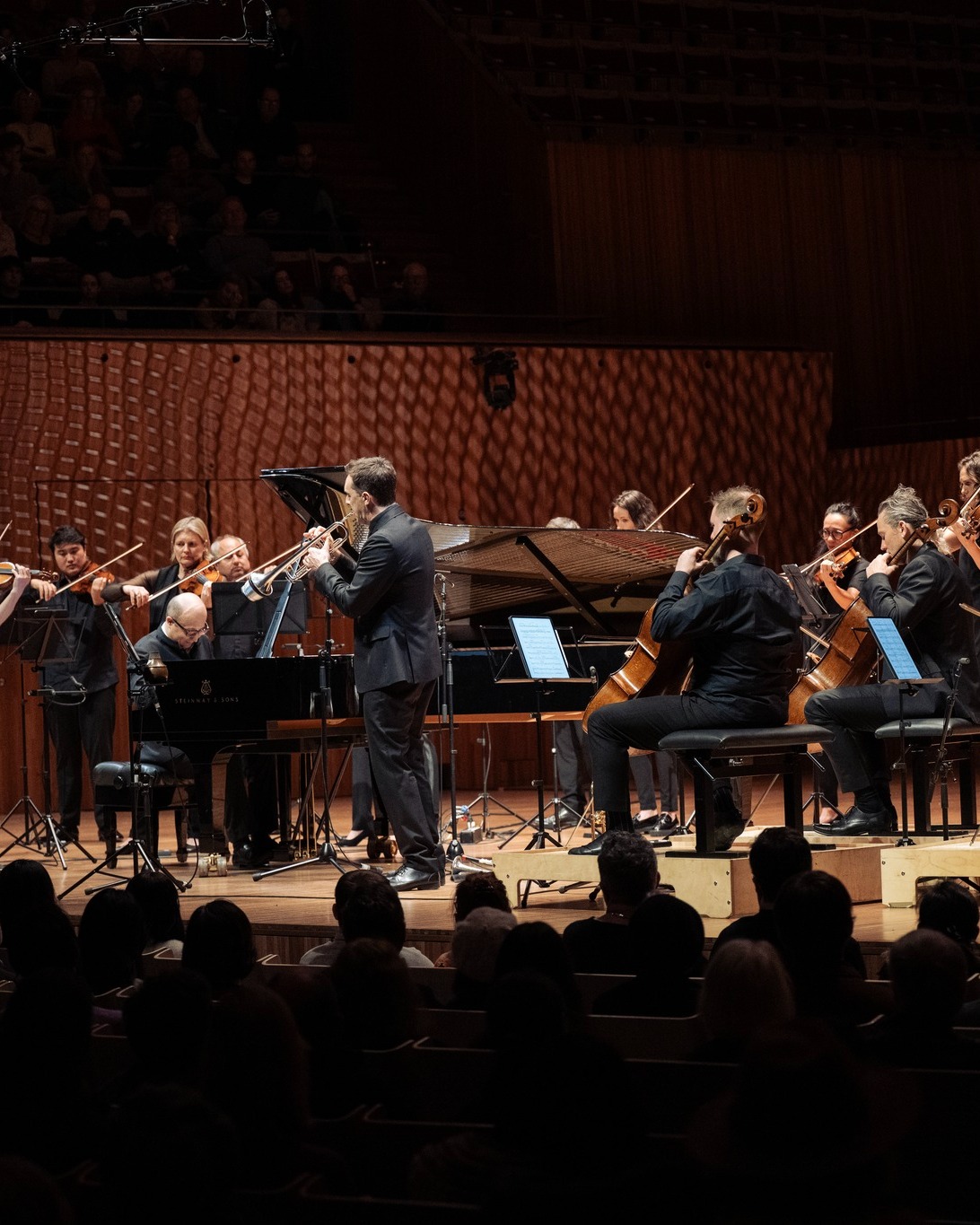
While Shostakovich knew all about censorship and political unrest, those troubles could not have been further from his mind in his early concerto for piano, trumpet and strings. Newly married, in his late twenties and unburdened by what was to come, the result is a piece that is full of joy and beauty, and full of humour, satire and music hall/piano bar vibes. The work started life as a trumpet concerto, which he amended to add a substantial piano part given a perceived lack of knowledge about writing for brass. What results is a riot and an ideal vehicle for the breathtaking virtuosity of Alexander Gavrylyuk. It’s hardly an original thought to pronounce that this guy is the real deal. Undoubtedly one of the most significant pianists of our time, he imbued the work with an astonishing breadth of colour and character, managing the fiendish (and very jumpy) writing while barely breaking a sweat. Trumpet duties were in the hands of Sydney Symphony Orchestra Principal, David Elton, a superb talent who made the exposed trumpet interjections look effortless.
The second half began with the same team performing a very clever and successful arrangement by the ACO’s Artistic Planning Manager, Bernard Rofe, of Gershwin’s ever-popular Rhapsody in Blue. Elton had the unenviable job of imitating the famous clarinet opening, which is no small ask on trumpet. It was superb. He also has the burden of lugging a piccolo trumpet and flugelhorn around the country to play short but very charming interjections that added much to the result. Gavrylyuk was in searing form and clearly enjoying himself. The luxurious and more romantic second theme was particularly memorable.
A word about programming. It can’t have been many times that Shostakovich’s eighth quartet has followed Rhapsody in Blue in performance. The transition from New York in the roaring 20’s to a practically still smouldering Dresden was jarring and not totally successful, but the quality of both performances rendered that ultimately trivial.
Rudolph Barshai’s string orchestra arrangement of the eighth quartet has become staple repertoire for any serious chamber orchestra. The ACO’s deep bench of experienced veterans would have countless performances under their collective belt. Their reading is deeply felt, convincing, cohesive and yet still fresh and daring. You will rarely hear a more ambitious tempo for the second movement. The pathos of the devastating final movement was sublime, with particularly memorable solos from guest principal cello Tomas Djupsjöbacka. There is much debate over the true meaning of the work and whether the composer’s dedication “to the victims of fascism and the war” hides a more subtle autobiographical narrative. Here is Shostakovich at the peak of his suppression and anxiety around censorship. He would no doubt empathise with his 21st century Ukrainian colleague Silvestrov.
A gift indeed from the ACO to us in the form of a memorable evening with genuinely special moments backed up by consistent commitment, cohesive readings and star soloists.
Photo credit: Nic Walker
_____________________________________________________________
Stewart Kelly reviewed “Gershwin & Shostakovich”, presented by the Australian Chamber Orchestra at Arts Centre Melbourne, Hamer Hall on Monday August 11, 2025.