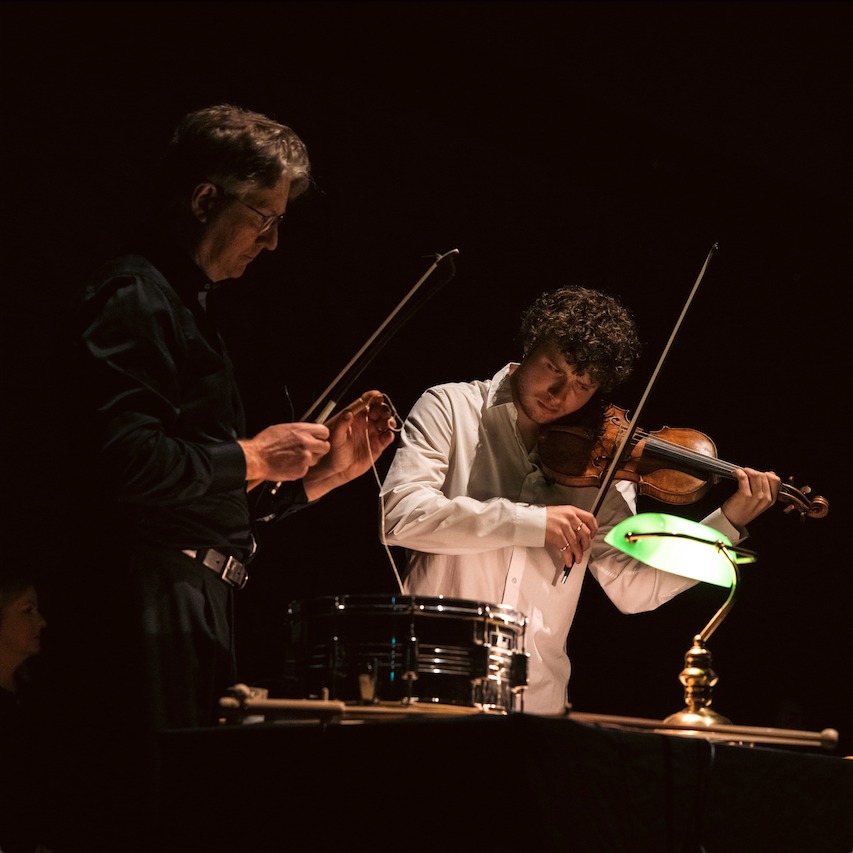
ELISION Ensemble is a tour de force in the world of new music, described as “Australia’s international contemporary music ensemble”, who “engage with co-creative processes of dialogue with composers, in which musicians imagine, develop and build new technical and expressive means”. What an exciting week it was at the Australian National Academy of Music for ELISION Ensemble members to be in Residence, working with students, passing on their knowledge and experience, all culminating in a super final public concert in the Rosina Auditorium. There was an electric atmosphere among students, staff, alumni and public filling the concert venue, all welcoming and anticipating a hefty program of new sounds and sights in the ever-increasing number of rarely performed compositions and World Premieres.
Artistic Director Daryl Buckley welcomed us, referring to ELISION’s international and cross-cultural collaborations, from its Melbourne foundations nearly 40 years ago, to now being thrilled with a second year of residency with ANAM. He referred to the need for traditional teaching practice to embrace performance of new works in the best way, and ensure scores do not “stay in the cupboard”. He paid tribute to the composer of tonight’s opening work, Franco Donatoni (1927-2000), who worked closely with ELISION in Melbourne in 1991, and who had shared notions of his compositional crises, seeing himself as a craftsman and a worker, seeing composing as a process of “work, work, always work”. Much applause and admiration also was for conductor Aaron Cassidy, who worked magnificently and with authority in split-second communications using new conducting hand gestures needed to achieve the precision of these detailed, most unconventional scores. Donatoni’s Spiri (from the Latin spiro – I breathe)(1977) began with the central breath of the oboe, joined by solo violin for increasing spirited activity, with strings, woodwind and percussion building with scintillating, agitated and fluid colour. Metallic keys and percussion added firm golden colour to sections, producing much joy with their myriad of jewel-box like colours. Quivering trills added a wistful sigh to close what was a complex, flowing and joyful work – well liked by the audience.
An important signpost in the excellent ANAM program notes, “To Listen or To Perceive”, led us to broaden our aural perception for Liza Lim’s ten-minute work, Veil, a piece first performed in Cologne in 2000, and such a contrast to tonight’s first work. The imagined sensuality of bend, gentle flow and movement of something “obscured or veiled” was felt in long notes and extremes of instruments’ registers, with eerie bow playing on the edge of gongs, an assertive bass flute, and suggestions of the sounds of nature. As patterns became interlaced, textures became denser, curving and shifting around towards a thoughtful calming close.
Female composers of note were highly represented in this program, with Berlin’s Isabel Mundry (b. 1963) featuring next with her 22-minute work Le Voyage (1996). This required stage setting for an expanded 19-piece ensemble where grand dimensions of sound and intense flurried activity surrounded us. With woodwind trills, sustained gong and low flute leading the way, random deafening percussive single notes established an early powerful statement. The focus was on colour, with hums, vibrations and overtones spreading through a widening soundspace. Occasional sections of silences and sparsity of single notes added an abstract and intense feeling. Percussion featured significantly, with even the triangle being given a detailed solo line. Declamatory sections were quite forceful and grand, with maximum pressure on performers to execute extreme timbres and techniques, subdued long sustains, intense fluttering of woodwind, an eternity of harmonics on upper strings, and intensely held silences.
Following interval, five ANAM students presented a ten-minute group improvisation in the form of a gentle soundscape, perhaps on the minimalist and tentative side as players thoughtfully blended in and out of gentle conversation or ensemble texture. With a focus on colour and the shared communication of spontaneous ideas, one had to feel for the slide whistle making its bird-like presence felt in a humble way.
Iannis Xenakis (1922-2001) was known as an avant-garde composer, influential in developing electronic music and introducing spatialization by dispersing musicians among the audience. Eonta (Beings) was an exciting piece of music theatre, opening with an explosive piano introduction, with two trumpet and three trombone players marching in, standing, heads bowed, muted bells pointed to the floor, delivering repeated chordal block clusters of sound. Wildly exciting, unpredictable, the brass delivered a variety of vibrant unison pulses, clusters of percussive colours with war-like intensity, and regimented musical theatre as they formally marched to new line-ups on stage. Sadly the music died with a muted two-note final cadence. What an exciting, evocative, socially and politically reflective work, performed tonight to much applause.
Completely new possibilities came with electronic keyboard and computer technology, with ANAM pianists Po Goh and Timothy O’Malley producing a performance of Melchior (2021) by multi-disciplinary artist Dariya Maminova (b. 1988). Rivers of sound from samples, including the composer’s own singing voice in a closing prayer-like melody, seemed to connect the past, the present and the future. Performed here with “live” performers with a minutely detailed score, (could this be projected next time?) this was a noteworthy finale, celebrating a stimulating collaboration between ELISION and ANAM.
Photo supplied.
__________________________________________________________________
Julie McErlain reviewed “ANAM at the CONVENT: ELISION ENSEMBLE”, presented at the Rosina Auditorium, Abbotsford Convent, on June 20, 2025.