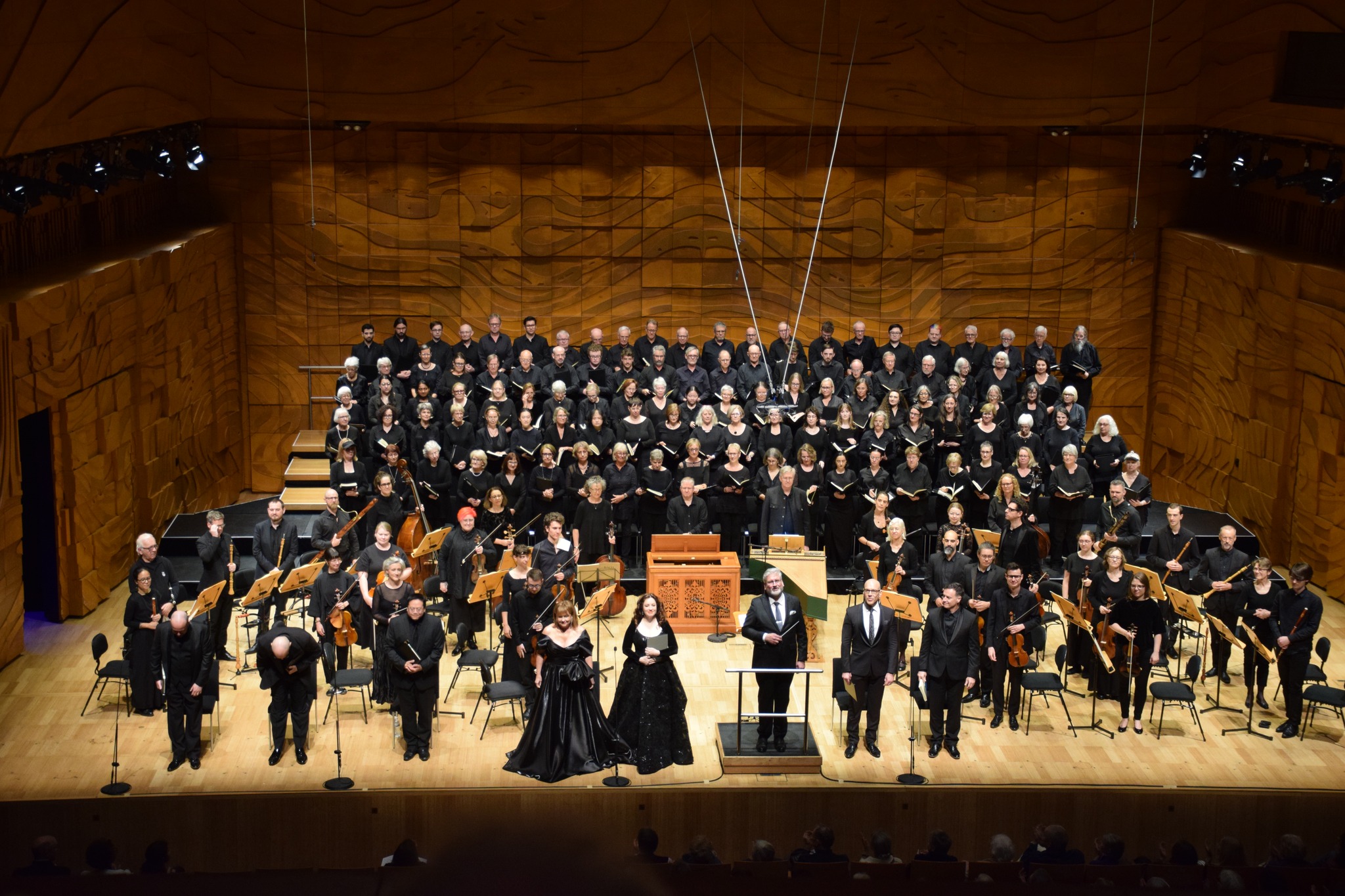
The St Matthew Passion was not only Bach’s most ambitious composition; it has also been the most ambitious undertaking by the Melbourne Bach Choir (MBC). Program notes by MBC’s Artistic Director and Conductor, Rick Prakhoff, suggest that it required a major act of faith for MBC to reprise a performance of the St Matthew Passion in 2010, following the initial one in 2006; a full All Saints St Kilda Anglican Church did not guarantee financial success even with amateur choristers. A complement of two orchestras, two four-part choirs, a children’s chorus and a minimum of six soloists requires a substantial financial commitment if top soloists and instrumentalists are employed – and this is exactly what MBC has ensured with each of the Choir’s seven performances of Bach’s masterpiece.
Reading the list of instrumentalists comprising the Melbourne Baroque Orchestra for this performance is like reading a “Who’s Who” of some of Melbourne’s best baroque players. The seven soloists: Andrew Goodwin (Evangelist), Adrian Tamburini (Jesus), Lorina Gore (Soprano arias), Sally-Anne Russell (Mezzo-soprano arias), Henry Choo (Tenor arias), Simon Meadows (Pilate, Baritone arias), Christopher Hillier (Baritone recitatives: Judas, Peter) are all major professional singers and, with the exception of Meadows and Hillier, have sung these parts in previous MBC performances, to much acclaim.
In fact, Andrew Goodwin’s Evangelist is legendary for its technical vocal brilliance and sensitive musicianship, attributes that caused a sensation when he first sang the role in 2014. His performance this time round was no less superlative in all respects; he spun out phrases with immaculate breath control and seamlessly integrated head voice with tenor strength that could be vibrant or smoothly hushed as required. Goodwin achieved a perfect balance between drama and restraint as he narrated the Easter story according to St Matthew with deeply moving emotional truth.
The move from church to concert hall does detract from a sense of the sacred, yet the Melbourne Recital Centre is probably as near to it as any secular space in Melbourne. The Elisabeth Murdoch Hall possesses a special physical beauty – walls of carved wood an evocation of nature – and the acoustic is superbly resonant. The space was used strategically too. Placed in two rows of a side balcony, the 16 young choristers from The Yarra Voices forming the Ripieno Choir produced firm chorale lines as the double choir sang the more complex chorus parts.
In some performances, members of the choir undertake the secondary Passion figures. Although most parts were given greater presence and impact by Meadows and Hillier, MBC’s 2026 Scholar, Maya Charles Sedergreen’s Maid rang out clearly. The financial support of eight choral Scholars is a most commendable initiative; it is valuable for the singers involved and for the maintenance of a high standard of choral singing.
As for many choirs, the MBC sopranos and altos significantly outnumber the tenors and basses, whose singing was often overshadowed by the upper voices. The men did have their moments in the sun, however, especially in the fugal sections and the beginning of passages such as “Lass ihn kreuzigen!”, where they displayed a strong robust tone without shouting. There was some impressive singers from Chorus 2, who had the bulk of the work as a single choir.
The variation in vocal and orchestral forces is one of the most appealing features of the St Matthew Passion, and it was a huge credit to Prakhoff and the performers that they gave such a disciplined and nuanced reading of such a complex work.
Just as choir and orchestra were physically divided on stage, so were the soloists – in a formation that worked well. With Tamburini standing alone next to Goodwin, the scenes comprising “The Prologue” were given sharper focus, as Jesus appeared more connected to the Evangelist. Tamburini’s resonant bass-baritone voice has a quality of pathos that is particularly well-suited to the part. There is authority coupled with depth – a sense of awareness of what must be endured.
On the opposite side – Judas, Peter and Pilate were more distant figures, literally and metaphorically. Commenting on the action via a series of arias, Lorina Gore and Sally-Anne Russell made an attractive pair in their sombre garb and sang with expressive musicality. Gore was initially a little hard to hear on the lower notes in the arias, but her duet with Russell, “So ist mein Jesus nun gefungen” (So is my Jesus now captured), was one of the musical highlights, so well balanced and blended was it. It was also one of the inspired numbers where Bach has the choir interweaving with the soloists – all beautifully done. Gore’s upper notes were clear and resonant, and there was a purity and delicacy to her musical singing that matched the flute obligatos that accompanied her arias.
Arguably, it is the alto/mezzo-soprano soloist who has the most striking arias in this work. In addition to “Buß und Reu” (Penance and remorse), accompanied by two flutes and continuo, and the two arias with Chorus – “Geduld” (Patience), accompanied by viola da gamba, harpsichord and organ, and “Sehet, Jesu” , with throbbing double bass pizzicato and Russell thrillingly powerful on her top notes – there is the moving aria with choir that opens Part 2, and one of the most ravishing oratorio arias ever written: ”Erbarme dich” (Have mercy). Russell’s rich voice and quiet commitment to the text paired with a rapturous violin obbligato, played with supple grace by Tim Willis, provided a sense of soulful, yearning gravity to this famous aria.
Deft playing also came from the leader of Orchestra 2, Cameron Jamieson, in the vigorous bass aria “Gebt mir meinem Jesum wieder”. The bass arias saw more extraordinary obbligato work from Laura Vaughan on viola da gamba. Placed immediately behind the conductor’s rostrum, the instrument’s warm, distinctive tone was clearly audible and gave urgency to Meadows’ fine singing.
In a wash of choral and instrumental sound, the oboes are guaranteed to rise above it all. Apart from the continuo instruments – mighty contributions from organist Calvin Bowman and cellist Roseanne Hunt in particular – it is the oboes that dominate, and they did so with distinction, with Adam Masters obbligato adornments exceptionally fine.
Given that the date of the first performance of the St Matthew Passion at Thomaskirche, Leipzig was in 1727, a performance by MBC in 2027 would seem almost automatic. A full house with a waiting list and an enthusiastic standing ovation greeting the end of this year’s high quality performance indicate a keen appetite for Bach’s masterpiece. Perhaps next year there could be some audience participation in some of the chorales – a practice enjoyed by many during those Bach Festival years under the direction of Leonard Fullard at Christ Church, South Yarra. A more uplifting way to celebrate Easter would be hard to find.
Photo supplied.
_______________________________________________________________________
Heather Leviston reviewed Bach’s “St Matthew Passion”, presented by the Melbourne Bach Choir at the Melbourne Recital Centre on Friday, April 3, 2026.