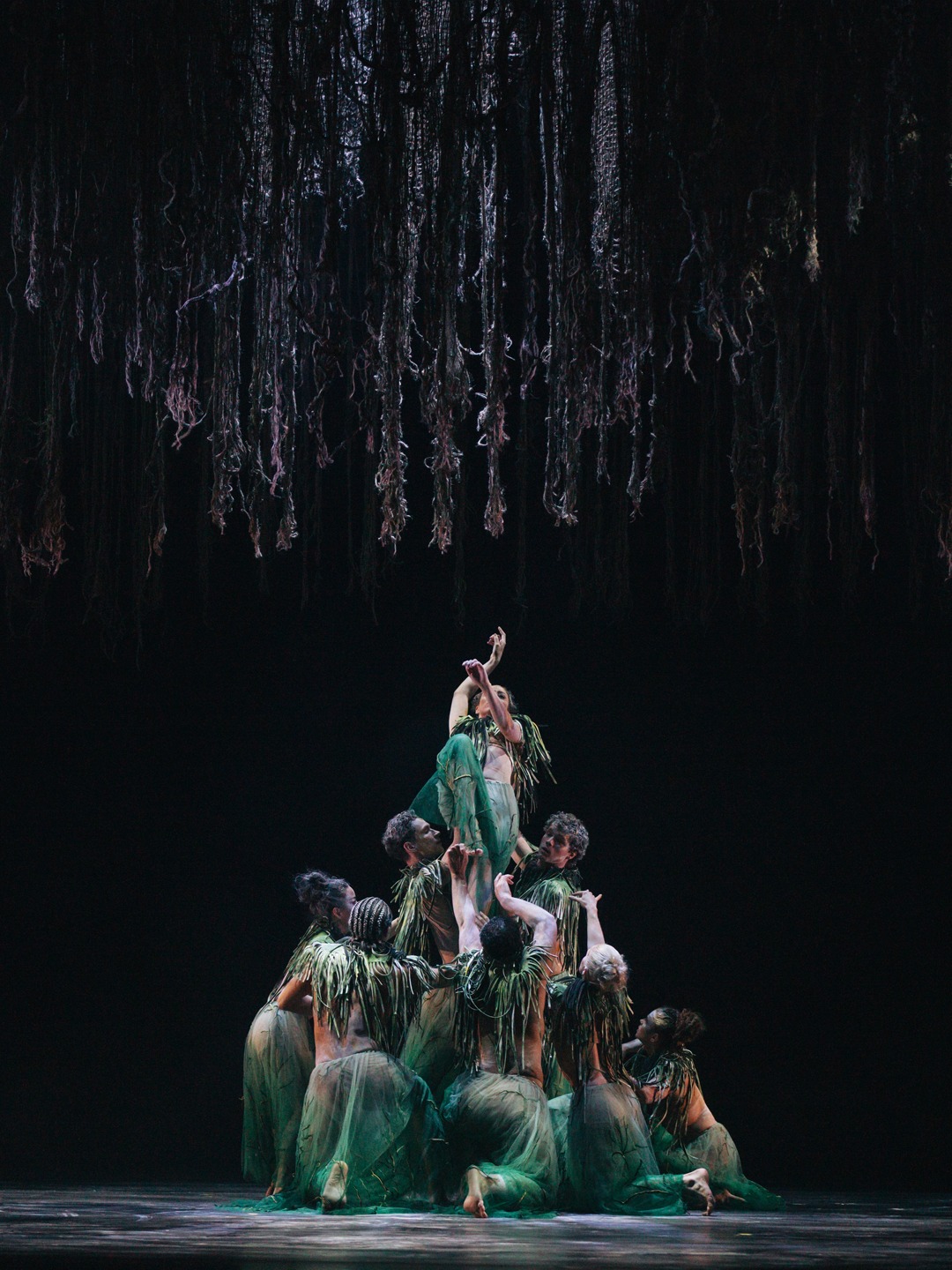
Flora is a garden of earthly delights grounded in exquisite dancing and storytelling. The work hums with life, ever evolving but not afraid to acknowledge the past. A collaboration between The Australian Ballet and Bangarra Dance Theatre, Flora digs deep, takes root while endeavoring to enrich and educate its audience.
Bangarra Dance Theatre Artistic Director Francis Rings choreographs this fourth collaboration between Bangarra Dance Theatre and The Australian Ballet. William Barton’s rich score is an excellent partner to Frances Rings’ unique modern dance style. The narrative explores Australia’s unique flowers and vegetation in 12 immersive sections that include titles such as “Mother Seed”, “Golden Wattle” and “Grass Tree Warriors”.
The 35 dancers on stage contributed to the choreography, which includes a broad range of movement not often seen in the ballet repertoire. Dancers effortlessly intertwine and undulate their bodies in a serpentine-like fashion to the meandering score. The rapid movement rarely pauses, reflecting life’s never-ending pulse. Flora’s choreography is at its strongest when the dancers come together to form a single organism, a theme that is repeated throughout the ballet in various forms.
Flora is also a reflection on how the Australian landscape has been affected by Anglo explorers and colonisation. The layered score moves between European string and percussion instruments and Indigenous chants and melodies, expertly performed by Orchestra Victoria under the baton of Jonathan Lo. The musicians are very much connected to the on-stage storytelling as they sing from the pit.
The ballet opens with an ensemble of women clearing the ground with their sticks, tapping the earth with a sense of purpose and poise. The setting is dark and misty with much filtered light against costumes of muted rust color. The scene progresses to one of the most memorable and creative sections in Flora: “Sleeping Yams”. A set piece resembling an intricate root system is lowered from the rafters suspending five dancers in aerial apparatuses. The dancers are clumped together in a way that makes it difficult to identify them as human. They begin to pulse and quiver in midair slowly revealing themselves as individuals. The metamorphosis is magical and eventually progresses to a single dancer. Callum Linnane performs an impressive solo grounded in intricate floor work exhibiting great control and strength. His ability to integrate classical technique with earthy pith while dancing to one of the more synthesized sections of the score is mesmerising.
“Grass Keepers – Spinifex” is another stand-out section danced by a large group of male dancers entering with props of spinifex cleverly manipulated to build different formations. The scene includes a perfectly synchronized dance of five performers moving in harmony and transforming the stage into dry bushland. The effect is dynamic and one of the more powerful dance scenes in the production.
Act 2 of Flora opens on twelve cocoons hanging from the stage in a circular design, each with its own harsh spotlight. The scene is meant to reflect the work of English botanist Sir Joseph Banks, who collected thousands of Australian plant specimens in 1770 to be displayed in museums. Inside each cocoon is a dancer representing a native flower, including Lemon Myrtle, Kangaroo Paw and Red Waratah. The section successfully portrays entrapment and vulnerability as each dancer breaks free from their encasing and eventually from the suspended exhibition.
Rings’ choreography moves the narrative with great sensitivity and understanding. The creative team’s contributions include Elizabeth Gadsby’s extraordinary set designs and props made from seemingly organic materials. The ambient lighting design by Karen Norris further supports the immersive setting. Costumes of voluptuous texture and style by Grace Lillian Lee include interpretations of fire, bush flowers, yams and trees.
Flora glides along as a tribute to Australia’s native land, an acknowledgement of the destruction of colonisation, and a political reckoning. The production’s ending is unexpected by remaining true to nature’s due course. The final section, “Bush Flower”, opens with soloist Courtney Radford, her dancing building slowly to envelop the audience in a warm embrace of petals and fluidity. A company of flowers joins Radford, dancing in a unifying form of vibrant colour. As the dancers move in and out of tightly woven patterns wedding bells are heard from Barton’s hypnotic score, leaving a sense of hope.
Flora runs for 1 hour and 47 minutes with reasonably priced tickets starting at $53 and $46 for youth adult tickets. Performances continue at Melbourne’s Regent Theatre through 21 March. Special note: The Flora program book is particularly worth purchasing as it has several informative articles about the production and Australian history.
Photo credit: Kate Longley
_____________________________________________________________
Paris Wages reviewed “Flora”, presented by The Australian Ballet and Bangarra Dance Theatre at the Regent Theatre, Melbourne on March 12, 2026