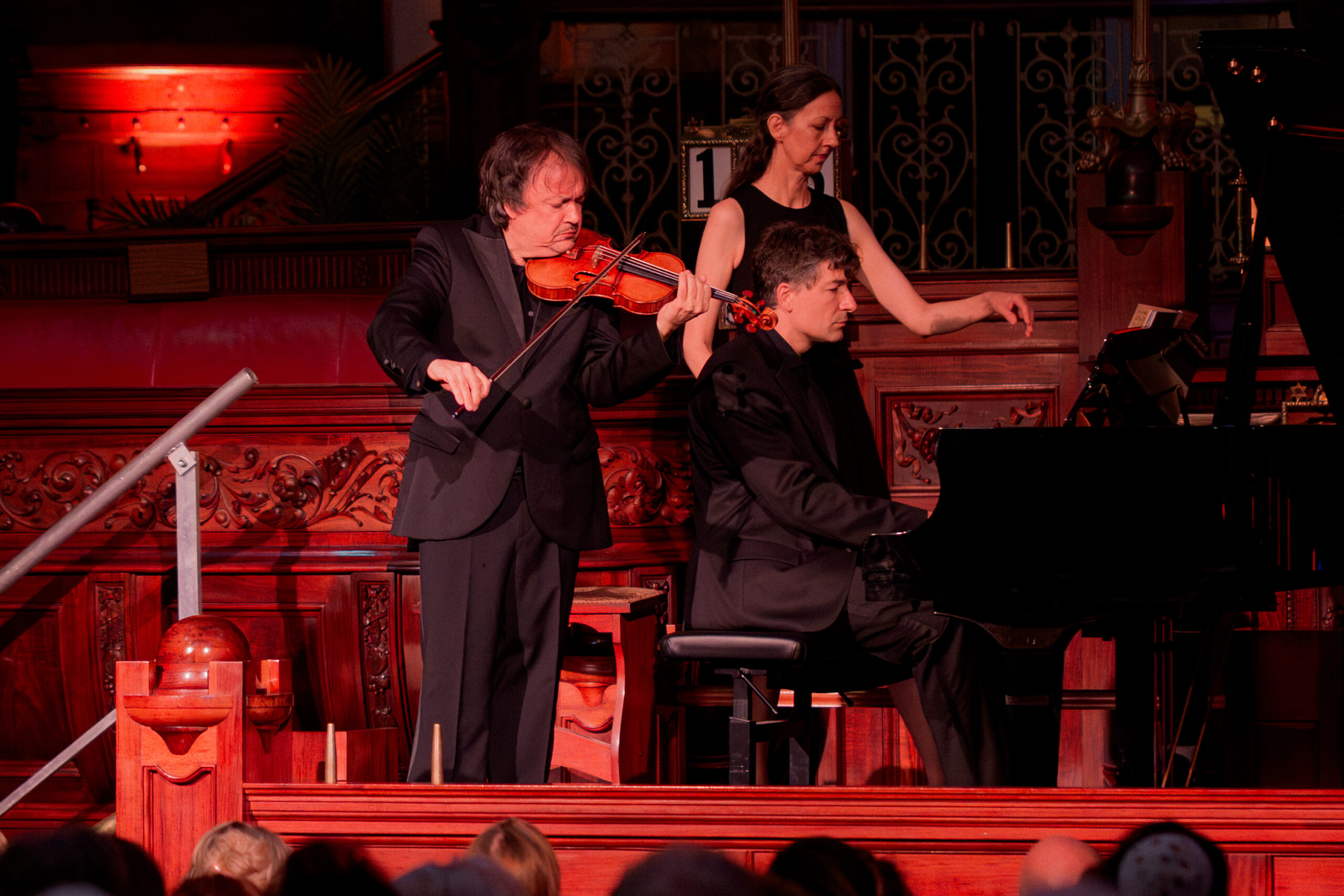
The Melbourne Hebrew Congregation at Toorak Synagogue hosted another Live at Yours Concert, this time featuring violinist Sergej Krylov and pianist Konstantin Shamray in an (almost) all-French program. Krylov was playing the wondrous “Camposelice” Stradivarius of 1710. Such is Krylov’s mastery of the violin he could surely make any instrument sound wondrous. Antonio Stradivarius could not possibly have imagined that one his violins would be bringing to life three French composers from the mid-19th to the early 20th centuries: Camille Saint-Saëns, César Franck and Maurice Ravel.
Playing to a packed audience, Krylov entered offstage, into the dark and played the Allemanda from Bach’s Partita for Solo Violin No 1 in B minor, BWV 1002 – an introduction as surprising as it was spellbinding, giving us a full taste of the range of the “Camposelice” Stradivarius in Krylov’s hands.
After a formal welcome the concert got underway with the Saint-Saëns’ Introduction and Rondo Cappricioso. Originally written for the violin virtuoso Pablo Sarasate to be accompanied by an orchestra, Saint-Saëns requested that Georges Bizet prepare a violin and piano reduction, published in 1870. This showstopper has a beguiling “gypsy” feel, giving the violinist full rein to play all over the fingerboard, reaching impossible high notes and throwing harmonic notes about wherever possible. Krylov was thoroughly in control and clearly enjoying himself, sounding effortless. His instrument achieved peak purity at stratospheric levels and provided a truly gutsy sound when needed down on the G string. The piano seemed to have little to do, until suddenly it burst in, bringing Konstantin Shamray briefly to the fore. The ensemble between them was faultless.
Having established the indissoluble relationship between the violin and gypsy music, the duo went on later to perform Maurice Ravel’s Tzigane a gypsy-themed virtuosic concert piece of the kind popularised by Sarasate’s Zigeunerweisen and Monti’s Czárdás. Krylov’s Tzigane was an unabashed show-stopper, working the “Camposelice” Stradivarius to the fullest.
Following the Bach, Konstantin Shamray introduced us to Ravel’s Violin and Piano Sonata No. 2, composed from 1923 to 1927, inspired by ragtime, jazz and blues music. By 1927 Ravel was already absorbing American popular music. In 1928 Ravel toured America and spent considerable time with George Gershwin. The two composers admired each other’s work immensely and legend has it that Gershwin asked Ravel for composition lessons. Ravel declined, apparently saying it would probably cause Gershwin to write “bad Ravel”.
This Violin Sonata consists of three movements: Allegretto, Blues (moderato) and Perpetuum mobile (allegro). The keys move from G major to A flat major, setting up an overarching tonal dissonance and also establishing the primacy of the major seventh chord in a jazz-inflected way.
In performance, this gave us a first movement that began lyrically with the piano playing a simple cantabile line that gets taken up by the violin. The piano underpins this with a rocking triple time of broken chords interrupted by birdlike, clipped grace notes intruding on the otherwise serene mood. Both instruments shared this chirpy motif around, giving a jazzy hint of what is to come. The movement closed with long, high notes on the violin, sublimely played by Krylov.
The mood changed considerably with the second movement. Ostensibly a “blues”, it began with the violin playing plucked four-note chords, rather march-like, with some off-beats given emphasis. Curiously the violin part starts in the key signature of G major, allowing the violin to use all the open strings for full pizzicato effect. But the written piano key signature is A flat major, setting up an ambiguous major seventh tonality.
When the piano took over the violin started a bluesy melody marked “nostalgico”, joining the piano in A-flat major. So far, so good and bluesy. By Letter 5 in the score the syncopated piano sounded like it wanted to swing and couldn’t quite get there. Shamray played what was written, but it came across like clumsy Kurt Weill. Ravel wrote this a year before Weill’s Threepenny Opera – did he want it to sound problematic?
Perhaps, for by Letter 7 in the score, though the piano has a convincing rhythmic trajectory, the violin struggled to make a presence playing jagged, plucked chords. On paper this section just doesn’t seem to work maybe because it is nearly impossible to write down exactly how jazz performers bend notes and play around with the beat. Those 12 bars from Letter 7 are more chaotic than climactic.
Whether or not Ravel wanted chaos, Krylov and Shamray didn’t seem to have a strategy to resolve the sense of struggle, it sounded a bit like “let’s just get through this passage”. To be fair, other performers don’t make much sense of this passage either.
Fortunately, the third movement, Perpetuum mobile, brought security back when Ravel finally made jazz his own. The piano offered light syncopated rhythms while the violin raced along with extraordinary, continual, breathless playing, achieving delicious changes of colour across all registers – perpetual motion indeed.
The piano writing is almost minimal, just enough to keep a beat. A simple two-note motif, introduced in the piano, prefigured Gershwin in its slight blues flavour. This was picked up by the violin at times amidst a flurry of cross string playing. Sergej Krylov was in his element and the two continued to demonstrate an exemplary partnership.
The final work of the night was César Franck’s magisterial Violin Sonata in A major, written in 1886 as a wedding present for the 28-year-old violinist Eugène Ysaÿe. This sonata has four movements, the first (Allegretto ben moderato) began with a somewhat unexpected quiet, rocking melody, introducing elements and motifs that would reappear throughout the sonata.
The second and third movements, Allegro and Ben moderato: Recitativo-Fantasia, engaged the violin and piano in much harder work. Krylov brought out a rich romantic tone demonstrating not only his astonishing fingerwork, but also his mastery of subtle and creative vibrato. In the previous works he used some very delicate, magical vibrato, even on harmonic notes. In the Franck he was able to dig into the sound and give us a rich tone. The piano part throughout requires virtuosic technique and Konstantin Shamray was right on top of it.
The final movement, Allegretto poco mosso, brought all the melodic motifs that we had been teased with together in an amazing canon, where the two instruments basically played the same material in imitation, but not together. The tempo indication poco mosso was taken seriously by the two performers and they performed this movement at a quite light and breezy speed that was very refreshing to hear.
Often this movement gets a stately sort of treatment. Instead, it was good to hear it dance along, a fitting finale for a wedding gift. The suggestion of pealing wedding bells towards the end hinted that the whole sonata could be received programmatically as the journey of a romance that starts hesitantly, goes through turbulent, passionate moments and ends with two voices singing the same melody of intertwining love.
Well, that was the effect Sergej Krylov and Konstantin Shamray had on this reviewer – a night of perfect harmony.
Photo credit: Jonathan Green
___________________________________________________
Nicholas Tolhurst reviewed the recital by Sergej Krylov’s and Konstantin Shamray’s recital, presented by Live at Yours at the Toorak Synagogue on March 10, 2026.