This weekend, International Women’s Day is an opportunity to reflect on women’s achievements, and opera lovers would be hard pressed to find a woman who has made a greater contribution to the Melbourne opera scene than Linda Thompson AM. For decades she has supported performers and creatives via Gertrude Opera and, more recently, Australian Contemporary Opera Company (ACOCO). Her championship of new and neglected works continues to enrich the cultural life of our community in a way that is rare and invaluable.
While it is tempting to outline the huge variety of operatic experiences she has brought us, it is the latest one that impresses as a particularly noteworthy example and an excellent way to launch ACOCO’s 2026 season. This production of the double bill Mary Motorhead and Trade by Irish composer Emma O’Halloran is outstanding on all counts. In the intimate space of the Beckett Theatre it is a powerful pair that explores the human psyche in a visceral way. The desire to be understood – known – and loved is presented in two very different transgressive scenarios, but share a depiction of raw vulnerability in striking and moving ways. ACOCO calls it an invitation to “reflect on the beauty, pain, and complexity of being human”.
These one-act operas are based on two plays by Emma O’Halloran’s uncle, Mark O’Halloran, and are scored for the same 10-strong chamber orchestra plus electronic tracks. With Alex Dowling’s sound design, the scores are a stunning blend of acoustic and electronic music and sound effects, combining in a soundscape that creates a strong sense of the composer’s distinctive “voice”. Although all singers were more than capable of operatic vocal projection, especially in such a small venue, body mics enabled well-integrated dynamics, which ranged from subtle pianissimo strings to stridently anguished saxophone. With considerable experience in conducting these operas, two-time GRAMMY- nominated Irish conductor Elaine Kelly demonstrated her deep musical understanding of the works’ depths and subtleties, eliciting gripping work from the band.
Described as a monodrama, Mary Motorhead (2019) concerns a woman incarcerated for 18 years for murdering her husband with a 12-inch carving knife. Why? We hear her story – her “secret history” – as she recounts her life of wild excesses, bitter disappointments and betrayals. As she reveals the “unknown” history, we come to a better understanding of what led to her crime.
The music begins and ends with a tribal beat as Mary, clothed in orange prison suit, sits on a chair in her bare “cell”, seven vertical light bars the only scenery. As her account unfolds music and lighting reflect Mary’s emotional trajectory. The physicality of Greta Nash’s direction ensured emotional vitality and interest. In the title role, Australian mezzo-soprano Emily Edmonds was brilliant, her range of expression: down-to-earth, sly, reflective, desperate or enraged, was portrayed with dynamism and clarity. Her abandoned dancing to the techno beat as the light bars flared colour embodied Mary’s wildness. All the while, Edmonds sang with remarkable technical assurance and command, her rich voice always a pleasure to hear even in Mary’s most vicious and frantic moments. Although Edmonds’ diction was generally very good, details were sometimes lost – an inherent problem with the female voice at the top of the range. Mary Motorhead is an excellent vehicle for displaying a singer’s musical, vocal and dramatic prowess, and Edmonds gave it her all to striking effect.
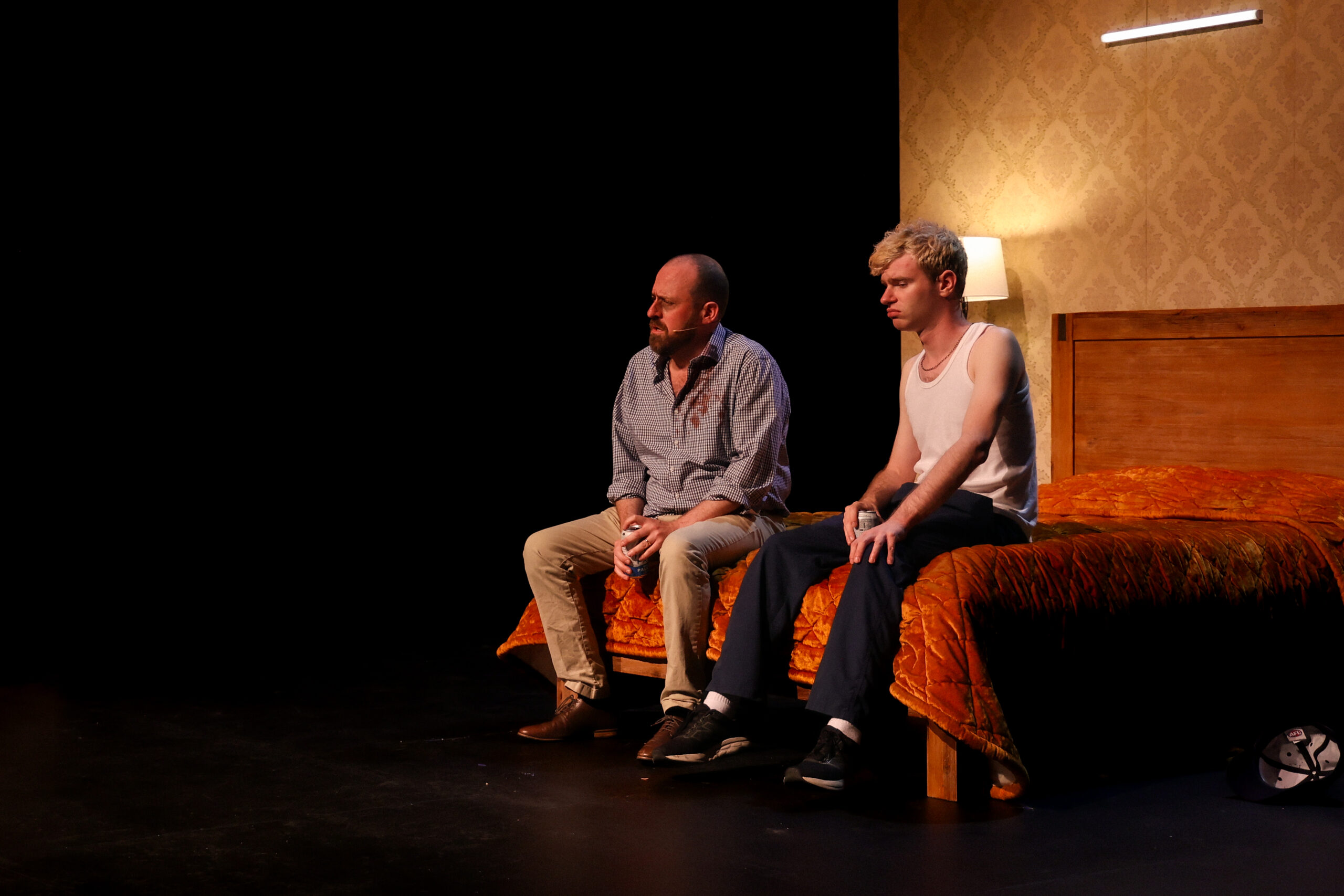
Running just over an hour, twice the length of the first opera, Trade (2022) begins on a different note – the long notes of a quiet flute. O’Halloran’s use of silences are more pronounced in this opera, reflecting the halting conversation between the two main characters. The setting is an unglamorous hotel room featuring a double bed covered in a lurid orange bedspread. Sitting on the bed, an 18-year-old man waits impatiently for a middle-aged man to emerge from the bathroom. We find our later why he is sporting a black eye and a bloodstained shirt. They have much in common: working-class backgrounds, in heterosexual relationships, fatherhood. And they share a secret: the older man pays for sex and the younger one is a rent boy. Opera is full of “bad” boys and girl, but O’Halloran’s shaping of the stories are much more confronting, provocative and thought provoking than most – without being sordid. An intense desire to be known and accepted is the key motivator.
Christopher Hillier as the older and Callum McGing as the younger man are compelling in their portrayals of men at odds with society, themselves and each other. Hillier’s vibrant baritone complemented McGing’s lighter tenor that occasionally transformed into an easy falsetto. Much of the singing was in the nature of conversational recitative, which served to heighten the climaxes. Every word was clearly articulated, and driving rhythms again propelled much of the dramatic energy. Hillier’s sensitive emersion in the role of a tortured soul seeking loving acceptance made the opera’s conclusion poignant indeed. I was not alone in wiping away a tear after witnessing the vulnerabilities of these all-too-human men.
Although O’Halloran’s compositions are unfamiliar to most Australians, she has a considerable body of work to her name in addition to being accorded much acclaim. Melbourne audiences are lucky to have an opportunity to experience these relatively recent operas, thanks to ACOCO and its supporters. Don’t miss them!
Photo credit: Kate Cameron
_____________________________________________________________________________
Heather Leviston reviewed “Mary Motorhead” and “Trade”, presented by the Australian Contemporary Opera Company at the Beckett Theatre, Malthouse Theatre Melbourne, on March 6, 2026.