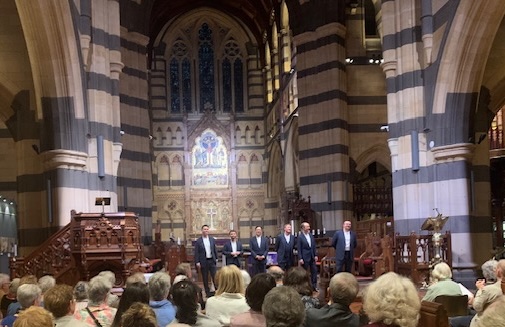
The King’s Singers gave a fine performance at St Paul’s Cathedral on Wednesday evening. As expected, the singing was almost flawless, and to point out any infelicitous moments would be splitting hairs.
But first, it is important to talk about how this concert came about. There is a new force in town: Classical Music Australia. Founder Chris Howlett spoke at the beginning of the concert about his aim to reduce barriers to people experiencing live performances by introducing a “pay what you can” ticketing model. The King’s Singers are the first in an ambitious program to bring artists of international standard to Australia. Howlett said people could attend this concert who would not otherwise be able to afford it and he expressed gratitude to patrons who opted to pay more to subsidise affordable tickets. It’s a “pay it forward model” with an outstanding lineup for 2026. More information can be found by looking up Classical Music Australia.
On to the concert. The performance was neatly devised to take advantage of the capacious acoustic of St Paul’s Cathedral bracketing mostly English Renaissance works under three headings: Sunrise; Sunset; and Darkness.
The first work was Plainchant from the Feast of Purification, “Videte miraculum” (“Behold the miracle of the mother of the Lord”). It emanated from somewhere mysterious and unseen, quite miraculous indeed.
The Sunrise works that followed were Nicholas Ludford’s Gloria from his Missa Christo Virgo Dilectissima then two works by William Byrd, his “Vigilate” and the Sanctus and Benedictus from his Mass for Five Voices. The Ludford demonstrated some fine smaller group work, splitting up between the two countertenors and tenor and the two baritones and bass. Byrd’s “Vigilate” (“Watch for you do not know when the Lord may come”) was full of energy, appropriate to an exhortatory text. Curiously, it remained the most animated work of the program.
The King’s Singers seemed to be aiming for works that showed their perfection in close harmony singing rather than any adventurous polyphony. The Sunset group opened with Weelkes’ “Hosanna to the son of David”, a work that is familiar to many choirs in Melbourne. There was agreement among some of the choristers in the audience that they took the work very fast and that their opening few bars were unsteady. It is a work that fully reveals itself with a more majestic pace and, perhaps, a larger ensemble. At times throughout, the first countertenor’s voice overshadowed his fellow countertenor, so that quite a lot of the concert was a bit like an accompaniment to his voice, but this is very much a fine point to make.
Robert Stone’s “The Lord’s Prayer” was sung only by the tenor, two baritones and bass, giving a nice growly feel to some elevated Anglican chant. The Sunset bracket was rounded out by a Tallis “Magnificat” from the “Dorian” service, John Taverner’s ode “O Wilhelme, pastor bone” (“O William, good shepherd, Father and supporter of the clergy”) and William Mundy’s “Sive vigilem” (“Whether I keep watch or sleep … Always I seem to hear the sound of the trumpet”).
All these latter works were rather in the manner of hymns, with some very juicy and tangy harmonies at the close of the Mundy (“Rise up, ye dead, and come to the judgement”).
Throughout, each member of the group took turns to introduce works, and a decidedly affable and learned lot they are, ensuring the vast audience crowding out St Paul’s all felt welcomed in.
It was explained that the final set – Darkness – was conceived as an Evensong, given that they were with us in the evening in a fine church (with “Renaissance trams”, as one of baritones quipped).
Darkness began with Hildegarde’s antiphon “O Euchari” sung by a countertenor near the altar. St Paul’s laps up a sound like this and the song took wing (“O St. Eucharius, You walked upon the blessed way”). We felt anointed.
Then followed Tallis’ “E’en like the hunted hind”, a strophic work, very hymn-like. The Tallis was sung by the first countertenor, the tenor, and the two baritones.
They swapped out one of the baritones for the bass for Christopher Tye’s “Nunc Dimittis” and the first countertenor was replaced by the second countertenor. His voice has a sweeter, more focused tone and felt better in blending with the other voices.
Robert White’s “Christe qui lux es et dies” (“Christ, who art the light and day, You drive away the darkness of night”) brought the whole ensemble back together and shone light into the final moments.
So, two niggling points: the first countertenor was rather too present; and the overall program felt “safe”, rescued by the King’s Singers unparalleled harmonic unity. Perhaps it’s up to the Tallis Scholars to deliver English polyphony.
However (and this is a delightful however), the King’s Singers gave us an encore of three songs in their pop repertoire, opening with an Australian song, “That’s the way it’s gonna be little darling”, followed by James Brown’s “Lonesome Road”, then an arrangement made for them by Stacey V Gibbs of “This Little Light”. As it happens, this was the most adventurous work of the night for harmony and independence among the voices and a fine example of the King’s Singers’ diversity.
_____________________________________________________
Nicholas Tolhurst reviewed The King’s Singers concert, presented by Classical Music Australia at St Paul’s Cathedral, Melbourne on March 4, 2026.