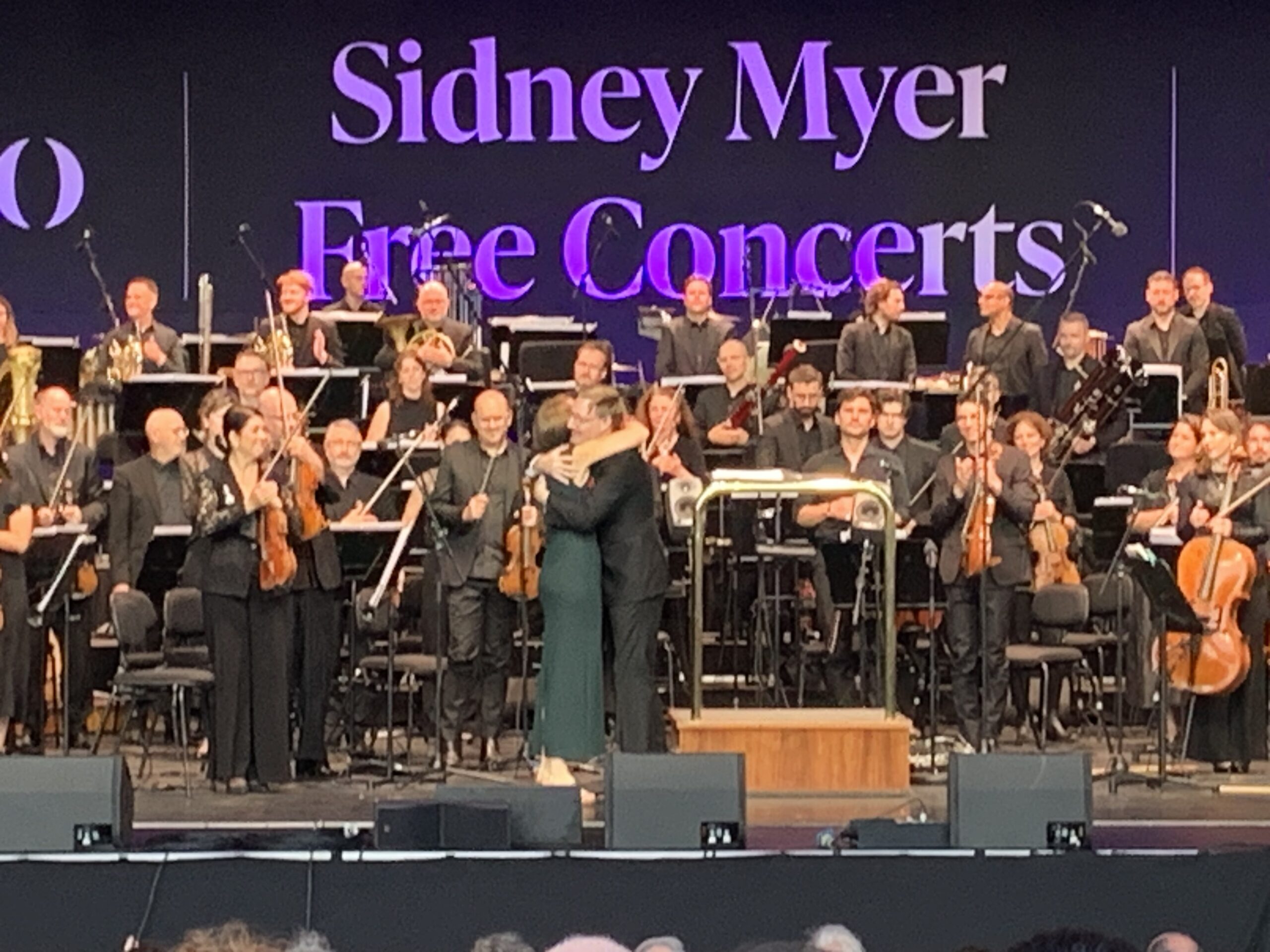
The stars were aligned for ABC Classic’s fiftieth birthday bash at Melbourne’s Sidney Myer Music Bowl, billed as the Melbourne Symphony Orchestra’s “love letter to ABC Classic”.
In an all-Australian program, soloists Slava Grigoryan, Aura Go, the Tawadros brothers and newly appointed MSO concertmaster Natalie Chee combined with the MSO under Benjamin Northey to present a feast of music by Australian composers.
It was the perfect weather for an outdoor concert: warm, a slight breeze, but not a cloud in the sky. And it was Valentine’s Day, so the emotional forecast was warm-hot. By 7.30, it seemed like the Bowl was close to full capacity. ABC Classic hosts Mairi Nicolson and Ed Le Brocq opened the concert, noting the many diverse features that composers have looked to for inspiration.
The MSO’s Acknowledgement of Country was written by the MSO’s 2025-26 First Nations Composer in Residence, James Henry. It was followed, fittingly, by Nigel Westlake’s Cudmirrah Fanfare – the theme music for ABC Classic’s Lunchtime Concert. Westlake has written extensively for both the concert hall and the screen.
Iconic guitarist Slava Grigoryan took the stage to play the solo guitar part in “Wooden Ships”, an excerpt from Westlake’s score for the film Antarctica. It was the perfect showcase for Westlake’s ability to conjure an image out of sounds, Grigoryan’s glorious tone, and the MSO’s impeccably balanced accompaniment.
The centrepiece of the first half was the world premiere of emerging composer Ella Macens’ My Heart on Yours, specially commissioned by ABC and MSO for this concert. Macens told the audience how she initially planned to write this music to express, in depth, the gratitude she felt for love. But then came Bondi. Macens said she was “very much present there when horror struck” and haunted in the aftermath by “a deep sense of grief and fear”. She asked herself: “How could I let something that was so harrowing and violent into a piece about love?” But then came the realisation that her grief and fear stemmed from love in the form of empathy and compassion. “Especially in times of great despair”, she said, “we must stay anchored to love … the emotional impression we make on somebody else; the emotion that lingers long after the physical contact has passed”.
Her love – and maturity – were palpable: in the tones and colours she used, in the gentle themes and the warm, rich orchestration. The MSO, under Northey’s sensitive direction, gave a searingly beautiful performance of this deeply moving work. As the final notes died away, the MSO leapt to their feet, Benjamin Northey gave her a hug, and the audience gave her a long and well-deserved standing ovation.
Life in a regional town was centre-stage in Peter Sculthorpe’s Small Town, a vivid and touching soundscape of a quiet country town interrupted by war. A lolloping rhythm and delicate orchestration evoke a sleepy country town. But the dreamy tune, beautifully rendered by MSO soloists, is interrupted by the Last Post, and the emotional landscape changes. Again, the orchestra conveyed the atmosphere in this delicately crafted piece with great sensitivity.
The first half ended with the third movement from Ross Edwards’ violin concerto, Maninyas, featuring the MSO’s Concertmaster, Natalie Chee, who was making her first solo performance with the orchestra since taking up her new role.
“Maninya” is a made-up word, first used as text in a piece for voice and cello. Edwards went on to write a series of works in the same style; and for him, “maninya” came to mean lively, chant-like, harmonically static music. This work lived up to its name. It had a relentless energy that compounded until suddenly arrested by long, deep notes, triggering a change of focus and relief. Chee played the fast-moving solo part with great conviction and the MSO provided a compelling accompaniment.
After interval, the stage lights glowed red for Momentum, a fanfare by the beloved Australian contemporary composer, Elena Kats-Chernin. It felt like an invitation to be happy.
Peggy Glanville-Hicks’ Etruscan Concerto was also a cheerful work, inspired by DH Lawrence’s Etruscan Places, and Aura Go’s performance conveyed joyful energy.
For generations of piano students, Miriam Hyde is associated, for better or worse, with AMEB grade books. But Hyde was prolific, producing over 150 piano works, as well as numerous songs and instrumental works. Her second piano concerto was written in 1935, with Hyde playing at the premiere with the London Symphony Orchestra. The second movement, marked Andante tranquillo, opens in a reflective mood, but contains moments of great intensity. It was heart-warming to hear Hyde’s complex and moving work, written almost a century ago, shared and greatly appreciated, by this contemporary Australian audience. Hyde and Glanville-Hicks were fortunate to have Aura Go, an internationally acclamed pianist and champion of under-exposed music, bring their works to a new audience.
James Henry’s Warrin (Wombat Season) was apparently inspired by the cycle of life experienced by the Wurundjeri people during the colder months (April-July). Henry’s music paints a picture: a solo violin evokes Bunjil the wedge-tailed eagle, a bumpy rhythm suggests a wombat on the move and plucked strings sound like rain.
Joseph and James Tawadros ensured the evening ended on a high with their dry sense of humour and galvanising performance of three of their own compositions: Constantinople, Bluegrass Nikriz and Permission to Evaporate. Northey and the MSO clearly loved collaborating with this virtuosic and charismatic duo, and the huge crowd at the Bowl jumped to their feet to give them a standing ovation.
Fifty years is long enough for multiple generations of composers, performers and audiences to have reaped the benefits of ABC Classic’s commissions and broadcasts, and the station could certainly feel the love at this birthday party.
_______________________________________________________
Sue Kaufmann attended the live concert at the Sidney Myer Music Bowl on February 14, 2026. The concert was livestreamed through the MSO’s YouTube channel and recorded by the ABC Classic.