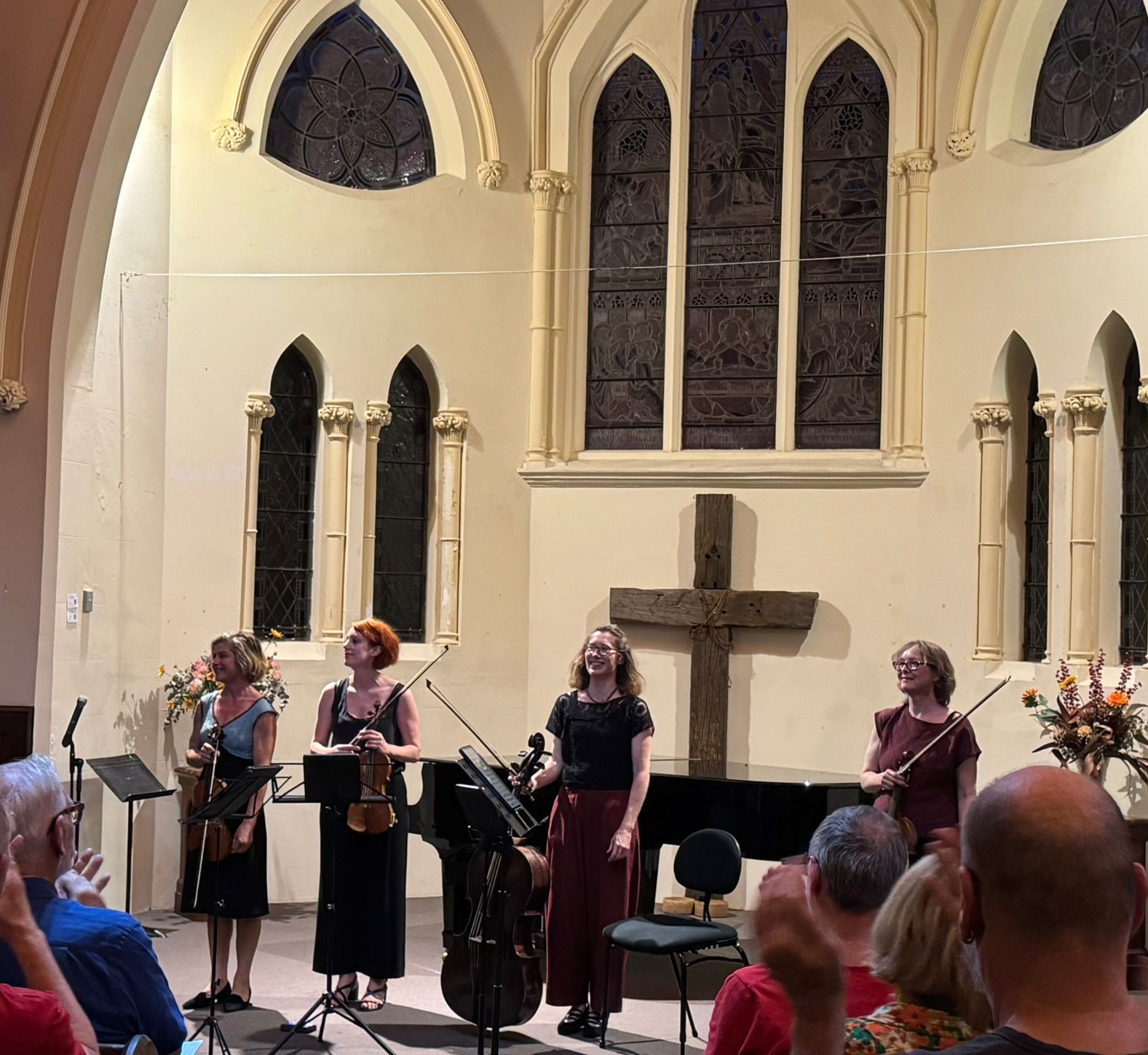
The inner-city suburb of Brunswick celebrated the launch of its eighteenth Beethoven Festival with a riveting concert by the local string quartet, Imaginista.
The Festival, directed by Mark Higginbotham, is presenting ten chamber music concerts over three weeks, with most featuring a work by the great LvB.
Imaginista Quartet consists of four highly sought-after Melbourne musicians: Zoë Black and Maja Savnik (first and second violins), Caroline Henbest (viola) and Josephine Vains (cello). The quartet, which came into existence about a year ago, performs historically informed chamber music from the classical era, using the gut strings and the lower tuning employed at that time.
For the Festival, Imaginista offered a long-neglected string quartet by Fanny Hensel Mendelssohn (1834) book-ended by Haydn’s F minor quartet (1772) and Mozart’s F major quartet (1790).
Haydn’s F minor quartet, Op. 20 No. 5 is a complex work that is technically demanding for the first violin. Black, supported by a balanced and beautifully blended accompaniment, executed the virtuosic passages flawlessly. A striking feature of this performance was the expressive way the Quartet shaped the phrases, drawing out the music’s underlying emotion. This approach gave the performance a sense of spontaneity.
The centrepiece of the program was Fanny Hensel Mendelssohn’s string quartet in E-flat major. Hensel Mendelssohn was a prolific composer, producing around 450 compositions; mostly piano and vocal works, and mostly unpublished during her lifetime. She only wrote one string quartet, and that one had started off as an unfinished piano sonata, which she resurrected and repurposed for one of her Sunday concerts.
The first three movements revolve around compelling lyrical melodies, frequently developed in beautifully scored fugal sequences. The players’ communication was seamless and Imaginista’s rich, warm sound was a perfect match for this style of writing.
It was a warm midsummer’s night, and the audience made good use of the small hand-held fans given out at the door. In fact, the gentle breeze from the fluttering fans – often moving in sync with the music – nicely complemented Hensel Mendelssohn’s lyrical melodies and lush harmonies.
But the “fanners” had their work cut out keeping in sync during the last movement. It started innocently enough with a merry little scale passage, but the music quickly gained momentum, and in no time at all the quartet looked to be running on an unstoppable hamster wheel. Fingers slithered along the fingerboards, and bows seemed to shred the strings as they cut back and forth. It was suspenseful and exhilarating – a sensational finish to a stellar performance of this virtuosic work.
Mozart’s F major quartet (K 590), one of the Prussian quartets published in 1790, occupied the second half of the program. This late quartet is vintage Mozart, with glittering runs, dramatic pauses, and moments of light relief. Highlights included the dialogue between the first violin and cello in the first movement, and the interplay between all four parts in the delicate second movement, the allegretto, and the viola solos in the final movement. The final movement is full of dramatic pauses and sudden changes in dynamics, which Imaginista exploited to create a vibrant finale.
Watching the players’ gestures and eye contact is part of the pleasure of a chamber music performance. At this event, the evident empathy between the four players took their performance to another level and cemented their connection with the audience.
Four equally skilled and sympathetic performers; a small, intimate venue; the gut strings’ soft warm tone; tuning the instruments to a lower pitch; chamber music (aka the music of friends) played by locals for locals … It would be impossible to say exactly what made this performance glow, but there can be no doubt that it did. The Imaginista Quartet lived up to its name.
Photo credit: Natasha Holmes
___________________________________________________
Sue Kaufmann attended the Imaginista Quartet concert, presented as part of The Brunswick Beethoven Festival, at the Brunswick Uniting Church on February 3, 2026.