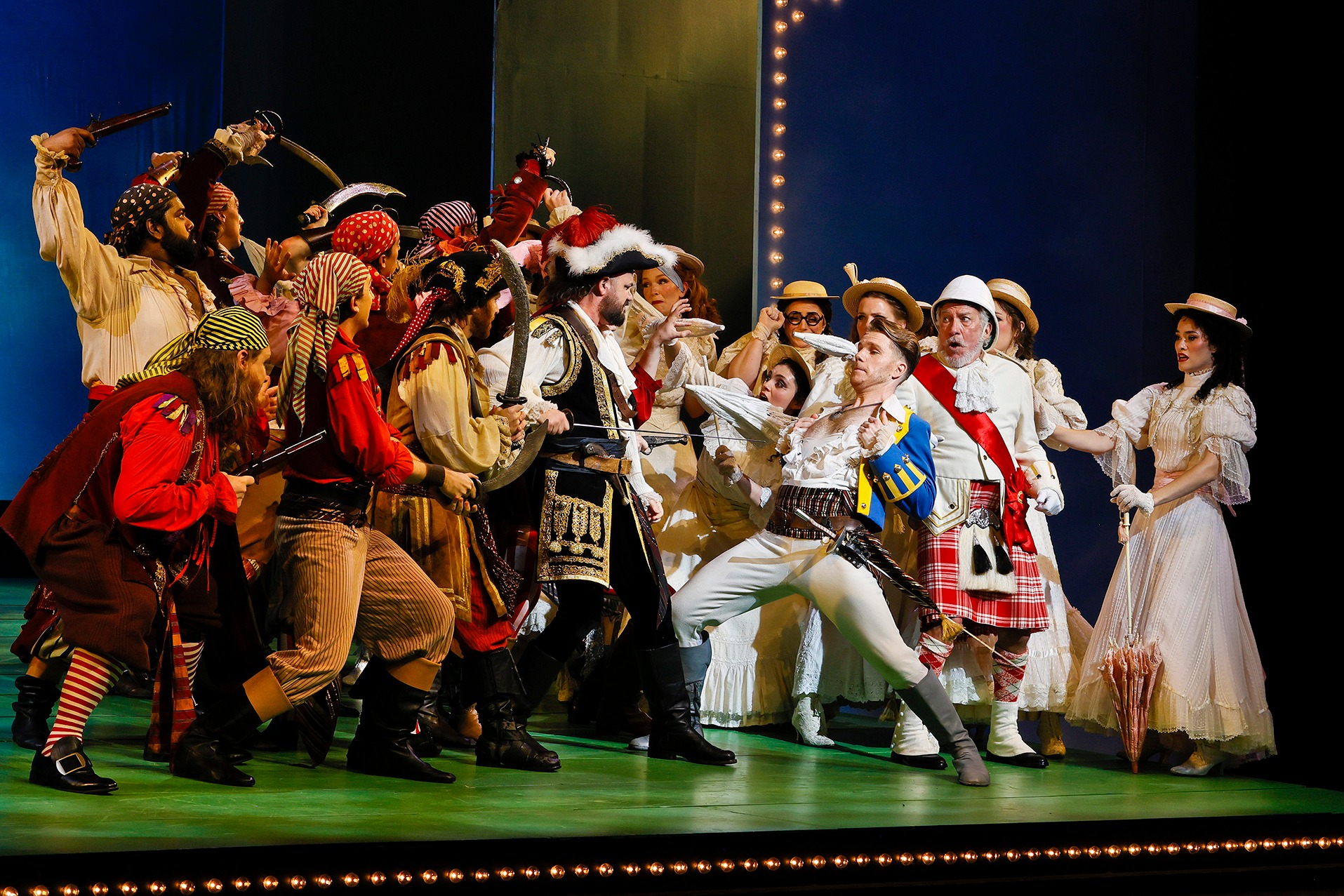
Now that Stuart Maunder is Victorian Opera’s Artistic Director, it was probably inevitable that the company would reprise a production of The Pirates of Penzance, particularly given his enduring self-confessed “obsession” with this 1879 comic opera gem by Gilbert and Sullivan. A great success when directed by Maunder in 1992 for Victoria State Opera (available on DVD), Pirates begged to be re-launched anyway, and, with Maunder once again at the directorial helm, a cracking show was ensured.
Synchronicity also played a (possibly unintended) role in the choice. Just as Pirates begins with the romantic lead, Frederic, celebrating his 21st birthday, so Victorian Opera (founded in 2005 by the Victorian Government to replace Victoria State Opera) is celebrating 21 years of artistic excellence and continuing growth. What a time it has been too. When the first VO ship, The Flying Dutchman, sailed into Hobson’s Bay in 2015, the production was a revelation with its astonishing technical wizardry of a kind seldom seen in Australia.
On Saturday night, we saw a plain background wash of blue sky with a solitary blinking light to guide the pirates our way. A weary figure staggered on and proceeded to magically illuminate the stage, then throw off his cloak to reveal himself as The Pirate King. Saving the customary Overture for the curtain calls, this sensational opening was an absolute coup de théâtre that set the tone for the whole evening. The capacity audience adored it and continued to respond enthusiastically throughout the performance. With cheering and clapping to rival the crowds at Rod Laver Arena, it was the loudest ongoing approval from a VSO/VO audience I have ever heard.
Framed within a light encircled stage-within-a-stage, the scenery was rolled in and out, beginning with a splendid pirate ship capable of “sailing” with several hands on deck. Whether pirate ship or two-dimensional trees and funerary monuments, the artwork was expertly rendered in the style of a nineteenth century illustrated adventure book – a perfect evocation of the period. Unexpected appearances and disappearances via concealed windows and hollows were abundant and hilarious. It would be a shame to spoil a surprise appearance in the final scene, in which all is forgiven due to shared values, albeit of a dubious kind. The combined expertise of Richard Roberts (Set Designer), Roger Kirk (Costume Designer) and Trudy Dalgleish (Lighting Designer) provided an excitingly vivid and creative setting for the action.
And there was plenty of action, so much so that Elizabeth Hill-Cooper deserves a special accolade for inventive choreography that enabled the singers to give of their vocal best while energetically bounding around the stage. The plot might be unbelievably silly, but this tale of a young boy mistakenly indentured until the age of 21 as a pirate instead of a pilot by his hapless nursemaid Ruth was embraced with gusto by all performers. Rather than simply vicious marauders, the pirates – orphans to a man – are presented as soft-hearted failures. In a similar comic reversal, even the policemen would generally prefer to hide rather than assert their authority.
As The Pirate King, Ben Mingay lit the stage not only literally but also figuratively with an exuberant performance. His rich bass baritone heralded the fact that what we were about to hear were real opera singers even though body mics were worn. They were needed because the spoken dialogue would have been almost impossible to hear throughout such a cavernous theatre. Mr Gilbert’s libretto, with its novel use of language and wordplay, and Mr Sullivan’s wordy, prestissimo patter songs were also made much more accessible with amplification.
The band of pirates made a lusty chorus, with Douglas Kelly as Samuel making a major contribution to the physical and vocal energy. Although The Pirate King could be viewed as the principal male role, it is really Frederic who has the lion’s share of the action, and Nicholas Jones had all the attributes needed to make Frederic a figure of heroic stature – in a Gilbert and Sullivan kind of way. With a relaxed but vibrant tenor voice, youthful good looks and considerable athleticism (one leaping exit suggested a dance background), he was supremely at ease in the role.
Antoinette Halloran completed the pirate crew as the piratical maid-of-all-work, Ruth. Some members of the audience may have felt a certain discomfort at this depiction of a rather predatory forty-seven-year-old spinster, but Halloran’s infectious personality and spirit of joie-de-vivre made Ruth’s attempts to marry the young, innocent, anxious-to-do-his-duty Frederic just part of the fun. Her disappointment when Frederic meets Major-General Stanley’s pretty young daughters – his first encounter with females other than Ruth – was conveyed with spot-on comic flair. This role adds to her string of successes in musical theatre roles where her dramatic and vocal strengths really shine.
In the other main female role, Nina Korbe was outstanding as Mabel, daughter of Major-General Stanley. It is in Mabel’s music that Sullivan’s skill in parodying bel canto stylistic elements is most clearly evident. Shades of Donizetti can also be heard in some of Frederic’s music and both singers were capable exponents of the style, with Korbe in particular showing excellent agility and clarity of tone in the upper reaches. Assured acting and a charming sweetness of manner made her Mabel very appealing. Her tender duet with Jones in Act 2 was a charming haven of calm within surrounding comic mayhem. It was a serious moment, a reminder that Sullivan was actually a gifted composer who merits attentive listening to fully appreciate his command of musical complexity – the famous “Tarantara” policemen’s chorus being a case in point.
The young singers who performed the roles of the Major-General’s other daughters were, arguably, the comic highlight of the show. With Rachael Joyce’s vivacious performance as Edith leading the way, Alessia Pintabona (Kate), Syrah Torii (Isabel) and the group as a whole executed Hill-Cooper’s ingenious choreography with outstanding discipline, often moving as one and always singing with lustrous tone. A feature of their vocal work – and of all cast members – was attention to clear diction.
Much loved and long admired, Richard Piper was terrific as their father – a very model of a successful Major-General. He wore his costumes with a seriousness that made them even more comical in an endearing way. His singing may not have been fully operatic, but it was admirable – his famous patter song a highlight. Timing – comic or otherwise – seems to be a Piper specialty.
Christopher Hillier gave a strong performance as Sergeant of Police, his fine baritone voice and dramatic skills a secure focus for his constabulary contingent. With VO’s male chorus divided between a group of pirates and a group of policemen in the final scene, it is a great credit to them that there was no weakening in the quality of their sound. Movement was extremely well-coordinated and precise – important features integral to the comic effect.
At the end of the evening, Orchestra Victoria and conductor James Pratt were accorded as much hearty cheering as the performers. And they deserved it. The tight discipline seen on stage was equaled in the pit.
Mounting a popular musical theatre work has long been an important way of making opera companies around the world financially viable. But it is usually far from a matter of subsidising “real” opera with something of lesser quality. This production of The Pirates of Penzance is first rate, and the music is wonderful. For some, this work will evoke strong feelings of nostalgia, for others it will be an excellent introduction to a melodic work full of joy and heart. Unlike Wagner’s Dutchman and crew, the Penzance pirates find happiness. This spectacular production is guaranteed to send you too into St Kilda’s sea breezes feeling uplifted and totally satisfied.
Photo credit: Jeff Busby
______________________________________________________________________
Heather Leviston reviewed Victorian Opera’s production of “The Pirates of Penzance” by Gilbert and Sullivan, presented at the Palais Theatre, St Kilda on January 31, 2026.