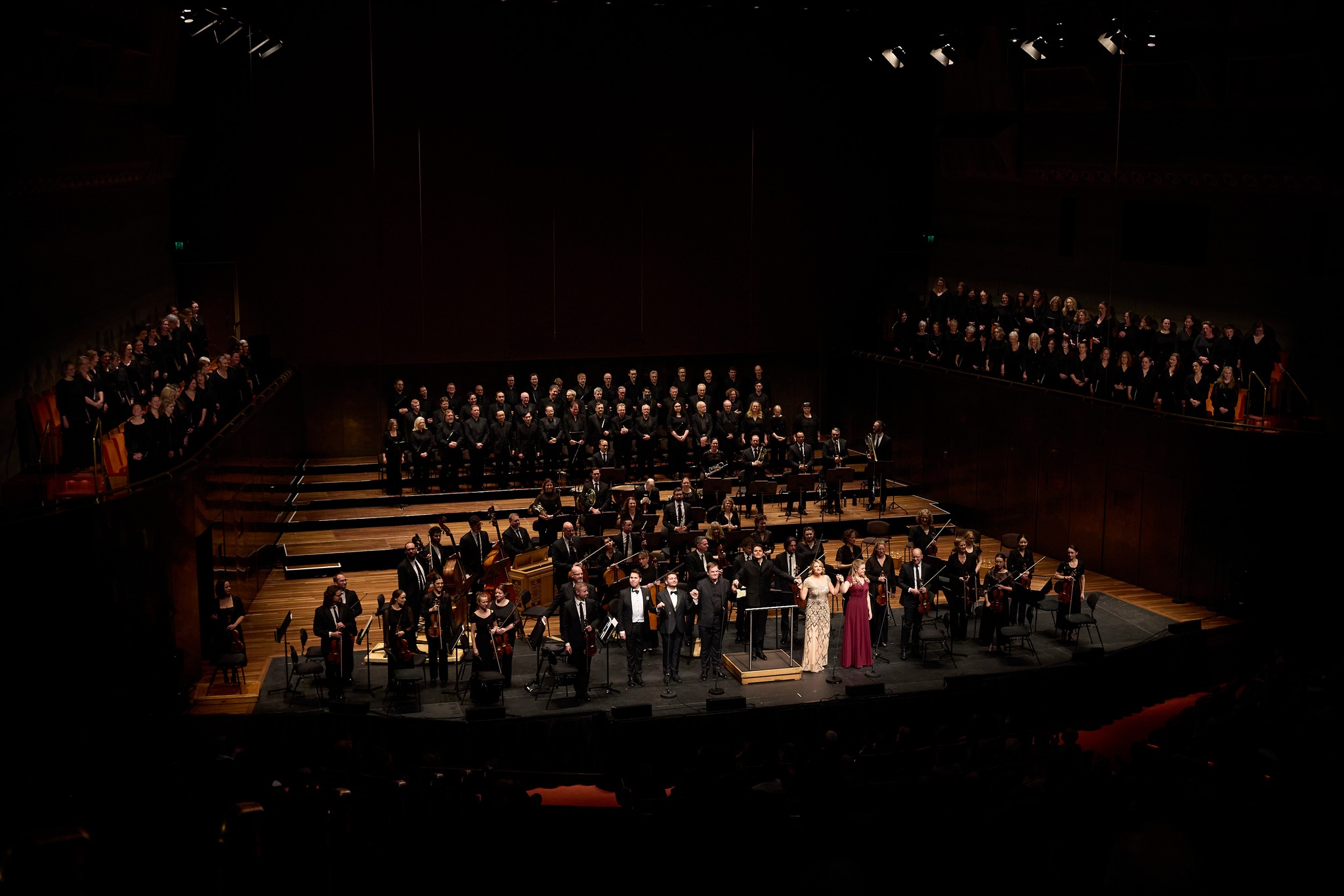
Australian conductor Nicholas Carter led the fine musicians of the Melbourne Symphony Orchestra and Chorus in a program that celebrated the 60th anniversary of the MSO Chorus, and drew together strands of personal intimacy and transcendence.
Beginning with a rarely heard interlude from Richard Strauss’s comedy opera Intermezzo, moving through the contemplative humanism of Brahms’s Schicksalslied (Song of Destiny), and culminating in the exalted architecture of Mozart’s Great Mass in C minor, the evening traced a path from domestic reflection through existential struggle to a vision of musical devotion that transcended its institutional context. Carter’s stage manner was confident and unassuming, guiding orchestra and chorus alike with clarity and respect, always seeking balance and connection.
Strauss’s Träumerei am Kamin (“Dreaming by the Fireside”) from his opera Intermezzo is a short orchestral vignette that lingers on the lyrical. It is not a work frequently performed, and its conventional orchestration can sometimes belie the quiet depth of its domestic introspection. In this performance the Melbourne Symphony Orchestra strings were entrusted with unfolding the opening, beginning in the lower strings before seamlessly passing upward through lines of ebbing crescendi and decrescendi. The horn and clarinet solos were executed with warmth, their timbres blending effortlessly with the strings, while a late trombone entry gave a gentle but notable grounding to the texture. Carter approached the piece without affectation, allowing the musical line to breathe with natural ease.
As a concert opener, the work perhaps felt more like an intimate prelude than a decisive statement. Its connection to the evening’s broader themes was tenuous, though not without subtle suggestion. Strauss’s opera Intermezzo grew from a real-life misunderstanding between the composer and his wife, while Mozart’s Great Mass is often interpreted as a musical love letter to his wife Constanze, conceived in celebration of marriage and family. If Strauss’s fireside dream suggested the contours of private life, Mozart’s Mass would show how such intimacy could be elevated into a sacred monument.
Brahms’s Schicksalslied (Song of Destiny), Op. 54, set to Hölderlin’s verses, is a work often positioned at the intersection of human despair and divine promise. Too easily can its expression of cultural identity be misread as political nationalism, yet Brahms’s artistry resists such reduction. His engagement with German folk tradition and Romantic poetry was never about the rhetoric of state, but about the resonance of inner life with cultural memory.
In Hamer Hall, the orchestral introduction unfolded in long, enveloped phrases, shaped with great care by Carter’s attentive gestures. The entry of the chorus was hushed, yet radiant – the sotto voce singing of the MSO Chorus sonorous even in the most delicate pianissimo. Here the chorus demonstrated their trademark blend: balanced, restrained, yet expressive of profound spiritual weight. Carter’s achievement was to position the chorus not as an adjunct to the orchestra but as its equal, ensuring the vocal sound remained central to the unfolding of Brahms’s meditation. Many conductors appear ambivalent when a chorus stands within a symphonic context, but Carter’s refusal to compromise their centrality gave this performance its most luminous moments. The “inner sound” of the chorus, cultivated with discipline and tonal sensitivity, left the deepest impression.
It was Mozart’s Great Mass in C minor, however, that carried the evening to its most exalted heights. Written in Vienna in 1782–83, the Mass stands as a singular monument within Mozart’s sacred output – indeed his only large-scale church work across a decade otherwise dominated by opera and instrumental composition. It was composed not out of economic necessity but out of deeply personal conviction: a promise to his new wife Constanze, who herself sang in its early performance, and perhaps an attempted gesture of reconciliation with his father Leopold and sister Nannerl. Yet the Mass was never completed, and its fragmentary nature heightens its aura of mystery. Mozart here reaches simultaneously backward to the contrapuntal discipline of Bach and Handel and forward to the lyricism of Italian opera, while also resisting the contemporary Viennese drive toward restraint in liturgical music. In doing so, he created a sacred work that is both devotional and theatrical, both intimate and monumental – a paradox of heart and form that transcends its ecclesiastical origins.
The performance began with a “Kyrie” of solemn weight. Chorus and orchestra were measured yet understated, the pacing carefully calibrated to establish gravity without heaviness. Soprano Siobhan Stagg embodied the “line of beauty” in Mozart’s melodic writing, her radiant tone shining through. The “Gloria” unfolded with confident polyphonic entries from the chorus. The closing “Cum Sancto Spiritu” surged as one of the highlights of the evening, the contrapuntal writing handled with energy and precision. In the “Laudamus te”, soprano Samantha Clarke sang with child-like exuberance, dispatching Mozart’s coloratura with thrilling ease. Her embellishments were subtle and restrained, perfectly judged to avoid excess and to remain faithful to the elegance of Mozart’s idiom.
The “Domine Deus” duet between Clarke and Stagg was a masterclass in balance. With two sopranos of equal strength, Mozart sets a daunting challenge, but here their blending was exquisite, each imitative entry perfectly matched in tone and phrasing. The “Et incarnatus est,” sung by Stagg in the “Credo”, was nothing short of transcendent, her phrasing suspended as if beyond time. The “Benedictus” quartet displayed a balance tilted toward the female voices – unsurprising given Mozart’s limited writing for the lower parts. Tenor Matteo Desole and baritone David Greco nevertheless lent supportive warmth, complementing rather than competing with their colleagues. Throughout, the MSO Chorus, prepared by Warren Trevelyan-Jones, exhibited focus and tonal unity. At moments when the singers visibly connected with Carter’s direction, the atmosphere in the hall was electric, the shared breath between conductor, chorus and orchestra creating a palpable charge.
If the program began with Strauss’s intimate reflections by the hearth and moved through Brahms’s meditation on human destiny, it was Mozart’s Great Mass that crowned the evening with a vision of music as love, devotion, and transcendence. Carter’s insistence on engaging the chorus as the equal heart of the performance allowed the Mass to shine in its fullest majesty. The Melbourne Symphony Orchestra and Chorus revealed themselves once again as an ensemble of great sensitivity, capable of traversing biography, philosophy and theology in music that speaks both to human intimacy and to the ineffable beyond.
Photo supplied.
______________________________________________________________________________
Stephen Marino reviewed “Mozart’s Great Mass” performed by the Melbourne Symphony Orchestra, Chorus and Soloists at Arts Centre Melbourne, Hamer Hall on Thursday, September 18, 2025.